
Abstract
Learning classical Chinese poetry requires readers to connect lines, imagery, the poet's biography, place, and historical background. Adaptive hypermedia offers a useful way to organise and guide movement across such linked materials, and generative AI creates new opportunities for adaptive explanation and learner-specific support. It remains unclear, however, how GenAI-supported adaptive hypermedia should be designed for adult poetry learning. We report an expert-informed qualitative study based on semi-structured interviews with 19 participants, including experts in classical Chinese poetry education (n = 11) and experts in GenAI-supported hypermedia design and development (n = 8). Using reflexive thematic analysis, we identify three learning priorities: connected knowledge, cultural-emotional resonance, and sustained interest. We also identify three design challenges: AI answers may be wrong or miss key background, support for different learners remains limited, and learners often receive too little help in building historical and cultural context. Based on these findings, we derive design considerations for GenAI-supported adaptive hypermedia for poetry learning. We then present Poetictok, a prototype that combines place-based exploration, archive cards that learners can reopen later, poem reconstruction tasks, and four role-bounded AI agents. The paper contributes design knowledge for adaptive hypermedia, with particular attention to linked context, adaptive guidance, and visible sources.
1 Introduction
Classical Chinese poetry is part of Chinese literary culture. Understanding a poem often depends on more than the lines alone [7]. Line structure shapes meaning [22]. Historical background and place-related context also guide interpretation [28]. Background information can also change emotional response to a poem [29]. Figure 1 shows one example from Snow on the River. The line uses parallel structure and dense imagery. The poet depicts the scene of fishing amid the icy winter to reflect his own experiences and feelings during political exile. However, learners often meet the situation that foregrounds literal explanation and isolated facts, which can make poetry feel distant and difficult [27]. Adult learners face an additional constraint: they often study in short sessions without a teacher available to provide background, guide interpretation, or answer questions on demand.
Poetry education has been criticised for pedagogical approaches that can make poems feel remote from learners’ lived experience [13]. In classical Chinese poetry learning, this concern is intensified by the need to connect literal explanation with historical, cultural, and affective context.
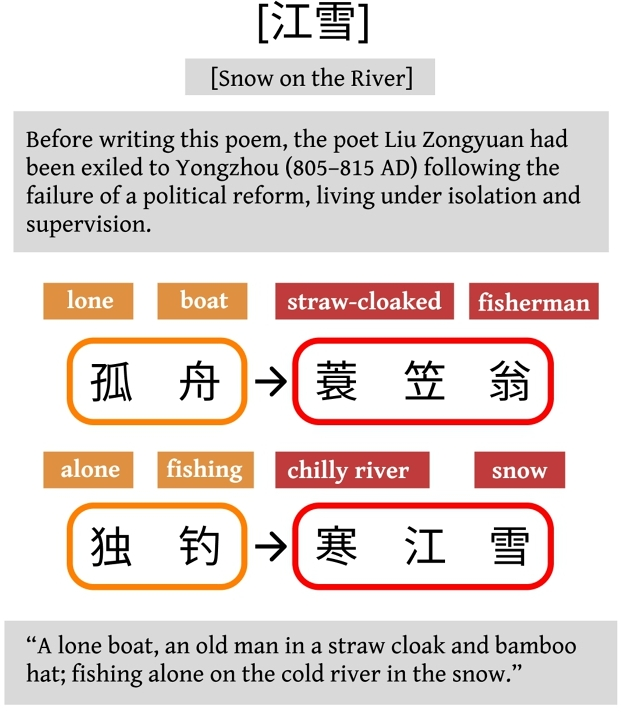
A line from Snow on the River with English glosses, imagery labels, and a short background note about the poet's exile.
Adaptive hypermedia addresses this learning problem by organising linked material and varying explanation or navigation during use [5]. Prior research has demonstrated that it can adapt content presentation and navigation in response to learner knowledge, goals, or interaction history [21]. For poetry learning, this means that a poem can sit at the centre of a linked structure with materials that include background notes, place, imagery, biography, and comparison across poems.
Generative AI-supported adaptive learning provides another opportunity for addressing the challenges of Chinese classical poetry learning. Generative AI can generate pathway content and explanations on demand [12]. Related studies also report GenAI-supported interventions and GenAI-supported chatbots in learning settings [14, 17]. What remains limited is design considerations on how GenAI-supported adaptive hypermedia should be built for adult learners of classical Chinese poetry.
In this paper, we ask two research questions:
What learning goals and learner needs should GenAI-supported adaptive hypermedia prioritise in adult learning of classical Chinese poetry?\
What design requirements and considerations can guide the coordination of generative AI and adaptive hypermedia in this context?\
To answer these questions, we conducted expert interviews, derived design considerations, and then built an initial prototype as a presentation of these considerations.
This work contributes:
an expert-informed account of the learning priorities and design challenges involved in classical Chinese poetry learning for adult learners;\
a set of design considerations for coordinating AI support and adaptive hypermedia, with attention to layered explanation, visible sources, and learner control across linked poetic materials;\
Poetictok, an initial prototype that instantiates these considerations through place-based exploration, archive cards, poem reconstruction tasks, and four role-bounded AI agents.\
2 Related Work
2.1 Digital approaches to poetry learning
Digital work on classical Chinese poetry has tried to move beyond literal explanation by adding background, scene, and multimodal support. Cao et al. built a interoperable data model for classical Chinese poetry [8]. Shih et al. used context-aware mobile guidance for the appreciation of scenic poetry [25]. Chao et al. used augmented reality to support motivation in poetry learning [9]. Li et al. created a virtual learning space for ancient Chinese poetry learning [23]. Wang et al. showed that emotional design can influence multimedia learning and appreciation of Chinese poetry [26]. These studies show the value of contextual and interactive support. Still, they leave open a question: how should poems, background notes, place, imagery, and comparison be organised so that learners can return to them during interpretation?
2.2 Adaptive hypermedia for learning and interpretation
Adaptive hypermedia describes systems that adapt presentation or navigation in linked material [5]. In educational settings, these techniques have been used to tailor explanation, recommend next steps, and organise learner-specific routes through complex content [6]. A review of educational hypermedia shows that non-linear access can support learning when tasks and structure remain clear [11]. Hypertext reading studies make a similar point. Link selection affects comprehension [24]. Weak structure can make networked material harder to follow [2]. For our study, the lesson is clear: poetry learning systems need not only rich material, but also clear organisation, guided movement, and opportunities to return to earlier material.
2.3 From adaptive hypermedia to GenAI-supported adaptive learning
AI-enabled adaptive learning systems adjust content, feedback, or sequence with AI methods [19]. Generative AI can also produce short explanations and learning paths on demand [12]. Adaptive interface research suggests that adaptive features need to be discoverable, intuitive, and integrated into the core learning loop if users are to perceive their value [18]. Explainable AI research in education makes a similar point about visible sources and understandable explanations [20]. This matters for classical Chinese poetry because contextual knowledge is central to interpretation [7]. There is still little design knowledge on how GenAI-supported adaptive hypermedia should combine linked context, adaptive explanation, and learner control in this domain.
3 Methodology: Expert Interview Study
The combination of generative AI and adaptive hypermedia remains underexplored in classical Chinese poetry learning. To obtain current design insight, we conducted semi-structured interviews with 19 experts. The sample included 11 classical Chinese poetry education experts and 8 experts whose work is relevant to GenAI-supported hypermedia design and development. The education group included 7 participants from basic education, 3 from higher education, and 1 from a cultural institute. The AI group included 4 industry practitioners and 4 researchers. This group came from AI interaction design, foundation model development, digital media, and interactive system design, whose work concerns learner-facing AI support, multimodal presentation, and the structure of interactive systems. Across the sample, participants had between 3 and 25 years of experience. All participants were based in mainland China or Hong Kong. A full participant profile appears in Table 1.
Table 1: Professional background of participants
PID | Expert role in this study | Institution type | Job title | Disciplinary background | Experience (yrs) |
|---|---|---|---|---|---|
P1 | AI game design & development | Industry | Senior Interaction Designer | AI-focused HCI design | 6 |
P2 | AI game design & development | Industry | Product Manager | AI-focused HCI design | 5 |
P3 | AI game design & development | Industry | Senior Product Manager | Foundation model development | 9 |
P4 | AI game design & development | Higher education | Professor | Digital Media | 20 |
P5 | AI game design & development | Higher education | Professor | Digital Media | 18 |
P6 | AI game design & development | Higher education | Professor | AI-focused Digital Media | 15 |
P7 | AI game design & development | Higher education | Associate Professor | AI-focused Game Design | 7 |
P8 | AI game design & development | Industry | AI Engineer | Foundation model development | 5 |
P9 | Education | Basic education | Teacher (Senior) | Chinese Language and Literature (Normal Major) | 25 |
P10 | Education | Higher education | Teacher | Chinese Language and Literature | 14 |
P11 | Education | Basic education | Teacher | Chinese Language and Literature (Normal Major) | 5 |
P12 | Education | Basic education | Teacher | Chinese Language and Literature (Normal Major) | 15 |
P13 | Education | Basic education | Teacher | Chinese Language and Literature (Normal Major) | 3 |
P14 | Education | Higher education | Professor | Chinese Language and Literature | 25 |
P15 | Education | Basic education | Teacher | Chinese Language and Literature (Normal Major) | 5 |
P16 | Education | Basic education | Teacher | Chinese Language and Literature (Normal Major) | 5 |
P17 | Education | Higher education | Professor | Chinese Language and Literature | 3 |
P18 | Education | Basic education | Teacher (Senior) | Chinese Language and Literature (Normal Major) | 19 |
P19 | Education | Cultural institute | Researcher | Chinese Language and Literature | 7 |
3.1 Semi-structured interview
The education interviews focused on how classical Chinese poetry is currently taught, what adult learners are able to gain from it, where common learning barriers arise, what kinds of linked background materials are useful, what hypermedia has been used for current teaching and learning, and what opportunities or limits experts saw in generative AI. These interviews were intended to clarify the learning priorities that GenAI-supported adaptive hypermedia should support and the design tensions that such a system would need to address.
The second interview focused on how linked materials might be structured, how explanation depth and navigation could vary across learners, how sources should be shown, what roles AI agents or interface elements should play, and what technical constraints would shape implementation. These interviews were intended to ground the design considerations in current interaction, system, and implementation concerns rather than pedagogical aims alone.
3.2 Data collection and analysis
All interviews were conducted online in a one-to-one format, lasted between 30 and 60 minutes, and were audio-recorded with consent. Participants first received an information sheet and were free to stop at any time. Interviews were conducted in Mandarin, transcribed, anonymised, and analysed using reflexive thematic analysis [3, 4]. Two bilingual members of the research team read the transcripts closely, generated initial codes, compared interpretations, and iteratively refined candidate themes. NVivo was used to support organisation and retrieval. In line with reflexive thematic analysis, we did not calculate inter-rater reliability.
3.3 Results overview
The education interviews yielded six themes covering learning barriers, learning pathways, multimedia and linked materials, AI roles, learning value, and adaptive hypermedia design considerations. The interviews with GenAI-supported adaptive hypermedia design and development experts yielded five themes covering knowledge reliability, agent and interface design, adaptive scaffolding, contextual framing, and implementation constraints. Full code lists and definition entries appear in Table 2 and Table 3.
Table 2: Codebook A of classical Chinese poetry education experts
Theme | Codes | Definition |
|---|---|---|
Learning barriers: comprehension difficulty and linked understanding | Low learning interest | Students lack intrinsic motivation for classical poetry. |
Life experience threshold | Understanding poetry requires some life experience. | |
Classical-Chinese language barriers | Classical Chinese grammar and shifts in word meaning hinder understanding. | |
Need knowledge network | Start from the poet's biography and creative background. | |
Difficulty with knowledge transfer | Can recite but cannot apply in context. | |
Learning pathway from perception to resonance | Emotion and mood hard to grasp | Hard to grasp the poet's emotion and mood. |
Repeated recitation | Repeated reading builds rhythm and mood. | |
Scene-based evocation | Real-life scenes spark interest and understanding. | |
Imagery identification | Compare imagery and feelings across poems and authors. | |
Learners’ creation drives learning | Composing and peer review support learning. | |
The role of multimedia and linked materials in poetry learning | Benefits of multimedia | Improves clarity, interactivity, and interest. |
Risks of multimedia | Flashy media distracts and reduces imagination. | |
Uneven multimedia practice | Students differ in how they use multimedia tools. | |
AI as an assistant and adaptive support for poetry learning | Functional view of AI | AI improves efficiency and offloads work. |
AI-assisted creation and review | Helps generate illustrations and correct text. | |
AI-generated learner-specific images | Produces different images from the same text for different needs. | |
AI persona / first-person dialogue | Poet-like voices can increase immersion. | |
Link to authoritative databases | Helps keep knowledge accurate. | |
Technical / environment constraints | Models can be unstable; school networks can be slow. | |
Learning potentials: aims and value | Moral cultivation | Helps develop aesthetic appreciation. |
Build expression and rhetoric | Supports language use and appreciation skills. | |
Cultural identity and confidence | Strengthens cultural pride and connection. | |
Cultural and historical heritage | Helps learners understand and inherit culture. | |
Cultural-industry literacy | Builds cultural literacy and audience awareness. | |
AI-supported Adaptive hypermedia design considerations for classical poetry learning | Advantages of interactive pathways | Interaction can lower entry barriers and strengthen memory. |
Expression strategies/orientation | Lyric tasks use imagery; narrative tasks use lived experience. | |
Policy factors | Policy support creates a positive outlook. | |
Audience fit and cognitive activation | Prior knowledge can be used as scaffolding. | |
Design challenge | Hard to balance rich interaction and clear learning focus. | |
Pros and cons of AI-assisted design | Efficiency and immersion increase, but aesthetics remain limited. |
Table 3: Codebook B of GenAI-supported adaptive hypermedia design and development experts
Theme | Codes | Definition |
|---|---|---|
Knowledge reliability and traceable support | Concerns about knowledge reliability | Concern about model accuracy; prefer semi-structured facts as a backstop. |
Iterative knowledge-base update and expansion | Generate externally to fill gaps, verify, then add to the knowledge base iteratively. | |
Open Q&A across domains vs database limits | Learners jump across eras and topics; a static knowledge base is hard to keep complete. | |
AI's structured summarisation advantage | Compared to search, AI can deliver short, structured knowledge. | |
Credible and affective human–AI relations (agent/interface design) | Unclear agent identity and role recognition | Users misread roles as teacher–student; want clearer agent and interface roles. |
Trustworthy needs an emotional dimension | Trust should include emotional connection, not only factual reliability. | |
Direct dialogue with poets for immersion | Let learners talk with AI-simulated poets to boost motivation and immersion. | |
Smarter adaptive agents | Agents should do more than scripted Q&A and respond to learner context. | |
Adaptive scaffolding: from learner differences to knowledge transfer | Adaptive scaffolding and dynamic support | Provide dynamic prompts for different learners and support later transfer. |
Learner adaptation is shallow in the current structure | A fixed interaction structure can miss learner interests and reduce motivation. | |
Balance of contextual framing and learner adaptation | Contextual framing for learning tasks | Reframe items as place-based or story-based learning paths. |
Multi-modal generation not mature | Image and 3D quality are not yet enough for high-quality learning. | |
From vision to implementation: methods and constraints | Implementation has high priority | Concepts must run; feasibility matters from the technical side. |
Method-driven development | Use design thinking as a framework: empathise, define, ideate, prototype, test. |
4 Discussion
We discuss the results as design-oriented considerations for GenAI-supported adaptive hypermedia. We structure the discussion around the learning goals such systems should support, the barriers they should address, and the design logic needed to combine AI support with linked contextual navigation.
4.1 What learners gain from classical Chinese poetry learning?
Connected knowledge rather than isolated facts. Educational experts emphasised the importance of making explicit links to rhetorical devices, imagery, historical context, and aesthetic appreciation. Because poetry is the expression of poets situated in specific personal and historical contexts, learners are expected to develop cultural and emotional experiences: “feel the rhythm and mood.” (P9) and “a way to grasp history.” (P11). P12 called for a background and biographical “knowledge network” before formal study (identified under the theme Learning barriers). They also emphasised the importance of constructing interconnected knowledge networks during the learning process itself: “relationship networks” among poets of the same period (P18), and “different poets may have visited the same place but produced different works, which provides a basis for comparison and helps learners to establish a contextual framework.” (P19). Taken together, these accounts indicate that learners are suggested to be supported in building structures that connect history, geography, literature, and other domains, rather than focusing on isolated poems in a vacuum. Such cross-cutting connections, in turn, can deepen their understanding of individual poems and situate them within broader cultural and spatial contexts.
Cultural and emotional connection. In this study, cultural -emotional experience denotes the affective dimension of cultural engagement, encompassing feelings of resonance, belonging, nostalgia, pride, and aesthetic pleasure that arise when encountering and interpreting cultural forms. Such experiences often transcend purely cognitive understanding, shaping identity(P18) and fostering deeper cultural appreciation (P11 and 17). In our analysis, they are closely linked to codes such as Cultural identity and confidence, Cultural and historical heritage, and Cultural‑industry literacy within the theme “Learning potentials: aims and value”. These experiences frequently emerge from the creation of scenes and atmospheres that serve as windows and lenses for cultivating interest in, and motivation to engage with, poetry and classical Chinese culture more broadly. Moreover, the cultural and emotional impact of learning classical Chinese poetry often manifests with a temporal delay. The theory of narrative transportation [15] describes this delayed resonance, that when learners are “carried” by an evocative scene, imagery and narrative help them form coherent interpretations that can later be reactivated in lived experience. As P19 explained, “Later on, I realised that some of the poems I had learned earlier had indeed influenced me. In certain situations, like being in York and far away from home, particular verses would resurface in my mind, and I felt they reflected and described my inner state of mind.”
Sustained interest. Experts argued that adult learners need short, achievable, and varied forms of interaction that fit fragmented study time. Interviewees report that multimedia is “more direct and interactive… [and] boosts interest” (P9, P10), and that reframing familiar content can “shake up old views” (P18). They also stressed learner fit: “Match the audience; start with concrete hooks, even pop bits, to spark interest” (code: Audience fit and cognitive activation, P18). Interactivity was treated as a practical lever: “It helps teach unfamiliar ideas and builds memory through interaction.” (code: Advantages of interactive pathways, P15). This shows that interest develops when interactions trigger attention, and sustained attention often points to the linked materials for poetry understanding, fit learning needs, and satisfy interest.
4.2 Challenges for designing and learning with adaptive hypermedia
AI answers may be fast, but may still miss key background. Both groups saw value in AI as a fast and structured source of support, but they also worried that model outputs may be unreliable, incomplete, or weakly grounded in the poem's historical and cultural setting. AI experts also described cases in which learners move quickly across periods, poets, or topics and the system responds smoothly but without enough grounding. One participant put it plainly: “Some outputs aren't reliable” (P5). At the same time, experts also valued AI's ability to provide “structured knowledge” (P8). This means in the adaptive hypermedia, staying tied to inspectable and traceable source units rather than free-form answers alone.
Context and experience gap. Education experts described multiple obstacles, including limited life experience, the linguistic distance of Classical Chinese, weak affective engagement, and difficulty transferring what has been learned into a new situation. As P12 noted, “Classical word order and meanings differ a lot,” while P13 observed that many learners “can't really feel the emotion.” These accounts suggest that poetry-learning systems need to do more than answer factual questions. They need to reconstruct enough cultural and historical context for learners to understand why a scene or image matters.
Pathway from perception to resonance. Interviewees also revealed a common and recommended pathway in the learning of classical Chinese poetry, summarised under the theme Learning pathway from perception to resonance: initial engagement through reading and recitation; translation and comprehension of Classical Chinese into modern Chinese; situating or evoking personal experiences; extracting and comparing imagery; and ultimately achieving affective–aesthetic resonance. Within this sequence, contextualisation plays a pivotal role: it was described not only as a way to “enhance retention” (P19), but also as a “scaffold” (P4, P5) that links linguistic, experiential, and emotional aspects of learning. These accounts suggest that hypermedia is a promising medium for supporting this pathway because it enables learners to move between a poem and linked contextual materials—such as individual lines, imagery notes, place notes, biography notes, and archive entries—while keeping those materials anchored to the learner's current interpretive focus.
4.3 Expert-informed design considerations for GenAI-supported adaptive hypermedia
Building on our findings that learners benefit from explicit, linked knowledge, cultural-emotional resonance, and sustained interest, yet face fragmented access and difficulty achieving situated understanding, we organise the considerations below around two complementary parts of an adaptive hypermedia system: GenAI as adaptive presentation and guidance, and hypermedia structure as linked contextual traversal.
4.3.1 Role A. Generative AI as adaptive presentation and guidance. Provide layered explanations through progressive disclosure. Experts wanted support that begins with a short gloss, then expands to background, and only then moves to deeper interpretation. For adult learners, this layered structure can keep information manageable while still allowing deeper study when needed. This form of adaptive presentation helps adjust depth without forcing every learner through the same full explanation [5, 21].
Keep background in small linked units and make sources visible. Rather than presenting background as one long passage, the system should store small units such as biography notes, place notes, imagery notes, and historical notes. AI output should show where a background fact comes from at the moment of use, so that learners can inspect and revisit it. This directly answers interviewees’ requests for a visible knowledge network rather than a single opaque explanation.
Use learner state to vary hint depth and suggested next steps. Learners differ in prior knowledge and confidence. Support should therefore be sensitive to current performance, giving fuller worked hints to novices and shorter cues to more advanced learners. When needed, the system can also suggest the next most useful note, scene, or task rather than leave the learner with one undifferentiated set of options. Knowledge tracing offers one way to model changing learner state [10]. Worked steps can then fade as competence grows [1]. Timely task-specific feedback also supports learning [16].
4.3.2 Role B. Hypermedia as linked contextual traversal. Build meaning through scene, place, and background. To convert background knowledge into felt understanding, the system should reconstruct a place, time, and situation that makes the poem interpretable. This does not require one long linear story. Instead, it can be achieved through a short path across linked cues, such as place, weather, figure, object, and background note. This supports interviewees’ emphasis on scene-based evocation and supports interpretation through structured traversal rather than through explanation alone.
Use interaction steps to make links explicit. Interaction should encourage learners to connect wording, imagery, place, and emotion rather than answer isolated quiz items. This can be done through exploration, collection, matching, reconstruction, and short comparison steps. The point is not to add interaction for its own sake, but to make relations among linked materials visible and usable during learning.
Support short comparison trails across poems. Experts often mentioned comparison across poems, particularly when poems share a place or image but differ in feeling. Design should therefore support brief comparison and reflection trails that help learners articulate differences and build a broader knowledge structure. These short trails can connect one poem to another through shared imagery, location, or mood, while still keeping the learner in control of interpretation.
Keep paths short, resumable, and under learner control. For adult learners, sessions should be short enough to pause and resume easily. Progress indicators, small steps, and immediate feedback matter because they reduce friction and make return visits more likely. Adaptive support should guide, but it should not lock the learner into one fixed route. Learners need room to reopen earlier notes, compare readings, and decide when to go deeper.
5 Poetictok: A Prototype
This section presents Poetictok as an initial prototype instantiation of the interview-informed design considerations. The prototype organises poetry learning as movement through a linked knowledge space in which a poem is connected to lines, imagery notes, place notes, biography notes, and archive entries. Role-bounded AI agents provide adaptive presentation and guidance at specific moments of the learning flow.
5.1 Concept and learning flow
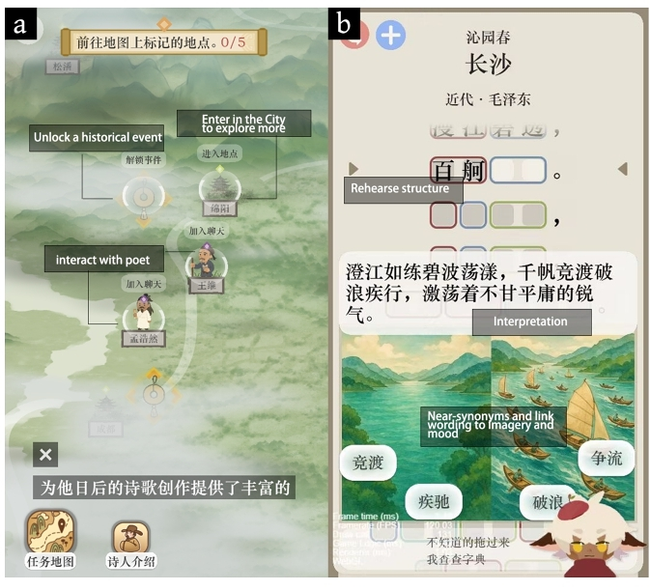
Two interface screenshots from Poetictok. The left screenshot shows map-based exploration with poets and locations. The right screenshot shows a poem reconstruction task with phrase selection and ordering.
Exploration in Poetictok begins from a stylised map of China that functions as an overview of the linked poetic knowledge space. The map marks historical place names and the poems associated with them, allowing learners either to follow a poet across multiple locations and stages of life or to explore a single place through poems written there by different poets. At the level of an individual poem, learners move through a short place-linked interface related to the target poem. Along the way, they encounter historical figures, trigger brief dialogues to collect small background units related to place, event, imagery, and poet biography if needed (Figure 2, a, map-based exploration with poets and locations). The design goal is to build contextual understanding through linked notes rather than through one long explanation. To check how many parts of the poem the learners have understood, we have a poem reconstruction phase(Figure 2, b) after the exploration phase. Learners complete a poem through wording or phrase selection and ordering tasks. The goal is to assess the imagery and interpretation in a structured way while linking them back to the background gathered earlier. Each poem session follows this two-part repeatable flow to fit learners’ needs, while still connecting context and text.
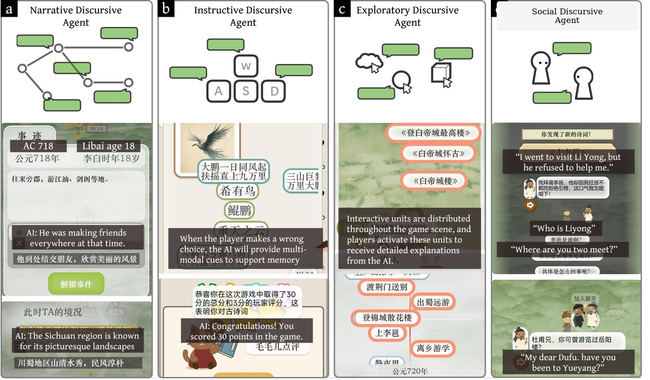
Four panels showing the four AI agent types in Poetictok. The Narrative agent explains the current situation, the Instructional agent provides hints during poem tasks, the Exploratory agent answers short object- or context-related questions, and the Social agent supports short in-character conversation.
5.2 Adaptive Hypermedia Design Rationale
Poetictok design centres on two core features: linked contextual traversal to help learners build poetic scene and background knowledge, and generative AI-powered adaptive presentation and guidance. This design directly responds to two core tensions surfaced in our interviews. First, learners need connected poetic knowledge, yet access to relevant information is often fragmented and untimely. Second, in self-paced adult learning, learners frequently struggle to engage with poems without emotional support and lived context. Figure 4 presents Poetictok’s end-to-end learner workflow, showing how the underlying LLM and knowledge base support four AI agents across the learning journey.
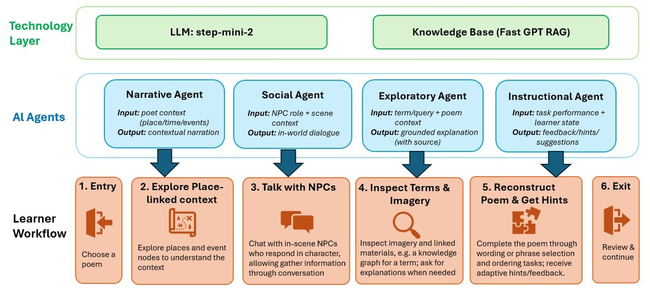
Poetictok's technical architecture and end-to-end learner workflow, showing how the underlying LLM and knowledge base support four AI agents across the six stages of the learning journey
Linked background units instead of one-time exposition. Rather than presenting background as a long reading passage, the exploration phase breaks context into small, inspectable encounters. At each stop, the learner completes a lightweight action, such as opening a landmark, talking to a historical figure, or collecting an object cue. Each action yields an archive card that can be reopened later, such as a short biography note, a place note, or an imagery note. These cards function as persistent linked units that remain available during later interpretation.
Guided interpretation through reconstruction tasks. To translate interviewees’ emphasis on imagery identification and expression into interaction, the reconstruction phase uses two task types: selecting a missing character or phrase from close alternatives, and ordering phrase blocks under a time limit. The selection task asks learners to distinguish between near-synonyms and link wording to imagery and mood. The ordering task tests understanding of the poem and rehearses structure in a way that is visible and checkable. In both cases, brief feedback points back to the relevant line feature or background unit instead of giving a detached final answer.
Role-bounded GenAI agents as adaptive presentation and guidance. AI functions are separated into four agents (Figure 3), each invoked at a predictable moment. The Narrative agent links the current location to the poem's situation. The Exploratory agent answers short “what is this?” questions and points learners to relevant archive cards. The Instructional agent provides hints during poem tasks and adjusts hint depth based on recent performance. The Social agent supports short in-character conversations for engagement and reflection, while remaining separate from factual guidance. This role separation helps learners predict what kind of support they will receive.
Visible sources and bounded context. To address concerns about unreliable AI output, the interface provides lightweight source cues. When the system presents a background fact, it can attach a small source label that points back to an in-system archive entry. When it offers interpretation, it signals that more than one reading may be possible rather than presenting a single fixed answer. In this way, AI support remains tied to linked source units and stays open to learner inspection.
6 Conclusion
This paper examined how GenAI-supported adaptive hypermedia can support adult learning of classical Chinese poetry. Our interview study showed that design should prioritise connected knowledge, cultural-emotional resonance, and sustained interest, while also addressing three recurring problems: AI answers may be wrong or miss key background, support for different learners remains limited, and many learners need help moving from noticing to interpretation. In response, we proposed design considerations that combine adaptive presentation, visible sources, and linked contextual navigation. Poetictok, as a prototype, instantiates these ideas through place-based exploration, archive cards that learners can reopen later, poem reconstruction tasks, and four role-bounded AI agents. The paper contributes design knowledge for adaptive hypermedia in the humanities, and offers a concrete prototype for future research.
7 Limitations and Future Work
This study has several limitations. Although the design target is adult learners, many education experts in our sample worked mainly in school or university settings. The findings should therefore be read as an expert-informed starting point that still needs direct study with adult learners. The prototype is presented as an instantiation of expert-informed design knowledge rather than as an empirically validated learning intervention; its effectiveness with adult learners remains to be evaluated. In addition, the interviews were conducted in Mandarin and translated into English after analysis, so some nuance may have been lost. We keep the technical account brief here because the main contribution of this paper is the design logic grounded in expert interviews. Future work will develop and evaluate Poetictok with adult learners and examine how different adaptive routes, source cues, and agent roles influence understanding, interest, and cultural-emotional experience in practice.
Source
Imported from ACM’s structured HTML source. ACM Reference Format: Wenjun Liu, Zhenhao Tian, Dake Liu, and Charlie Hargood. 2026. Designing GenAI-Supported Adaptive Hypermedia for Classical Chinese Poetry Learning: Expert-Informed Design Considerations. In 37th ACM Conference on Hypertext (HT '26), September 14--18, 2026, London, United Kingdom. ACM, New York, NY, USA 9 Pages. https://doi.org/10.1145/3800935.3830852
References
[1] Robert K. Atkinson, Alexander Renkl, and Mary Margaret Merrill. 2003. Transitioning From Studying Examples to Solving Problems: Effects of Self-Explanation Prompts and Fading Worked-Out Steps. Journal of Educational Psychology 95, 4 (2003), 774–783. https://doi.org/10.1037/0022-0663.95.4.774
[2] Helen Blom, Eliane Segers, Harry Knoors, Daan Hermans, and Ludo Verhoeven. 2018. Comprehension and Navigation of Networked Hypertexts. Journal of Computer Assisted Learning 34, 3 (2018), 306–314. https://doi.org/10.1111/jcal.12243
[3] Virginia Braun and Victoria Clarke. 2006. Using Thematic Analysis in Psychology. Qualitative Research in Psychology 3, 2 (2006), 77–101. https://doi.org/10.1191/1478088706qp063oa
[4] Virginia Braun and Victoria Clarke. 2021. One Size Fits All? What Counts as Quality Practice in (Reflexive) Thematic Analysis?Qualitative Research in Psychology 18, 3 (2021), 328–352. https://doi.org/10.1080/14780887.2020.1769238
[5] Peter Brusilovsky. 2001. Adaptive Hypermedia. User Modeling and User-Adapted Interaction 11, 1-2 (2001), 87–110. https://doi.org/10.1023/A:1011143116306
[6] Peter Brusilovsky. 2012. Adaptive Hypermedia for Education and Training. In Adaptive Technologies for Training and Education, Paula J. Durlach and Alan M. Lesgold (Eds.). Cambridge University Press, Cambridge, UK, 46–66. https://doi.org/10.1017/CBO9781139049580.006
[7] Zong-qi Cai (Ed.). 2018. How to Read Chinese Poetry in Context: Poetic Culture from Antiquity Through the Tang. Columbia University Press, New York, NY, USA. 328 pages. https://doi.org/10.7312/cai-18536
[8] Yiwei Cao, Ralf Klamma, Yan Gao, Rynson W. H. Lau, and Matthias Jarke. 2009. A Web 2.0 Personal Learning Environment for Classical Chinese Poetry. In Proceedings of the 8th International Conference on Web-Based Learning (Aachen, Germany). Springer, Berlin, Heidelberg, 98–107. https://doi.org/10.1007/978-3-642-03426-8_12
[9] Nan Chao, Shengge Yang, Yuxian Qin, Zeming Song, Zhaofan Su, and Xiaomei Nie. 2021. AR-Poetry: Enhancing Children's Motivation in Learning Classical Chinese Poetry via Interactive Augmented Reality. In Proceedings of the Ninth International Symposium of Chinese CHI (Hong Kong). Association for Computing Machinery, New York, NY, USA, 162–166. https://doi.org/10.1145/3490355.3490518
[10] Albert T. Corbett and John R. Anderson. 1994. Knowledge Tracing: Modeling the Acquisition of Procedural Knowledge. User Modeling and User-Adapted Interaction 4 (1994), 253–278. https://doi.org/10.1007/BF01099821
[11] Andrew Dillon and Ralph Gabbard. 1998. Hypermedia as an Educational Technology: A Review of the Quantitative Research Literature on Learner Comprehension, Control, and Style. Review of Educational Research 68, 3 (1998), 322–349. https://doi.org/10.3102/00346543068003322
[12] Chaitali Diwan, Srinath Srinivasa, Gandharv Suri, Saksham Agarwal, and Prasad Ram. 2023. AI-based Learning Content Generation and Learning Pathway Augmentation to Increase Learner Engagement. Computers and Education: Artificial Intelligence 4 (2023), 100110. https://doi.org/10.1016/j.caeai.2022.100110
[13] Mark Dressman. 2014. The Paradox of Poetry Education. In The Routledge International Handbook of the Arts and Education, Mike Fleming, Liora Bresler, and John O'Toole (Eds.). Routledge, London, UK, 203–211.
[14] Tim Fütterer, Lisa Bardach, Jochen Kuhn, Stefan Daniel Keller, and Peter Gerjets. 2026. Enhancing School Students’ Self-Regulated Learning through Generative AI Support: A Randomized Controlled Trial. Educational Psychology Review 38, Article 42 (2026), 42 pages. https://doi.org/10.1007/s10648-026-10133-8
[15] Melanie C. Green and Timothy C. Brock. 2000. The Role of Transportation in the Persuasiveness of Public Narratives. Journal of Personality and Social Psychology 79, 5 (2000), 701–721. https://doi.org/10.1037/0022-3514.79.5.701
[16] John Hattie and Helen Timperley. 2007. The Power of Feedback. Review of Educational Research 77, 1 (2007), 81–112. https://doi.org/10.3102/003465430298487
[17] Kun Huang and Ching-Huei Chen. 2025. Instructional Video and GenAI-Supported Chatbot in Digital Game-Based Learning: Influences on Science Learning, Cognitive Load and Game Behaviours. Journal of Computer Assisted Learning 41, 4 (2025), e70094. https://doi.org/10.1111/jcal.70094
[18] Hossein Jamali, Sergiu M. Dascalu, Frederick C. Harris Jr., and Rui Wu. 2025. AI-powered Adaptive Learning Interfaces: A User Experience Study in Education Platforms. Frontiers in Computer Science 7 (2025), 1672081. https://doi.org/10.3389/fcomp.2025.1672081
[19] Tumaini Kabudi, Ilias Pappas, and Dag Hakon Olsen. 2021. AI-enabled Adaptive Learning Systems: A Systematic Mapping of the Literature. Computers and Education: Artificial Intelligence 2 (2021), 100017. https://doi.org/10.1016/j.caeai.2021.100017
[20] Hassan Khosravi, Simon Buckingham Shum, Guanliang Chen, Cristina Conati, Yi-Shan Tsai, Judy Kay, Simon Knight, Roberto Martinez-Maldonado, Shazia Sadiq, and Dragan Gasevic. 2022. Explainable Artificial Intelligence in Education. Computers and Education: Artificial Intelligence 3 (2022), 100074. https://doi.org/10.1016/j.caeai.2022.100074
[21] Evgeny Knutov, Paul De Bra, and Mykola Pechenizkiy. 2009. AH 12 Years Later: A Comprehensive Survey of Adaptive Hypermedia Methods and Techniques. New Review of Hypermedia and Multimedia 15, 1 (2009), 5–38. https://doi.org/10.1080/13614560902801608
[22] John Lee, Yin Hei Kong, and Mengqi Luo. 2018. Syntactic Patterns in Classical Chinese Poems: A Quantitative Study. Digital Scholarship in the Humanities 33, 1 (2018), 82–95. https://doi.org/10.1093/llc/fqw059
[23] Yidan Li, Xinyi Liang, Tyrone T. O. Kwok, and Yip-Chun Au Yeung. 2022. Metacosmization of Ancient Chinese Poetry Learning Using a Virtual Learning Space. In 2022 IEEE International Conference on Teaching, Assessment and Learning for Engineering (TALE) (Hong Kong). IEEE, Piscataway, NJ, USA, 125–132. https://doi.org/10.1109/TALE54877.2022.00028
[24] Ladislao Salmerón and Victoria García. 2011. Reading Skills and Children's Navigation Strategies in Hypertext. Computers in Human Behavior 27, 3 (2011), 1143–1151. https://doi.org/10.1016/j.chb.2010.12.008
[25] Wen-Chung Shih, Shian-Shyong Tseng, Che-Ching Yang, Chih-Yu Lin, and Tyne Liang. 2012. A Folksonomy-Based Guidance Mechanism for Context-Aware Ubiquitous Learning: A Case Study of Chinese Scenic Poetry Appreciation Activities. Journal of Educational Technology & Society 15, 1 (2012), 90–101. Retrieved April 25, 2026 from https://www.proquest.com/scholarly-journals/folksonomy-based-guidance-mechanism-context-aware/docview/1287024876/se-2
[26] Yi Wang, Zhijin Zhou, Shaoying Gong, Dandan Jia, and Jing Lei. 2021. The Effects of Emotional Design on Multimedia Learning and Appreciation of Chinese Poetry. Frontiers in Psychology 12 (2021), 621969. https://doi.org/10.3389/fpsyg.2021.621969
[27] Heping Xie and Sue Deng. 2023. Drawing as a Strategy for Children to Learn Ancient Chinese Poetry. Acta Psychologica 240 (2023), 104039. https://doi.org/10.1016/j.actpsy.2023.104039
[28] Weiya Zhang, Zhicheng Lai, and Shu Tang. 2025. Spatiotemporal Distribution Characteristics of Nanjing Place Names—Based on Data Mining of Tang-Song Poetry and Online Travelogues. PLOS ONE 20, 2 (2025), e0319244. https://doi.org/10.1371/journal.pone.0319244
[29] Yannan Zhang and Xiao Wang. 2025. The Impact of Sensory Modalities and Background Information on the Emotional Resonance of Li Bai's Classical Poetry. Frontiers in Psychology 16 (2025), 1541680. https://doi.org/10.3389/fpsyg.2025.1541680
Do you like what you are reading? Subscribe to receive updates.
Unsubscribe anytime