
Abstract
Warning: This paper discusses sexual violence and may contain material that some readers, particularly survivors, may find distressing.
Online communities increasingly provide spaces where survivors of sexual violence can share their experiences and seek support. Although prior research has examined stigma and social support separately, less is known about how stigma expressed in survivor narratives relates to the support offered in response. We introduce the SCOPE dataset, linking stigma signals in online survivor narratives to support types in corresponding comment threads. We annotate posts using a multi-dimensional stigma taxonomy, including Experienced, Internalized, Anticipated, and Structural Stigma, and comments using a support taxonomy encompassing Information Support, Emotional Support, Esteem Support, Tangible Assistance, and Group Interaction. Using contextual, linguistic, and emotion analyses, we compare Stigma and No Stigma content and find that Stigma narratives place greater emphasis on internalized distress, whereas No Stigma narratives focus more on interpreting situations and experiences. Internalized Stigma is the most prevalent category, and community responses remain broadly stable across stigma types, with Information and Esteem Support appearing most often. These findings show how stigma shapes survivor narratives and peer responses and have implications for computational modeling, content moderation, and safer online systems.
1 Introduction
Online platforms such as Reddit have become important socio-technical spaces where individuals share lived experiences and seek advice or support from peers [3, 5, 7, 10, 38]. While these interactions can foster support and solidarity, survivor narratives may also reveal the complex ways in which stigma is experienced, anticipated, and internalized, as well as how communities respond to these experiences [25, 28, 31, 33, 45]. Understanding how stigma manifests in survivor narratives and how online communities respond is therefore critical to designing safer digital spaces and more supportive interventions [4, 31].
Prior research has largely examined stigma and social support separately. Studies of stigma have analyzed stigmatizing language in online narratives [9, 24] and investigated how narrative framing relates to stigma in mental health discussions [11, 36]. In parallel, research on online social support has identified distinct forms of support and examined how they are expressed and exchanged within online communities [16, 17, 42, 43]. However, limited work has jointly examined how stigma expressed in a post relates to the support provided in response, particularly across fine-grained stigma categories within online communities for survivors of sexual violence.
To address this gap, we introduce SCOPE (Stigma and COmmunity Peer Expressions), a novel dataset of Reddit posts about sexual violence and their associated comment threads, annotated for stigma and community support. Posts are labeled using a multilevel stigma taxonomy that distinguishes Stigma from No Stigma and further categorizes stigma as Experienced, Internalized, Anticipated, or Structural [8]. Comments are annotated using the support taxonomy developed by Lopes and Da Silva [34], which captures Information, Emotional, Esteem, Tangible, and Group-Interaction support. By linking survivor disclosures with community responses, our framework enables systematic study of how different forms of stigma relate to peer-support strategies.
Our analyses show that posts labeled Stigma emphasize validation, whereas posts labeled as No Stigma lean toward informational and guidance-oriented support; however, this distinction is not absolute, as support strategies remain largely consistent across both labels, differing mainly in emphasis. At the post level, LIWC analysis reveals that Internalized, Experienced, and Anticipated Stigma exhibit higher Authenticity but lower Analytic scores than Structural Stigma, reflecting more personal, subjective narratives, while posts labeled as No Stigma fall between these groups. At the comment level, Esteem Support exhibits the highest Clout, Group Interaction exhibits the highest Authenticity, and Information Support shows the highest Analytic scores, aligning with their respective communicative roles. Emotion analysis also indicates greater emotional intensity in self-blaming narratives than in Structural Stigma and No Stigma content. These findings demonstrate how stigma shapes survivor narratives and peer responses and highlight implications for computational modeling, content moderation, and the design of safer online environments. We release the annotated dataset and code at https://github.com/ShirleneRose/Stigma_SV.
Table 1: Definitions of stigma and support categories used in the annotation task.
Category | Definition | |
|---|---|---|
Stigma | Experienced | Direct stigma from others, e.g., blame, disbelief, or dismissal |
Internalized | Self-directed stigma, such as shame, guilt, or self-blame | |
Anticipated | Fear or expectation of judgment, blame, or negative reactions from others | |
Structural | Stigma embedded in institutional or societal systems, such as legal or cultural barriers | |
Support | Information Support | Advice, information, or guidance about resources or next steps |
Emotional Support | Expressions of empathy or compassion | |
Esteem Support | Affirmation of worth, validation, or encouragement | |
Tangible Assistance | Offers of concrete help or direct support | |
Group Interaction | References to shared experiences or community belonging |
2 Modeling Stigma and Support in Survivor Narratives
Stigma in Survivor Narratives. Stigma is commonly understood as a socially discrediting attribute that shapes how individuals are perceived and treated [25]. Stigma is also framed as a multi-level social process embedded in cultural norms, institutional practices, and power dynamics [1, 33]. Prior work identifies several key mechanisms of stigma, including enacted (experienced discrimination), anticipated (expectations of judgment), and internalized (self-directed stigma) [14, 20], as well as structural stigma, which reflects institutional and systemic barriers [27, 45]. In the context of sexual violence, these forms of stigma often co-occur in narratives; survivors may recount blame from others, express fear of disclosure, or articulate feelings of shame and distrust toward institutions [28, 48]. Building on these frameworks, we adopt a taxonomy comprising Experienced, Internalized, Anticipated, and Structural Stigma [9], as these categories capture distinct dimensions of stigma observable in textual narratives.
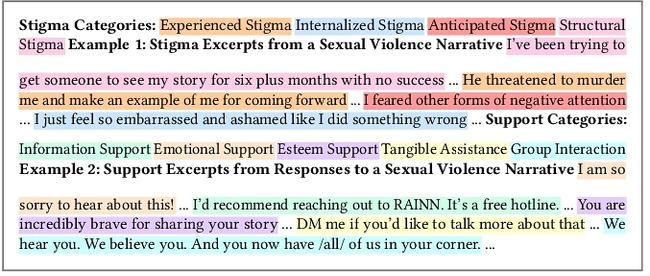
Support in Community Responses. To characterize how communities respond to survivor narratives, we draw on an established framework of online social support [34]. This framework identifies functional types of support commonly observed in online health and crisis contexts [16, 42]. We consider Information Support (advice or guidance), Emotional Support (expressions of empathy and care), Esteem Support (affirmation of worth or validation), Tangible Assistance (offers of direct or practical help), and Group Interaction (signals of shared experience or belonging). These categories capture distinct functions that are particularly relevant to discussions of sexual violence, where survivors may seek validation, reassurance, or actionable guidance. For example, Emotional Support can validate experiences, while Information Support may guide next steps, underscoring the importance of distinguishing between these categories in our analysis. Table 1 summarizes the stigma and support categories and their definitions.
To illustrate these categories, we present two paraphrased examples from Reddit, highlighting color-coded excerpts that reflect specific stigma and support types. Example 1 shows multiple co-occurring forms of stigma within a single narrative, while Example 2 demonstrates several forms of community support responses.
3 Methodology
3.1 Data Collection
We built on a dataset of sexual violence narratives curated by Garg et al. [22], which includes 5,328 posts from three subreddits: r/meToo, r/SexualHarassment, and r/sexualassault. The dataset's domain specificity and relevance to survivor disclosures make it well-suited to our analysis. To capture community responses, we collected direct replies to these posts using Python's Reddit API Wrapper (PRAW). We performed standard preprocessing by removing empty posts and comments as well as those labeled as “[deleted]” or “[removed].” We also excluded posts without comments to ensure that each post had an interactional context for analyzing support. The final dataset includes 3,675 posts and 5,131 comments.
3.2 Data Annotation
3.2.1 Annotating Posts. We adopted a multi-stage annotation pipeline to identify and characterize stigma in Reddit discussions of sexual violence. Posts were first screened for relevance, then labeled as Stigma or No Stigma, and finally annotated at a fine-grained level to capture specific types of stigma. Below, we describe each stage.
Relevance Checking. We screened posts for topical relevance and labeled them as ‘Relevant’ if they directly discussed sexual violence, and ‘Not Relevant’ otherwise.
Stigma vs. No Stigma. After filtering for relevance, posts were assigned a binary label: Stigma if they contained stigmatizing language, beliefs, or experiences, and No Stigma otherwise.
Fine-grained Stigma Labeling. We applied fine-grained annotation using the taxonomy in Table 1, labeling posts as Experienced, Internalized, Anticipated, and/or Structural Stigma, allowing multiple labels per post. Annotation was conducted iteratively, with disagreements resolved through discussion and guideline refinement until consensus was reached. As shown in Table 2, agreement improved across rounds, with initially subjective categories (e.g., Internalized Stigma, Anticipated Stigma) reaching substantial agreement over time.
3.2.2 Annotating Support in Comments. We annotated comments for support types using the taxonomy in Table 1, allowing multiple labels per comment. Annotation was conducted iteratively with disagreements resolved through discussion and guideline refinement. As shown in Table 3, agreement was generally high, with more explicit categories (e.g., Information Support) showing stronger consistency and others (e.g., Esteem Support) improving over time.
Table 2: Cohen's kappa scores for Stigma categories (κ).
Tag | Round 1 | Round 2 | Round 3 |
|---|---|---|---|
Anticipated | 0.407 | 0.510 | 0.608 |
Experienced | 0.268 | 0.675 | 0.722 |
Internalized | 0.396 | 0.558 | 0.639 |
Structural | 0.375 | 0.733 | 0.852 |
No Stigma | 0.385 | 0.610 | 0.834 |
Not Applicable | 0.508 | 0.643 | 1.000 |
Table 3: Cohen's kappa scores for support categories (κ).
Tag | Round 1 | Round 2 | Round 3 |
|---|---|---|---|
Information Support | 0.690 | 0.639 | 0.970 |
Emotional Support | 0.884 | 0.871 | 0.821 |
Esteem Support | 0.542 | 0.795 | 0.778 |
Group Interaction | 0.831 | 0.901 | 0.838 |
Tangible Assistance | 0.718 | 0.901 | 1.000 |
None | 0.918 | 0.846 | 1.000 |
3.3 LLM-Based Classification and Scaling of Stigma and Support Annotations
To extend the annotated data, we applied a K-shot in-context learning approach to classify stigma in posts and support in comments. Each category was treated as a separate binary yes/no decision, allowing multi-label assignments.
Stigma Classification. We first screened posts for relevance, labeling them as ‘Relevant’ if they directly discussed sexual violence. Relevant posts were then assigned a coarse label of Stigma or No Stigma. For fine-grained stigma classification, each post was paired with the definition of a single target category (Experienced, Internalized, Anticipated, or Structural) along with K = 5 semantically similar labeled examples. We chose K = 5 based on pilot experiments to balance contextual diversity with prompt length. Examples were retrieved using cosine similarity over MPNet-based SentenceTransformer embeddings [21], ensuring semantic relevance and stylistic similarity. The model followed a fixed procedure: it read the post, compared it to the category definition, and decided whether the stigma type was present (yes/no). We set the temperature to 0 to ensure consistency [6]. After validating this setup on the annotated subset, we applied it to the remaining data, achieving strong alignment with human labels and enabling scalable, consistent annotation.
Support Classification. We applied the same in-context learning approach to support classification. Each comment was evaluated against one category at a time (Information, Emotional, Esteem, Tangible, Group Interaction) using K = 5 semantically similar examples retrieved via MPNet-based cosine similarity. The prompt mirrored the stigma classification setup, combining the category definition, examples, and a binary yes/no decision. We set the temperature to 0 for consistency. After validating the approach on the annotated subset, we applied it to the remaining comments, enabling efficient annotation while maintaining alignment with the taxonomy.
3.4 Contextual Analysis
Topic Analysis. To identify recurring conceptual patterns in both sexual violence narratives and community responses, we applied the LLooM framework [30], a large language model–assisted method for extracting higher-level concepts from text collections. LLooM combines concept generation and example matching using LLMs to surface interpretable themes that capture common patterns across posts and comments.
LIWC. To analyze linguistic patterns in narratives and responses, we used Linguistic Inquiry and Word Count (LIWC) [12], which captures linguistically meaningful features such as emotional expression, cognitive processes, and social language.
Emotion Analysis. To quantify emotional expression, we used the NRC Emotion Lexicon [37] to capture eight core emotions. We compared emotion distributions across Stigma and No Stigma posts and their corresponding comments, highlighting differences in emotional tone and community responses.
4 Results
4.1 Classification Results
Stigma Categories. Table 4 presents the macro-averaged precision, recall, and F1 scores for each of the models. Level 1 classifies posts as ‘Relevant’ or ‘Not Relevant,’ Level 2 distinguishes Stigma from No Stigma, and Level 3 assigns fine-grained stigma categories. At Level 1, Gemini (2.0 Flash) achieves the best performance (F1 = 0.957), with a more balanced precision–recall trade-off than other models. At Level 2, Gemini again achieves the highest F1 score (F1 = 0.820), while GPT-4o-mini shows higher precision but lower recall, resulting in a lower overall F1. Llama and GPT-oss achieve lower F1 scores when distinguishing Stigma from No Stigma. At Level 3, which is a multi-label classification task, Gemini maintains the strongest performance (F1 = 0.773). Llama and GPT favor recall over precision, while GPT-oss is more conservative, favoring precision over recall.
Table 4: Macro Precision (P), Recall (R), and F1 across Stigma classification tasks. Relevant (Rel.), Stigma (Stig.)
Rel. vs Not Rel. | Stig. vs No Stig. | Fine-grained Stig. | |||||||
|---|---|---|---|---|---|---|---|---|---|
Model | P | R | F1 | P | R | F1 | P | R | F1 |
gemini-2.0-flash | 0.957 | 0.957 | 0.957 | 0.820 | 0.820 | 0.820 | 0.732 | 0.825 | 0.773 |
Llama-3.3-70B | 0.808 | 0.638 | 0.684 | 0.711 | 0.823 | 0.727 | 0.593 | 0.883 | 0.683 |
gpt-4o-mini | 0.854 | 0.709 | 0.760 | 0.891 | 0.729 | 0.777 | 0.570 | 0.924 | 0.683 |
gpt-oss-120b | 0.670 | 0.869 | 0.716 | 0.700 | 0.829 | 0.680 | 0.776 | 0.562 | 0.652 |
Table 5: Distribution of support types across Stigma categories in posts. Stigma (Stig.), Emotional (Emo.), Informational (Info.)
Stig. Type | #Posts | #Comments | ||||
|---|---|---|---|---|---|---|
Emo. | Esteem | Group | Info. | Tangible | ||
Internalized | 1809 | 988 | 1108 | 444 | 1326 | 228 |
Anticipated | 1325 | 681 | 730 | 317 | 960 | 177 |
Experienced | 1273 | 669 | 681 | 286 | 915 | 156 |
Structural | 325 | 154 | 142 | 71 | 213 | 46 |
Support Categories. For support classification in comments, Gemini achieves the strongest overall performance, with an F1 score of 0.798. In contrast, GPT-4o-mini attains slightly higher precision (0.806), reflecting a more conservative prediction strategy, but substantially lower recall (0.649), indicating that it misses a considerable number of support instances.
Performance Considerations and Task Complexity. The observed performance (F1 ≈ 0.7–0.8) reflects the inherent difficulty of stigma and support classification. These tasks involve nuanced, context-dependent, and socially grounded categories that lack clear lexical boundaries. Stigma detection is particularly challenging due to annotator subjectivity and overlapping concepts, which can co-occur within the same narrative and introduce labeling ambiguity [9, 24]. Similarly, support classification is complicated by the frequent co-occurrence of multiple, semantically similar support categories within a single comment. Prior work reports comparable performance ranges for both stigma classification [8, 9, 26] and support detection [2], suggesting that our results reflect the complexity of the tasks rather than solely the limitations of the models.
Overall Data Labeling. Based on the classification results, we selected Gemini 2.0 Flash as the primary model for labeling both posts and comments in the full dataset. Table 5 presents the frequency of each support category across stigma categories in posts. Internalized Stigma is the most prevalent category and is associated with the highest volume of support responses. Across all stigma categories, Informational and Esteem Support are the most common forms of response, while Tangible Support remains relatively rare.
4.2 Contextual Analysis
Table 6: LLooM-derived post concepts and examples across Stigma and No Stigma narratives.
Category | Concept | Example |
|---|---|---|
Stigma | Self-Blame & minimization after SV | I can't help but feel extremely guilty about this and that it's my fault. I don't know if I gave him the wrong message...and not telling him to stop...but I kept pushing him away |
Self-blame & self-silencing after SV | am I blowing it out of proportion? was it actually just a mistake and should I forgive him? | |
Stigma & fear of disclosure after SV | I feel disgusted and ick when I'm with her. I felt guilty at that time for hating her so much... I played it off like it was nothing when it actually bothered me and wasn't able to talk to her about it. | |
Intimacy avoidance due to trauma | I've stopped talking to him, mostly stayed in my room, and be really nervous when parents r not home, I've been scarred. | |
Secondary victimization by partner | he was defensive… so I must have given it to him… he called me a psycho… he proceeded to explain to me that I came back and that I am crazy. | |
No Stigma | Recounting assault | earlier today at school I experienced unwanted touching… |
Trauma impact & well-being | this is a very complicated situation… my sister… told my mum that my dad sexually abused her for many years. | |
Seeking clarification on SV | I'm confused about whether I'm overreacting or if this is actually inappropriate. | |
Institutional navigation & sexual harassment | there is no hr, no one higher than him… | |
Ambiguous consent & intoxication | I don't remember agreeing, and I'm confused about whether I actually consented while I was intoxicated. |
Table 7: LLooM-derived support concepts and examples across Stigma and No Stigma narratives.
Category | Concept | Example |
|---|---|---|
Stigma | Normalizing & Validating trauma responses | he's in the wrong, not you. you did tell him you weren't interested with something clearer than words – your actions you described |
Experience sharing & advice | as a person who had been the recipient of sexual harassment, I strongly suggest that you document everything | |
Empowering survivor identity | you were 10. do not look at the thoughts or actions or behaviors of a ten year old... you did nothing wrong | |
Resource signposting for survivors | if your friend needs free legal advice and support, you can contact rightsofwomen.org.uk | |
Rejecting intoxication as excuse | I wouldn't forgive him, but I'm not you. he says he was out of his head drunk, but it doesn't ring true | |
No Stigma | Affirming emotional support | it's okay to dm me |
Empathetic validation and affirmation | stay strong. stand high. if she calls the police then that's on her | |
Defining assault | more like sexual assault!! you have every right to your own body and your rules! | |
Encouraging professional help | I would suggest calling your local women's shelter, they have the resources | |
Supporting trauma processing | sexual harassment definition: “behavior characterized by the making of unwelcome and inappropriate sexual remarks or physical advances” |
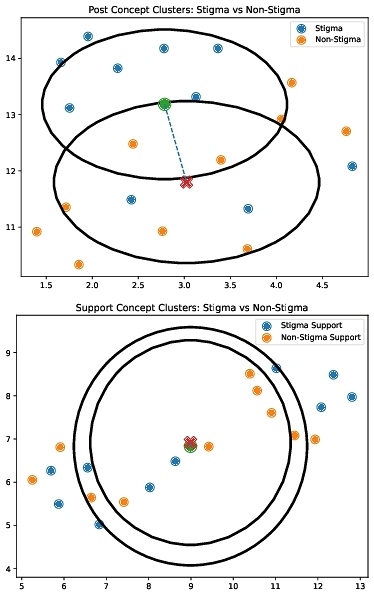
Concept Discovery with LLooM. Table 6 summarizes the most frequent concepts extracted from posts labeled as Stigma and No Stigma. Stigma-related narratives are primarily characterized by themes of internalized distress and interpersonal harm, including internalized self-blame and minimization following sexual violence, internalized blame and self-silencing, fear of disclosure, and intimacy avoidance due to trauma. These themes reflect narratives centered on guilt, self-doubt, and psychological withdrawal following traumatic experiences. In contrast, No Stigma posts are more oriented toward situational interpretation and clarification, including recollections of past sexual assault, impact of trauma on functioning and well-being, seeking clarification on sexual violence, and navigating ambiguous sexual encounters, indicating a focus on describing events and making sense of experiences rather than expressing Internalized Stigma.
As shown in Table 7, comments on Stigma-related posts emphasize validation and affirmation, including normalizing trauma responses, experience sharing, and empowering survivor identity, often alongside actionable guidance such as resource signposting and challenging harmful narratives. In contrast, comments associated with No Stigma posts emphasize informational and guidance-oriented interactions, with themes such as affirming emotional support, empathetic validation, defining and identifying sexual assault-related concepts, and encouragement of professional mental health support. Compared to Stigma-related responses, these comments place greater emphasis on clarification and practical advice rather than counteracting Internalized Stigma.
To examine structural differences, we embedded LLooM-derived concepts and visualized them using dimensionality reduction. Figure 1(a) shows partial separation between Stigma and No Stigma post concepts, with Stigma clustering around internalized distress and No Stigma around situational interpretation, indicating clear thematic differences. In contrast, Figure 1(b) shows substantial overlap in comment-related concepts. While Stigma support emphasizes validation and No Stigma leans toward informational guidance, boundaries are less distinct, suggesting shared support strategies across contexts.
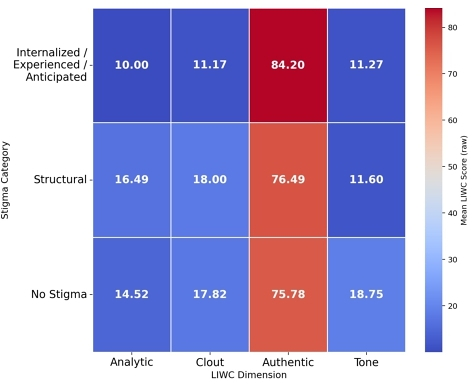
Linguistic Analysis Using LIWC. We grouped stigma into two broad categories: Felt Stigma (including Internalized, Experienced, Anticipated), reflecting personal experiences, and Structural Stigma, capturing systemic barriers. As shown in Figure 2, posts tagged as Internalized, Experienced, and Anticipated Stigma exhibit higher Authenticity (84.20) and lower Analytic scores (10.00) than Structural Stigma (Authentic = 76.49, Analytic = 16.49), reflecting a more emotionally confessional style compared to the more analytical framing of structural barriers. No Stigma posts fall between these extremes, suggesting a relatively neutral linguistic baseline. At the comment level, Clout scores are consistently high across all stigma categories and support types, indicating that responses generally adopt a confident, authoritative tone. Esteem Support exhibits the highest Clout across categories (76.26, 77.50, and 68.24 for Internalized/Experienced/Anticipated, Structural, and No Stigma), suggesting that affirmation-based responses are particularly assertive. Group Interaction shows the highest Authenticity, reflecting the personal and experiential nature of peer engagement, while Information Support has the highest Analytic scores, consistent with its instructional and solution-oriented role.1
Emotion Analysis. To examine the emotional characteristics of Stigma and No Stigma content, we applied the NRC Emotion Lexicon, which captures eight basic emotions: anger, fear, sadness, disgust, anticipation, trust, joy, and surprise [39]. Across posts, narratives labeled as Internalized, Experienced, Anticipated Stigma exhibit relatively higher proportions of negative emotions such as sadness, fear, and anger, reflecting the distress and personal vulnerability associated with lived experiences of stigma. In contrast, Structural posts show a more moderated emotional profile, with comparatively balanced levels of both negative and neutral emotions, indicating discussions that are less personal and more systemic in nature, while No Stigma posts display higher levels of trust, anticipation, and joy, suggesting more neutral or forward-looking conversations. A similar pattern is observed in support comments, where responses across all categories are dominated by trust and anticipation, but comments addressing Internalized/Experienced/Anticipated content exhibit slightly higher negative affect, including sadness and fear, reflecting empathetic engagement with distressing experiences. Support for Structural content remains comparatively neutral, while responses to No Stigma posts maintain a more balanced and positive emotional distribution. Overall, these results demonstrate that emotionally intense signals are most prominent in personally Experienced Stigma, whereas structural and No Stigma content exhibit comparatively moderated emotional patterns.2
Support Dynamics in Survivor Narratives. Our results show that support patterns are largely consistent across stigma categories, with differences mainly in emphasis rather than the categories employed. Information Support is most prevalent, followed by Esteem and Emotional Support, reflecting a general focus on guidance and validation. The differences are modest: Internalized, Experienced, and Anticipated Stigma receive slightly more Esteem Support (26.1%), Structural Stigma shows higher Tangible Support (7%), and No Stigma posts have the most Information Support (38.7%). Overall, communities rely on stable support strategies, adjusting emphasis based on the disclosure type.
5 Related Work
Stigma has been widely conceptualized as a multidimensional social process involving labeling, stereotyping, and discrimination across social and institutional contexts [33], with subsequent work distinguishing mechanisms such as experienced, anticipated, and internalized stigma in health-related domains including HIV, mental illness, and substance use [14, 15, 19, 20, 44]. While these frameworks establish stigma as a layered phenomenon affecting both individual perceptions and structural outcomes, they primarily focus on offline settings and do not examine how these mechanisms manifest in large-scale online discourse. Prior research on online platforms, particularly Reddit, shows that users frequently engage in self-disclosure and seek advice in anonymous environments [5, 16, 22, 40], with responses often containing diverse forms of social support, including emotional, informational, and peer-based support expressed through linguistic patterns [17, 42, 43]. Additional studies highlight structured interaction patterns in online health communication and community-driven platforms [34, 47], but have not explicitly modeled how different types of stigma are embedded within narratives or how they relate to specific forms of support. Advances in computational methods, including natural language processing and large language models, have enabled large-scale analysis of stigmatizing language and thematic structures in online discourse [6, 8, 24, 30, 32, 35, 46], yet these approaches primarily focus on detection or representation learning rather than jointly capturing the multi-dimensional nature of stigma and its interaction with support. Our work addresses this gap through a hierarchical multi-label framework that links stigma expressions in survivor narratives to support strategies in community responses.
6 Ethics and Limitations
This work examines sensitive discussions of sexual violence, so we take several steps to minimize potential harm. Although the data are publicly available on Reddit, posts may contain deeply personal experiences, and users may not expect them to be used for research. We therefore paraphrase all excerpts, remove potentially identifiable details, and only share post/comment IDs to avoid sharing the original content. The annotations capture expressions in the text and should not be interpreted as clinical or psychological assessments of individuals. In addition, the norms, moderation practices, and user populations of the selected subreddits may shape both survivor disclosures and community responses. Our approach also has methodological limitations. LLM-based annotations may introduce systematic biases or miss nuanced and overlapping forms of stigma and support, and validation against manually annotated data reduces but does not eliminate these errors. The proposed taxonomy may not capture all expressions of stigma and support across diverse communities. Because the analysis is limited to English-language Reddit data, its generalizability may be constrained by demographic, platform-specific, and self-selection biases, and the findings may not reflect evolving patterns over time. Finally, the dataset is imbalanced across stigma categories. Although this imbalance reflects the collected data, it limits comparisons for less common categories. We therefore interpret findings related to Structural Stigma cautiously and call for larger, more balanced datasets in future work.
7 Discussion and Conclusion
This work provides an interaction-centered account of stigma and support in online sexual violence discussions. Prior research has established stigma as a multi-dimensional social process and has shown that Reddit can serve as a space for disclosure, anonymity, and support-seeking [5, 9, 16, 20]. Our SCOPE dataset links survivor narratives with the responses, enabling us to examine how disclosure framing and peer support are jointly shaped within socio-technical spaces.
A main finding of our work is the relative stability of community support norms. Across Stigma and No Stigma posts, commenters rely on a broadly consistent repertoire of Information, Emotional Support, and Esteem Support, as well as Tangible Assistance and Group Interaction, with differences arising mainly in emphasis rather than in kind. This pattern suggests that community members draw on recognizable and durable response conventions that provide validation, guidance, and reassurance. Our findings extend prior work on online support exchange by showing that these response norms are resilient across different stigma profiles [13, 17, 29, 42]. This resilience also highlights how platform affordances, such as pseudonymous threading, can foster care even around deeply marginalized experiences [18].
The linguistic and emotional patterns further clarify why these support norms matter. Posts labeled as Internalized, Experienced, and Anticipated Stigma are more confessional and affectively intense, whereas Structural Stigma is framed in more analytical language. Community replies, however, tend to stabilize the interaction through validation, affirmation, and practical guidance. Theoretically, this suggests that online communities actively work to repair the “identity” that survivors anticipate or internalize [25, 33]. Peer support does more than respond to distress; it helps make disclosures legible and credible. This aligns with prior work on reciprocity, linguistic accommodation, and community participation [4, 17, 43].
These results also suggest that moderation and support tools should preserve constructive responses such as validation, information, and belonging. More broadly, they show that platform outcomes depend on interaction norms as well as content [23]. For automated and human-in-the-loop systems [41], the goal should not be to generate highly customized responses for every stigma subtype, but to leverage datasets like SCOPE to detect and amplify timely, safe, and norm-congruent forms of peer assistance.
In conclusion, SCOPE contributes a dataset and computational framework for studying stigma and support together rather than separately. The main contribution of this work is demonstrating that while stigma deeply shapes how survivors narrate their experiences, community responses remain structurally stable even as those narratives differ. This interactional perspective offers a foundation for future research on online sexual violence discourse and for designing safer, more responsive digital support environments across platforms with varying affordances, anonymity structures, and moderation regimes.
Acknowledgments
We thank Google for access to Gemini through the Gemini Academic Program Award. We also thank the Reddit communities whose public discussions made this work possible.
Notes
1see additional figures at https://github.com/ShirleneRose/Stigma_SV/
2See our GitHub repository for additional figures and results.
Source
Imported from ACM’s structured HTML source. ACM Reference Format: Shirlene Bandela, Karan Bindal, Vaibhav Garg, and Rezvaneh Rezapour. 2026. Stigma and Support in Online Sexual Violence Narratives on Reddit. In 37th ACM Conference on Hypertext (HT '26), September 14--18, 2026, London, United Kingdom. ACM, New York, NY, USA 8 Pages. https://doi.org/10.1145/3800935.3830853
References
[1] Peter Aggleton, Richard Parker, and Miriam Maluwa. 2003. Stigma, Discrimination and HIV/AIDS in Latin America and the Caribbean. Sustainable Development Department Technical papers series SOC-130. Inter-American Development Bank, Washington, D.C.
[2] Zahra Ahani, Moein Shahiki Tash, Fazlourrahman Balouchzahi, Luis Ramos, Grigori Sidorov, Alexander Gelbukh, and Rau l Monroy. 2026. Social Support Detection from Social Media Texts. Plos One 21, 3 (2026), e0337476.
[3] Ramona Alaggia and Susan Wang. 2020. “I Never Told Anyone Until the# Metoo Movement”: What Can we Learn from Sexual Abuse and Sexual Assault Disclosures Made Through Social Media?Child Abuse & Neglect 103 (2020), 104312.
[4] Nazanin Andalibi, Oliver L Haimson, Munmun De Choudhury, and Andrea Forte. 2018. Social Support, Reciprocity, and Anonymity in Responses to Sexual Abuse Disclosures on Social Media. ACM Transactions on Computer-Human Interaction (TOCHI) 25, 5 (2018), 1–35.
[5] Nazanin Andalibi, Oliver L Haimson, Munmun De Choudhury, and Andrea Forte. 2016. Understanding Social Media Disclosures of Sexual Abuse Through the Lenses of Support Seeking and Anonymity. In Proceedings of the 2016 CHI Conference on Human Factors in Computing Systems. 3906–3918.
[6] Shubham Atreja, Joshua Ashkinaze, Lingyao Li, Julia Mendelsohn, and Libby Hemphill. 2025. What's in a Prompt?: A Large-Scale Experiment to Assess the Impact of Prompt Design on the Compliance and Accuracy of LLM-Generated Text Annotations. In Proceedings of the International AAAI Conference on Web and Social Media, Vol. 19. AAAI, Copenhagen, Denmark, 122–145.
[7] Madeleine Bair. 2022. Reddit Narratives of Victims/Survivors of Intimate Partner Violence. Master's thesis. Millersville University of Pennsylvania.
[8] Layla Bouzoubaa, Elham Aghakhani, and Rezvaneh Rezapour. 2024. Words Matter: Reducing Stigma in Online Conversations about Substance Use with Large Language Models. In Proceedings of the 2024 Conference on Empirical Methods in Natural Language Processing. 9139–9156.
[9] Layla Bouzoubaa, Elham Aghakhani, and Rezvaneh Rezapour. 2025. Phenotypes of Stigma Expressed by People Who Use Drugs on Reddit. Social Science & Medicine (2025), 118889.
[10] Layla Bouzoubaa, Elham Aghakhani, Max Song, Quang Trinh, and Shadi Rezapour. 2024. Decoding the Narratives: Analyzing Personal Drug Experiences Shared on Reddit. In Findings of the Association for Computational Linguistics: ACL 2024. Association for Computational Linguistics, Bangkok, Thailand, 6131–6148. https://doi.org/10.18653/v1/2024.findings-acl.367
[11] Layla Bouzoubaa, Hyung Wook Choi, Milan Varghese, Valerie Earnshaw, and Rezvaneh Rezapour. 2026. The Cognitive, Affective, and Behavioral Expression of Self-stigma among People Who Use Drugs in Online Substance Use Communities. arXiv preprint arXiv:2606.25143 (2026).
[12] Ryan L Boyd, Ashwini Ashokkumar, Sarah Seraj, and James W Pennebaker. 2022. The Development and Psychometric Properties of LIWC-22. Austin, TX: University of Texas at Austin 10, 1-47 (2022), 6.
[13] Stevie Chancellor, Andrea Hu, and Munmun De Choudhury. 2018. Norms Matter: Contrasting Social Support Around Behavior Change in Online Weight Loss Communities. In Proceedings of the 2018 CHI Conference on Human Factors in Computing Systems. 1–14.
[14] Patrick W Corrigan, Amy Kerr, and Lissa Knudsen. 2005. The Stigma of Mental Illness: Explanatory Models and Methods for Change. Applied and Preventive Psychology 11, 3 (2005), 179–190.
[15] Patrick W Corrigan and Deepa Rao. 2012. On the Self-Stigma of Mental Illness: Stages, Disclosure, and Strategies for Change. The Canadian Journal of Psychiatry 57, 8 (2012), 464–469.
[16] Munmun De Choudhury and Sushovan De. 2014. Mental Health Discourse on Reddit: Self-Disclosure, Social Support, and Anonymity. In Proceedings of the International AAAI Conference on Web and Social Media, Vol. 8. 71–80.
[17] Munmun De Choudhury and Emre Kiciman. 2017. The Language of Social Support in Social Media and its Effect on Suicidal Ideation Risk. In Proceedings of the International AAAI Conference on Web and Social Media, Vol. 11. 32–41.
[18] Jill P Dimond, Michaelanne Dye, Daphne LaRose, and Amy S Bruckman. 2013. Hollaback! The Role of Storytelling Online in a Social Movement Organization. In Proceedings of the 2013 Conference on Computer Supported Cooperative Work. 477–490.
[19] Valerie A Earnshaw. 2020. Stigma and Substance Use Disorders: A Clinical, Research, and Advocacy Agenda.American Psychologist 75, 9 (2020), 1300.
[20] Valerie A Earnshaw and Stephenie R Chaudoir. 2009. From Conceptualizing to Measuring HIV Stigma: A Review of HIV Stigma Mechanism Measures. AIDS and Behavior 13, 6 (2009), 1160–1177.
[21] Hugging Face. 2025. MPNET Sentence Transformer. https://huggingface.co/sentence-transformers/all-mpnet-base-v2 Accessed 2025-08-02.
[22] Vaibhav Garg, Hannah Javidi, Jiaqing Yuan, Ruijie Xi, and Munindar P Singh. 2025. Analyzing Reddit Stories of Sexual Violence: Incidents, Effects, and Requests for Advice. In Proceedings of the International AAAI Conference on Web and Social Media, Vol. 19. 568–585.
[23] Tarleton Gillespie. 2018. Custodians of the Internet: Platforms, Content Moderation, and the Hidden Decisions That Shape Social Media. Yale University Press.
[24] Salvatore Giorgi, Douglas Bellew, Daniel Roy Sadek Habib, João Sedoc, Chase Smitterberg, Amanda Devoto, McKenzie Himelein-Wachowiak, and Brenda Curtis. 2024. Lived Experience Matters: Automatic Detection of Stigma Toward People Who Use Substances on Social Media. In Proceedings of the International AAAI Conference on Web and Social Media, Vol. 18. 474–487.
[25] Erving Goffman. 1963. Stigma: Notes on the Management of Spoiled Identity. Prentice-Hall, Englewood Cliffs, NJ.
[26] Swapna Gottipati, Mark Chong, Andrew Wei Kiat Lim, and Benny Haryanto Kawidiredjo. 2021. Exploring Media Portrayals of People with Mental Disorders using NLP. In Proceedings of the 14th International Joint Conference on Biomedical Engineering Systems and Technologies (BIOSTEC 2021) - Volume 5: HEALTHINF. SciTePress, 708–715.
[27] Mark L Hatzenbuehler, Jo C Phelan, and Bruce G Link. 2013. Stigma as a Fundamental Cause of Population Health Inequalities. American Journal of Public Health 103, 5 (2013), 813–821.
[28] Angie C Kennedy and Kristen A Prock. 2018. “I Still Feel Like I Am Not Normal”: A Review of the Role of Stigma and Stigmatization Among Female Survivors of Child Sexual Abuse, Sexual Assault, and Intimate Partner Violence. Trauma, Violence, & Abuse 19, 5 (2018), 512–527.
[29] Robert E Kraut and Paul Resnick. 2012. Building Successful Online Communities: Evidence-based Social Design. MIT Press.
[30] Michelle S Lam, Janice Teoh, James A Landay, Jeffrey Heer, and Michael S Bernstein. 2024. Concept Induction: Analyzing Unstructured Text with High-Level Concepts using LlooM. In Proceedings of the 2024 CHI Conference on Human Factors in Computing Systems. 1–28.
[31] Stephanie Lanthier, Robin Mason, Carmen H Logie, Ted Myers, and Janice Du Mont. 2023. “Coming Out of the Closet About Sexual Assault”: Intersectional Sexual Assault Stigma and (Non) Disclosure to Formal Support Providers Among Survivors Using Reddit. Social Science & Medicine 328 (2023), 115978.
[32] Min Hyung Lee and Richard Kyung. 2022. Mental Health Stigma and Natural Language Processing: Two Enigmas Through the Lens of a Limited Corpus. In 2022 IEEE World AI IoT Congress (AIIoT). IEEE, 688–691.
[33] Bruce G Link and Jo C Phelan. 2001. Conceptualizing Stigma. Annual Review of Sociology 27, 1 (2001), 363–385.
[34] Carla Teixeira Lopes and Bárbara Guimarães Da Silva. 2019. A Classification Scheme for Analyses of Messages Exchanged in Online Health Forums. (2019).
[35] Katerina Margatina, Timo Schick, Nikolaos Aletras, and Jane Dwivedi-Yu. 2023. Active Learning Principles for In-Context Learning with Large Language Models. In Findings of the Association for Computational Linguistics: EMNLP 2023. Association for Computational Linguistics, Singapore, 5011–5034. https://doi.org/10.18653/v1/2023.findings-emnlp.334
[36] Shravika Mittal and Munmun De Choudhury. 2023. Moral Framing of Mental Health Discourse and its Relationship to Stigma: A Comparison of Social Media and News. In Proceedings of the 2023 CHI Conference on Human Factors in Computing Systems. 1–19.
[37] Saif M Mohammad and Peter D Turney. 2013. Crowdsourcing a Word–Emotion Association Lexicon. Computational Intelligence 29, 3 (2013), 436–465.
[38] Tully O'Neill. 2018. ‘Today I Speak’: Exploring How Victim-Survivors Use Reddit. International Journal for Crime, Justice and Social Democracy 7, 1 (2018), 44–59.
[39] Robert Plutchik. 2001. The Nature of Emotions: Human Emotions Have Deep Evolutionary Roots, a Fact That May Explain their Complexity and Provide Tools for Clinical Practice. American Scientist 89, 4 (2001), 344–350.
[40] Mansi Saxena, Vaibhav Garg, Bhaskar Ray, Aura Mishra, and Munindar Singh. 2025. Understanding Narratives of Trauma on Social Media. In Proceedings of the 17th ACM Web Science Conference 2025. Association for Computing Machinery, New York, NY, USA, 338–347. https://doi.org/10.1145/3717867.3717892
[41] Joseph Seering, Tony Wang, Jina Yoon, and Geoff Kaufman. 2019. Moderator Engagement and Community Development in the Age of Algorithms. New Media & Society 21, 7 (2019), 1417–1443.
[42] Ashish Sharma, Monojit Choudhury, Tim Althoff, and Amit Sharma. 2020. Engagement Patterns of Peer-To-Peer Interactions on Mental Health Platforms. In Proceedings of the International AAAI Conference on Web and Social Media, Vol. 14. 614–625.
[43] Eva Sharma and Munmun De Choudhury. 2018. Mental Health Support and its Relationship to Linguistic Accommodation in Online Communities. In Proceedings of the 2018 CHI Conference on Human Factors in Computing Systems. 1–13.
[44] Laramie R Smith, Valerie A Earnshaw, Michael M Copenhaver, and Chinazo O Cunningham. 2016. Substance Use Stigma: Reliability and Validity of a Theory-Based Scale for Substance-Using Populations. Drug and Alcohol Dependence 162 (2016), 34–43.
[45] Anne L Stangl, Valerie A Earnshaw, Carmen H Logie, Wim Van Brakel, Leickness C. Simbayi, Iman Barré, and John F Dovidio. 2019. The Health Stigma and Discrimination Framework: A Global, Crosscutting Framework to Inform Research, Intervention Development, and Policy on Health-Related Stigmas. BMC Medicine 17, 1 (2019), 31.
[46] Nadiya Straton, Hyeju Jang, and Raymond Ng. 2020. Stigma Annotation Scheme and Stigmatized Language Detection in Health-Care Discussions on Social Media. In Proceedings of the Twelfth Language Resources and Evaluation Conference. 1178–1190.
[47] Sachin Thukral, Hardik Meisheri, Tushar Kataria, Aman Agarwal, Ishan Verma, Arnab Chatterjee, and Lipika Dey. 2018. Analyzing Behavioral Trends in Community Driven Discussion Platforms like Reddit. In 2018 IEEE/ACM International Conference on Advances in Social Networks Analysis and Mining (ASONAM). IEEE, 662–669.
[48] Sarah E. Ullman. 2023. Talking About Sexual Assault: Society's Response to Survivors (2nd ed.). American Psychological Association.
Do you like what you are reading? Subscribe to receive updates.
Unsubscribe anytime