
Abstract
LLM-powered virtual conversational companions tend to lose engagement once conversational novelty fades, as dialogue alone provides no persistent reason to return. Virtual pets address part of this problem through a care loop, but existing implementations tend to use generic characters that bear no relation to the user. In this work, we present PET (Personalized gEnerative Tamagotchi), a hyper-personalized virtual companion that combines generative character creation with the care-loop mechanic for personal goal-setting. PET uses a multi-agent AI pipeline – Profiler, Strategist, Designer, and CareTaker – to synthesize a unique virtual companion whose appearance, personality, and narrative are derived from each user's goals and self-description. The companion's vitality is coupled to daily behavior check-ins, while an LLM-driven agent maintains in-character interaction grounded in persistent memory. A 7-day field deployment revealed that the care loop was the primary driver of sustained engagement, with participants reporting real-world impact on their daily behaviors, motivated by their companion's HP/XP state. Generative personalization contributed to emotional attachment and served as a mnemonic anchor for daily habits.
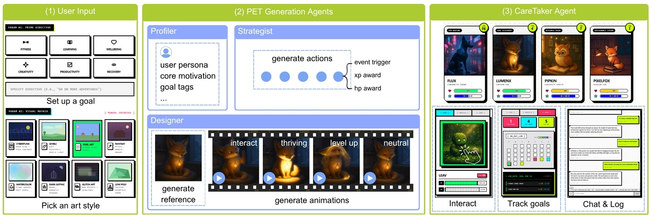
A three-panel diagram showing the PET pipeline from left to right. Panel 1, User Input, shows form fields where users enter personal goals and select an art style. Panel 2, PET Generation Agents, contains three sub-modules: the Profiler outputs a structured user persona with core motivations and goal tags; the Strategist outputs a list of personalized actions with HP and XP reward values; and the Designer outputs a reference image of the companion along with animated status videos depicting states such as interacting, thriving, leveling up, and neutral. Six example companion images are shown as glowing, stylized animals. Panel 3, CareTaker Agent, shows the runtime chat interface where users converse with their companion, with HP and XP bars, chat bubbles, and automatic goal-tracking logs visible.
1 Introduction
Generative AI companions are becoming a new form of agentic media: dynamic interfaces that mediate how people encounter information about themselves, their routines, and their goals. For personal goal setting, this mediation can be hyper-personalized: a companion can be generated from a user's self-description, adapt recommendations to that user's goals, and connect daily check-ins, rewards, memory, and visual state changes into an evolving personal experience.
This creates a design opportunity, but also a problem. Large language models have made virtual companions convincingly conversational, but conversation alone is not enough to keep people coming back. Even within a single week, engagement with LLM-based agents drops measurably as users exhaust the novelty of open-ended dialogue [6]. Once the initial curiosity wears off, the system needs another reason for the user to return.
Virtual pets take a different approach. The original Tamagotchi required regular feeding, cleaning, and attention; neglect caused the creature to sicken and die. This mechanic produced what is now called the Tamagotchi effect: people form genuine attachment to digital entities when they feel responsible for the entity's well-being [1, 4]. The pet depends on you, and that dependency pulls you back every day. Coupling a virtual pet's health to real-world behaviors (children's diet [1], household energy use [4]) has been shown to drive measurable behavior change. But the characters in these systems are generic: every user gets the same avatar, with no connection to their individual identity. A “self-avatar Tamagotchi” that reflects the user's own traits was proposed to strengthen identification through the Proteus effect [8], but it was never built.
We present PET (Personalized gEnerative Tamagotchi), a system that realizes this vision and extends it. PET uses a multi-agent generative AI pipeline to create a unique virtual companion whose appearance, name, personality, lore, and action plan all come from the user's own goals and self-description. The system turns this generated identity into a persistent feedback structure: HP (Health Points) decay daily if neglected, while XP (Experience Points) accumulate toward level-ups through daily behavior check-ins. An LLM-driven conversational layer lets the companion interact in character, with persistent memory to maintain continuity across sessions. Rather than treating goal support as a linear checklist, PET links user-defined goals, daily actions, companion vitality, narrative memory, and conversational reflection into a nonlinear, evolving loop. Where earlier systems like Infi [4] focused on a single behavior domain, PET lets users define their own goals across fitness, learning, creativity, productivity, or anything else.
We deployed PET for 7 days with 6 participants to investigate:
How does PET's care-loop mechanic sustain daily engagement beyond initial conversational novelty?\
How does generative personalization shape users’ identification with, ownership of, and attachment to their companion?\
Our contributions:
PET, a hyper-personalized virtual companion system where each user receives a unique character whose visual identity, personality, lore, and behavioral agenda are generated from their individual profile.\
A care-loop interaction model that couples the companion's HP/XP state to multi-domain, user-defined behaviors, giving users a persistent reason to return.\
A composable multi-agent pipeline (Profiler, Strategist, Designer, CareTaker) that separates user profiling, action planning, character generation, and runtime interaction, making the provenance of the companion's identity and behavior easier to trace and adapt.\
A 7-day field deployment showing that the care loop drives daily engagement and real-world behavior change, while generative personalization can support attachment and ownership.\
2 Related Work
2.1 Virtual Companions and Conversational Agents
People use virtual companions mostly for emotional support and loneliness relief, not just task completion [15], and five design principles have been proposed for building them well: human-like design, adaptivity, proactive reciprocity, transparency, and support for long-term relationships [16]. Keeping users engaged over time, however, remains an open problem. A 7-day study of an LLM-based companion found steadily declining message volume and session duration, with users asking for more distinctive personality and stable memory [6]; LLM-guided hypermedia has also explored natural-language goals as a basis for navigating linked content [17].
In the health domain, conversational agents show promise when they go beyond information delivery. Empathic virtual agents outperform text-only systems for behavior change counseling [13], and personalized examples, recommendations, and navigation cues can motivate more effective action than generic guidance [2, 3]. Context-rich messages from wearables (e.g., “I noticed your step count...”) can even make devices feel like companions, with perceived companionship fully mediating behavior change [11]. Yet rule-based chatbots grow repetitive within two weeks, and users explicitly request more intelligent, LLM-based alternatives [10]. The design challenge is combining good conversation with a reason to return.
2.2 Virtual Pets and the Care Loop
Virtual pets whose health is coupled to the user's real-world behaviors create a care loop: the pet depends on you, and that dependency gives you a reason to return. A 3-day RCT showed that children ate more vegetables when their virtual dog's health reflected their diet [1]. A larger 420-participant RCT extended this mechanic to energy-saving behavior using a Tamagotchi-inspired system augmented with GPT-3.5 conversation, finding that care-based feedback combined with generative AI significantly increased emotional attachment and pro-environmental intention [4]. Related work has also shown that virtual pet cuteness drives parasocial interaction and prosocial behavior [18], and the Tamagotchi mechanic has been applied to thyroid cancer education with positive expert evaluation [7]. Still, every existing system either targets a single behavior domain or uses a generic character shared across all users. The idea of a “self-avatar Tamagotchi” has been proposed but not built or tested [8].
2.3 Personalization and the Proteus Effect
Customized avatars in VR exercise reduce perceived exertion and improve physical performance through the Proteus effect, an effect driven by self-identification and perceived control rather than visual priming alone [12]. Different user types also respond differently to persuasive strategies, making one-size-fits-all gamification ineffective [14]. In the gamification literature, digital achievements do enhance behavioral persistence (especially when milestones are few and difficult [9]), but achievements on their own do not sustain motivation; they need to be embedded in an emotionally engaging context. PET brings these three areas – personalized characters, care-loop mechanics, and LLM-driven conversation – into one system.
3 PET: A Multi-Agent Framework for Generative Companionship
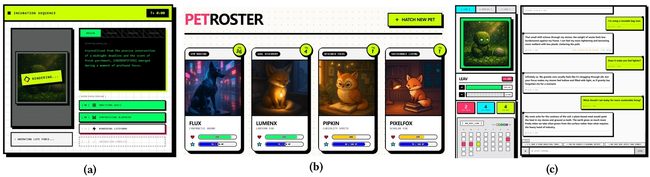
Three panels showing the PET user journey: generation, dashboard, and chat.
PET runs four agents in a staged pipeline (Figure 1): Profiler, Strategist, Designer, and CareTaker. Together, they form a traceable path from user input to companion behavior: persona, action plan, generated identity, and runtime interaction history. PET surfaces this provenance through an incubation sequence that reveals each part of the companion's identity as the corresponding agent completes its work (Figure 2 a).
Profiler. The Profiler takes the user's self-description, personal goals, and behavioral preferences as input and produces a structured persona capturing identity, motivations, target domains, and preferred interaction style. Every downstream agent references this persona so the companion remains consistent across appearance, personality, action planning, and dialogue.
Strategist. The Strategist turns high-level goals into specific daily actions and assigns each action HP and XP rewards based on estimated difficulty and alignment with the user's goals. HP decays daily, requiring users to act to keep the companion healthy; XP accumulates toward level-ups, following evidence that difficult, infrequent achievements can support persistence [9].
Designer. The Designer generates the companion's concept, visual reference image, animated state loops, name, traits, and lore. The lore and image are passed to the CareTaker so the companion's conversation can draw from the same generated identity.
CareTaker. The CareTaker governs daily interaction after generation. At the start of each session, it loads the companion identity, personalized action list, compressed conversation memory, recent check-ins, and current HP/XP state. Users report progress in natural language; the CareTaker awards HP/XP, responds in character, and ties behavior back into the ongoing companion narrative. The dashboard lets users track progress, streaks, and companion growth, closing the loop between daily behavior and long-term attachment [4].
4 Evaluation
We conducted a 7-day field deployment to evaluate whether PET's personalization, care-loop mechanics, and generative companionship could support daily engagement and goal-directed behavior. Six undergraduate students (ages 18–24) created one or more companions from their own goals and preferences, used PET freely for 7 days, and then completed the System Usability Scale (SUS) [5] plus a 15–20 minute semi-structured interview.
4.1 Findings
General usage. Participants created 9 companions and logged 139 goal-directed actions through 222 chat messages across goals including fitness, fat loss, reading, digital wellness, and game-development skill-building. Figure 3 summarizes usage. Participants who created two companions generally engaged more frequently, though activity varied substantially (M = 37.0, SD = 31.4 chats; M = 23.2, SD = 15.4 actions).
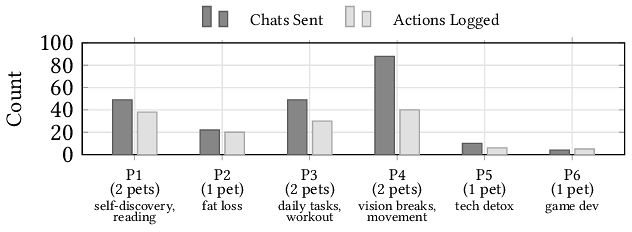
A grouped bar chart showing per-participant chats sent and actions logged during the PET deployment.
Care-loop engagement and daily return. The HP/XP mechanics were, by every account, the main reason participants came back each day. P2 described the pull directly: “When you type something that's towards the habit, you see the HP get added, you see XP get added — I find that really satisfying [...] that is what would keep me hooked on the app.” P1 reported a strong sense of achievement: “I feel like a great sense of achievement watching [...] the XP grow,” and an emotional reluctance to disengage: “I don't want [it] to die.” P3 similarly noted, “I feel like I have formed a connection, at least to try and keep it alive,” and valued seeing the HP and XP update in real time as “visual confirmation that you're actually upgrading the pet.” In the open-ended survey, P2 drew an explicit comparison to Duolingo's streak system: “doing it to keep the streak alive (external reward) instead of doing it because I enjoyed the process (internal reward).” This pattern is consistent with the reciprocal dependency effect documented in prior virtual pet work [1, 4].
Real-world behavioral impact. PET also changed how participants acted outside the app. P2 described how HP decay directly motivated action: “What pushed me the most was knowing that its HP would drop [...] I need to read a couple more pages, so I have something to [report] when I talk to my AI companion.” P1 reported exercising more while using PET, noting that the XP differentiation between activity types encouraged additional effort. P2 also highlighted that PET recognized adjacent behaviors: “Usually with a lot of other habit trackers they kind of just click a checkmark, but here I can specifically write how I improved towards my goals [...] I can also write about something adjacent [...], and the pet would react to that in a positive light. So I really love that feature.” P3 described a moment where the companion proactively suggested a complementary activity: “It would push me to do a recovery stretch for my workout, which was helpful because [...] that's not something I would have thought of [...] when it provides other alternatives for you to do, that could be good for your daily tasks and your motivation.” Natural-language check-ins clearly let users report a richer picture of their progress than a simple checkbox would.
Companionship and emotional connection. Some participants talked about their PET companion less like a tool and more like a partner. P1 characterized the companion as “a partner, not only a pet,” and used it not just for check-ins but for advice: “I can ask [it] for recommendations, like what should I [eat] for my dinner.” In the exit survey, P1 wrote: “I feel like I am accompanied when I try to accomplish my goals. Like I feel like something is staying with me.” P2 found that the generated companion image served as a mnemonic anchor beyond the app itself: “There's that image attached to the habit. It's a lot easier to remember to do it, kind of like Duolingo.” P1 described the generated golden retriever companion as looking “like a real one,” while their second companion — a dragon in a castle, generated for a reading goal — illustrated how generative personalization can produce companions unconstrained by physical-world possibilities (“that's pretty neat, that's cute”). P4 appreciated the aesthetic variety: “the aesthetic is pretty good [...] I like that you can pick different art styles.” P2 was also pleasantly surprised by the companion's animations: “I wasn't expecting it to move [...] it was just really cool. I love that.” For these participants, the personalized character clearly mattered.
Usability. PET received a mean SUS score of 84.38 (SD = 10.63), indicating acceptable to above-average usability [5]. Participants described onboarding and pet creation as intuitive, and P3 noted that suggested quick replies made daily check-ins faster.
4.2 Limitations and Future Work
This initial study involved a small, undergraduate sample over seven days; longer deployments with more diverse participants are needed. Future PET versions should combine generative AI with user-guided selection to strengthen ownership, improve memory and tone matching to reduce repetitive replies, and add visual evolution so sustained effort produces visible companion growth.
5 Discussions & Conclusions
PET's main contribution is not simply that it is a visual + conversational agent, but that it gives the perosnal goal a pet-like behavioral stake. Prior work shows that rule-based and LLM-based companions often lose engagement after novelty fades [6, 10]. In PET, participants described HP and XP as the reason they returned, while conversation made those mechanics feel relational. The care loop therefore works as a re-engagement scaffold, and dialogue turns that scaffold into companionship.
PET reframes goal support as an evolving structure for traversing linked personal data: self-description, generated companion identity, daily action traces, HP/XP state, memory, and narrative feedback. For agentic media, this suggests that future systems should make these links inspectable and adjustable, so users can understand why a companion behaves a certain way and retain agency over the personalized structure being built around them.
Generative personalization was promising but incomplete. For some participants, the generated image and lore created attachment and made PET feel like a partner. For others, the companion felt less owned because they had little control over the outcome. A stronger approach may be hybrid: let generative models propose a distinctive identity, but let users steer key traits, aesthetics, and personality dimensions.
Finally, natural-language check-ins changed what could count as progress. Participants could report partial, adjacent, or unplanned actions that would not fit a fixed checklist. The open challenge is to preserve this flexibility while improving memory, reward transparency, and response specificity over longer deployments.
Conclusions. We built PET to test whether a personalized, generative virtual companion with care-loop mechanics could keep users engaged and drive goal-directed behavior over time. Our 7-day deployment provides initial evidence on both research questions. For RQ1, participants came back daily to maintain their companion's HP, and the mechanic translated this into short-term impact: reading more, exercising more, and picking up habits they would not have tried otherwise. For RQ2, personalization was more nuanced. Some participants felt a genuine connection to their generated companion and described it as a partner; the personalized image served as a mnemonic anchor for daily habits. Others wanted more control over the creation process, suggesting that a hybrid approach (combining generative AI with user-guided selection) could strengthen identification. Overall, PET offers an initial model for hyper-personalized companion systems in which generated identity, behavioral traces, and conversational interaction are linked into an evolving goal-support experience.
Source
Imported from ACM’s structured HTML source. ACM Reference Format: Qiming Sun and Sharon I-Han Hsiao. 2026. Hyper-Personalized Virtual Companion: Generative Tamagotchi to Cultivate Personal Goals. In 37th ACM Conference on Hypertext (HT '26), September 14--18, 2026, London, United Kingdom. ACM, New York, NY, USA 5 Pages. https://doi.org/10.1145/3800935.3830854
References
[1] Sun Joo Ahn, Kyle Johnsen, James Moore, Scott Brown, Melanie Biersmith, and Catherine Ball. 2016. Using virtual pets to increase fruit and vegetable consumption in children: A technology-assisted social cognitive theory approach. Cyberpsychology, Behavior, and Social Networking 19, 2 (2016), 86–92.
[2] Nele Albers, Beyza Hizli, Bouke L Scheltinga, Eline Meijer, and Willem-Paul Brinkman. 2023. Setting physical activity goals with a virtual coach: vicarious experiences, personalization and acceptance. Journal of medical systems 47, 1 (2023), 15.
[3] Jordan Barria-Pineda, Kamil Akhuseyinoglu, and Peter Brusilovsky. 2023. Adaptive navigational support and explainable recommendations in a personalized programming practice system. In Proceedings of the 34th ACM Conference on Hypertext and Social Media. 1–9.
[4] Manon Berney, Abdessalam Ouaazki, Vladimir Macko, Bruno Kocher, and Adrian Holzer. 2024. Care-based eco-feedback augmented with generative AI: fostering pro-environmental behavior through emotional attachment. In Proceedings of the 2024 CHI Conference on Human Factors in Computing Systems. 1–15.
[5] John Brooke. 1996. SUS – A quick and dirty usability scale. Usability evaluation in industry 189, 194 (1996), 4–7.
[6] Rodrigo Calvo, Heting Wang, Alexander Barquero, Xuanpu Zhang, Rohith Venkatakrishnan, and Jaime Ruiz. 2025. Exploring Interactions with Companion Virtual Agents. In Proceedings of the 13th International Conference on Human-Agent Interaction. 274–283.
[7] Thiago Narak C De Oliveira, Juliana Amaral De Figueiredo, and Maria Andréia Formico Rodrigues. 2024. A Tamagotchi-style game for interactive thyroid cancer care and education. In 2024 IEEE 12th International Conference on Serious Games and Applications for Health (SeGAH). IEEE, 1–8.
[8] Bruce Ferwerda and Michael Lee. 2019. Tamagotchi++: a serious, personalized game to encourage healthy behavior. In 24th International on Intelligent User Interfaces (IUI), March 16-20, 2019, Los Angeles, USA, Vol. 2327. CEUR-WS.
[9] Christopher Groening and Carmen Binnewies. 2019. “Achievement unlocked!”-The impact of digital achievements as a gamification element on motivation and performance. Computers in Human Behavior 97 (2019), 151–166.
[10] Khe Foon Hew, Weijiao Huang, Jiahui Du, and Chengyuan Jia. 2023. Using chatbots to support student goal setting and social presence in fully online activities: Learner engagement and perceptions. Journal of computing in higher education 35, 1 (2023), 40–68.
[11] Jinkyu Jang and Jinwoo Kim. 2020. Healthier life with digital companions: Effects of reflection-level and statement-type of messages on behavior change via a perceived companion. International Journal of Human–Computer Interaction 36, 2 (2020), 172–189.
[12] Martin Kocur, Melanie Kloss, Christoph Schaufler, Valentin Schwind, and Niels Henze. 2025. Investigating the impact of customized avatars and the proteus effect during physical exercise in virtual reality. In Proceedings of the 2025 CHI Conference on Human Factors in Computing Systems. 1–18.
[13] Christine Lisetti, Reza Amini, Ugan Yasavur, and Naphtali Rishe. 2013. I can help you change! an empathic virtual agent delivers behavior change health interventions. ACM Transactions on Management Information Systems (TMIS) 4, 4 (2013), 1–28.
[14] Rita Orji, Gustavo F Tondello, and Lennart E Nacke. 2018. Personalizing persuasive strategies in gameful systems to gamification user types. In Proceedings of the 2018 CHI conference on human factors in computing systems. 1–14.
[15] Dominik Siemon, Timo Strohmann, Bijan Khosrawi-Rad, Triparna de Vreede, Edona Elshan, and Michael Meyer. 2022. Why do we turn to virtual companions? A text mining analysis of Replika reviews. (2022).
[16] Timo Strohmann, Dominik Siemon, Bijan Khosrawi-Rad, and Susanne Robra-Bissantz. 2023. Toward a design theory for virtual companionship. Human–Computer Interaction 38, 3-4 (2023), 194–234.
[17] Danai Vachtsevanou, Jérémy Lemee, Raffael Rot, Simon Mayer, Andrei Ciortea, and Ganesh Ramanathan. 2023. HyperBrain: human-inspired hypermedia guidance using a large language model. In Proceedings of the 34th ACM Conference on Hypertext and Social Media. 1–5.
[18] Fei Zhou, Yifan Lin, and Jian Mou. 2024. Virtual pets’ cuteness matters: A shared reality paradigm for promoting internet helping behaviour. Technological Forecasting and Social Change 202 (2024), 123308.
Do you like what you are reading? Subscribe to receive updates.
Unsubscribe anytime