
Abstract
This paper introduces phantom links: indexical, intratextual references that point to specific elements within a text or story without providing an explicit navigational pathway. As intentional but unanchored links, phantom links occupy a position between pattern-based intratextuality, which distributes meaning through repetition and thematic recurrence, and hypertextual links. Neither framework adequately describes relations that are directional yet unresolved, precise yet unencoded. Phantom links fill this conceptual gap.
Phantom link structures are abundant in the anchor texts of hypertext fiction and in the long tradition of non-linear, proto-hypertextual storytelling found in world literature, from ancient Indian narratives and eighteenth-century picaresque novels to contemporary collaborative fiction. Some works of hypertext fiction, such as Blok by Sławomir Shuty, originated from authorial phantom links that were later hypertextualised. The paper also proposes a model for identifying proto-hypertextual structures in world literature through a process that combines statistical analysis, human interpretation, and AI-assisted methods. The model highlights the limits of computational link detection, even when AI is incorporated into the analytical process.
1 Introduction
Phantom links are non-explicit hypertext structures found within a single work or a body of works that share a referential frame. A single phantom link is an indexical expression without a visible anchor that points to an element placed elsewhere. In Olga Tokarczuk's House of Day, House of Night (2002), a mention of "that wild rose wine that Marta makes" points to an earlier or future occurrence of Marta's wine across interconnected short stories[27]. A phantom link satisfies three criteria: (1) indexical specificity – it points to a particular element within the story rather than a general thematic pattern; (2) reader activation – the connection must be recognised and possibly reconstructed by the reader; and (3) non-resolution – no explicit navigational mechanism is provided.
In Stuart Moulthrop's Victory Garden, a densely linked hypertext fiction from 1991 [16], many link anchors linguistically foreground the direction of the link and point to its destination ("somewhere in Saudi Arabia", "what we don't see that counts", "we depended on that", "before my time"). The semantics of the text – "before my time" – go hand in hand with the mechanics of the link: a jump to a lexia that describes the antiwar activist youth of the protagonist. Phantom link are made of similar indexical expressions, lyrical or transparent [28], but the activation of a connection is not prompted by an explicit label and is not followed by an actual link activation and arrival.
Charles Sanders Peirce's semiotic theory distinguishes between three fundamental types of signs: icons, symbols, and indices. Icons rely on resemblance, symbols on convention, and indices are defined by a direct or existential connection to their object. An index does not merely resemble or represent; it points. Phantom links operate through this indexical power of language, but are distinct from the function that Peirce attributes to proper names and coreferential pronouns. They can hold names – for example, "a good carpenter, Cash is" – yet they operate on a wider connotative range (Cash as a carpenter, a good carpentry by Cash) and act almost as question marks that readers feel compelled to answer: in this case, to find out more about Cash and the quality of his work. Phantom links should not be confused with deictic and indexical expressions, which in the theory of language function as "fields for pointing" at objects, characters, and timelines [6], although they often overlap with them. A single work may contain seven thousand deictic expressions [19], yet only a small number will qualify as phantom links.
As a special perspective on writing and knowledge management in general, some hypertexts live outside established systems. Jill Walker Rettberg described feral hypertexts [31]: structures that live in the wild, "moving beneath the radar," unrecognised as hypertexts. Phantom links are more elusive still. They require close reading and some competence: the reader's knowledge of a fictional world, a shared timeline, or a body of lore distributed across narrators or editions. Phantom links support, reveal, and fortify this type of structure.
Why would hypertext research need phantom links? The introduction of this new category of links can help fill the gaps in studies on proto-hypertext traditions, draw clearer borders between intra-, inter-, and hypertextuality, and – by engaging hypertext methods as a step in inquiry – share new insights within the broader, interdisciplinary fields of world literature studies, narratology, and literary history.
2 Background
Just as Vannevar Bush's memex is considered a proto-hypertext of hypertext systems [3], a portion of literary culture — from ancient and medieval epics to contemporary fiction and philosophy — is considered proto-hypertextual. As hypertexts avant la lettre [5], pioneering non-linear, node-link storytelling is found across individual traditions. The examples include generative composition rules in the Roman poetry genre of cento, spatial and combinatorial poems in German Baroque, and Polish early hypermedia writing in the genre of silva rerum[21]. Some authors have identified proto-hypertext in individual non-fictional works such as Wittgenstein's Philosophical Investigations, Walter Benjamin's Arcades Project (1927–1940), [17] or Jacques Derrida's Glas, or in pre-hypertext novels from The Life and Opinions of Tristram Shandy to Vladimir Nabokov's Pale Fire.
The discussion has revealed a methodological question that remains open. The classification of certain works as proto-hypertexts may be challenged as a form of retrospective interpretation that projects concepts developed in the digital era onto earlier literary and narrative forms. Within the category of proto-hypertexts, some scholars include non-fictional manuscripts that exhibit index-card or database-like paradigms of writing, while others require the presence of an actual linking apparatus. The designation of earlier works as hypertexts may be disputed as a “retrospective anachronism” [10], an unnecessary appropriation, or even a form of “imperialist classification” [1]. The criteria for identifying proto-hypertexts remain unclear. Krapp identifies a paradox underlying such classifications: if hypertext is found wherever annotations, glosses, and internal indexing are present, then where does the novelty of hypertext—and the analytical method it offers—actually reside? [10]
The most obvious location for phantom links is the domain of intratextuality. When approaching the life's work of a single author, the intratextual method works with a system of internal patterning that produces coherence through "repetitions of language, imagery, or idea," and structures such as "continuities, discontinuities, [and] juxtapositions" [8]. In Virgil's Georgics (29 BCE), for example, the recurrence of agricultural imagery and lexicon across books creates coherence through variation. A term such as boves (cattle) reappears in different contexts, accumulating meaning without pointing to a single referential instance. Similarly, in Catullus’ poems (1st century BCE), sound patterns and refrains create what Gail Trimble describes as "echoes" [30]. These mechanisms depend on recognition rather than retrieval: they engage memory but do not direct the reader toward a specific prior passage.
Intratextuality operates as a system of distributed resonance governed by pattern and structural recurrence. Intertextuality, on the other hand, describes relations between texts and positions a work within a network of prior cultural objects. George Landow extended Julia Kristeva's logic of intertextuality into hypertext, where the link operationalises the intertextual connection [11] — making the relation explicit, encoded, and navigable.
Phantom links occupy a third position: they are intratextual rather than intertextual, and indexical rather than operational, inscribing a directional force — or gravity — into specific words and phrases without encoding a visible anchor. They can be approached as a transitional category between intratextual pattern and hypertextual operation. They retain the interpretive openness of the former while approaching the structural specificity of the latter. What distinguishes them is not ambiguity, but the presence of a directed yet incomplete relation: a link that is clearly felt but not given in the sense that a hypertext practitioner might expect.
Finally, authorial design and intention are prerequisites of phantom links — without them, an indexical expression remains merely deictic.
3 Phantom links in literary tradition: classification table
Intratextual hints and clues, which are central to puzzle, mystery, and crime fiction, draw on the associative power of language. Associations and allusions have long been hallmarks of literary fiction. Yet some of the most notable works of world literature emphasize the indexical power of language, making repeated references to selected portions of the narrative a deliberate part of their artistic strategy.
In William Faulkner's The Sound and the Fury (1929) and As I Lay Dying (1930)[7], fragmented narrations distribute events across multiple perspectives. Characters, events, and references recur, but in linguistically, stylistically, and discursively altered forms. In Alain Robbe-Grillet's La Maison de rendez-vous (1965)[24], internal links point to whole episodes and scenes — such as the recurring image of an "Eurasian girl leading a large black dog on a leash, standing" — which the reader must bind together to achieve coherence and apprehend the interplay of echoes, clues and multiple points of view [14, p.240]. Fragmentation, discontinuity, and recurrence are also prominent in Olga Tokarczuk's House of Day, House of Night. Described as a "constellation novel", it binds loosely connected narrative fragments told by a third-person narrator morphing into free indirect speech. Recurring motifs and objects reappear across sections. Critics warned readers to "hold the entirety of the book in [their] head at all times" in order to perceive relations that may remain unmarked, can be missed, but are detectable. The text operates as a mycelium [12]: a network without links.
A fascinating example of phantom links made the subject of authorial meta-reflection can be found in The Manuscript Found in Saragossa (1810) by Jan Potocki, a frame-tale novel written in French at the turn of the eighteenth and nineteenth centuries. It consists of 36 stories spread across 66 chapters and told by more than 20 narrators. At a certain point in the middle of the novel, one of them, Don Pedro de Velasquez, voices his confusion about the last story told, and other narrators chime in [22]:
I have tried in vain to concentrate all my attention on the gypsy chief's words but I am unable to discover any coherence whatsoever in them. I do not know who is speaking and who is listening. Sometimes the Marqués de Val Florida is telling the story of his life to his daughter, sometimes it is she who is relating it to the gypsy chief, who in turn is repeating it to us. It is a veritable labyrinth. I had always thought that novels and other works of that kind should be written in several columns like chronological tables. ’You are right,’ said Rebecca. ’One would find in one column, for example, the story of the Marquesa de Val Florida being unfaithful to her husband, in the other the effects this event had on him. That would no doubt clarify the story.’
In the same fashion as his contemporary Laurence Sterne in The Life and Opinions of Tristram Shandy, Gentleman, Potocki identifies connections that need better material or symbolic support than that offered by print to manifest, and advocates for augmentation methods not yet known or imagined, apart from the proposed system of tables. A more recent example can be found in Fourteen Days: An Unauthorized Gathering (2024), edited by Margaret Atwood and Douglas Preston [2]. Set in a New York apartment building during lockdown, the novel presents discrete stories linked by shared space, shared experiences such as 9/11, and sometimes shared characters that return as nodes in a growing network of relations. Most of the indexical expressions connect narrators, not stories: "the tenant in 4C whom Vinegar had trashed the night before" refers to the acts of telling the stories, not the stories themselves. But there are also deeper phantom links that reach the story level and connect stories via narrative content: "Where the hell did she get money for that, living in this dump", for example, refers not only to a neighbour who will be telling her story, but also to her as the protagonist in someone else's story.
Table 1: Typology of Internal Textual Relations
Type | Characteristics | Description |
|---|---|---|
Indexical Reference | Specific, directional | A word / phrase that points to a particular name, event, location. Conventional sign of directed reference. |
Echo | Implicit, non-indexical | Repetition of language, imagery, motifs. Readers recognize similarity rather than retrieve a specific prior instance. |
Pattern | Distributed, thematic | Recurring themes, symbols or narrative structures that create unity through repetition and variation. |
Hint | Suggestive, open-ended | A localized signal drawing attention to a potentially significant element. May remain suggestive rather than decisive. |
Clue | Specific, resolving | An indexical signal embedded in a puzzle structure. Requires reconstruction and is ultimately exhausted once the mystery or problem is solved. |
Phantom Link | Explicit, activating, unresolved | Points to a specific element elsewhere in the text but provides no explicit path and no definitive closure. Recognition activates interpretation. |
Word that Yields | Semi-explicit, activating | Michael Joyce's term for words and phrases in afternoon, a story that function as latent gateways [9]. They may or may not turn out to be hypertext links. |
Hypertext Link | Explicit, operational | A formally encoded connection between textual units. The relation is externalized into the interface and can be followed directly without reconstruction. |
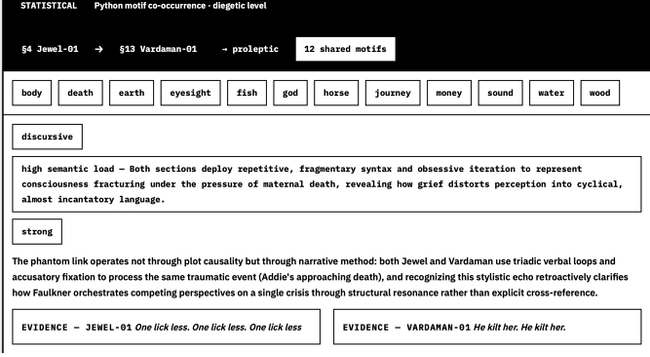
Fourteen Days offers a clear distinction between diegetic phantom links at the level of story, or fabula, and discursive phantom links at the level of syuzhet. Written by a group of more than 30 authors from the American Authors’ Guild Foundation, with individual contributions intentionally left unmarked across 14 chapters, the book invites readers to explore cameo appearances and Easter eggs that may help connect events and characters. A diegetic phantom link operates within the fictional world and depends on the reader's accumulated knowledge of characters, places, and objects. It maps connections at the fabula level: the story and storyworld itself. A discursive phantom link connects voice, focalization, temporal arrangement, and meta-commentary. It marks references made by one narrator to another. Finally, we can speak of an extradiegetic phantom link that points beyond a particular work to other works by the same author or within the same series of stories.
These three levels point to three variables: depth, or how deeply within the discourse, telling, and story the link resides; frequency, or how often the link occurs; and semantic load, or what new information the link contributes to the accumulated knowledge of a given object, person, or event.
4 Phantom links in hypertext theory and practice
In the realm of hypertext fiction, phantom links have several affiliates. In early Storyspace, by default, visible words on a screen were not marked as links, and only after selecting the OPT + CMD ("Tinker and Bell" keys) were the anchors of actual links revealed. In combination with a default link mechanism (a basic link that connected not words but lexias) this resulted in layers of ambiguity: without activating the special keys, each word was potentially a link. Even if it wasn't, clicking on it would still take the reader along the default path, reserved for any unanchored word, and trigger an interpretation of that particular traversal step. Defaulting on unmarked, unanchored links made Storyspace a space for hermeneutic game: the user never knew if an "active" word was active on the run-time layer or on the interpretative layer of expectations, assumptions, and meaning-making. Phantom links, as intentional referrals to other parts of the story, should be the best candidates for anchored text, but the playfulness of the "words that yield" [15] paradigm may not necessarily render them as such.
Another hypertext affiliate to the phantom link is the concept of bidirectional links. A bidirectional link works in both directions, allowing for automatic back-referencing and two-way navigation. It can have multiple sources or targets and point to specific parts of resources [26]. Although on the web the concept remains somewhat underimplemented [20], its place in hypertext research is undisputable. Phantom links also point in several directions at once. This is highly visible in As I Lay Dying, where the actions of two characters — Cash's sawing wood for a coffin, and Dewey Dell's using a fan to cool her mother in bed — are referred to in various places by various characters. For Cash, these referrals include: "He looks up, still sawing", "from here he cannot even hear Cash sawing", "he stays out there, (...) hammering and sawing on that goddamn box"; for Dewey Dell: "The girl is standing by the bed, fanning her", "near-naked girl always standing over Addie with a fan", "The fan still moving like it has for ten days". Because the two actions are continuous and different narrators contribute new information about the act of coffin-making and fanning, upon encountering another mention the reader may direct their attention to any of the occurrences of Cash's sawing and Dewey Dell's fanning. The connection that is made travels in all directions, with bidirectionality as a mechanism for individual reference. In this way, phantom links reinforce the network of accumulated knowledge, but the referential gravity is not necessarily directional, but circles around a specific event in the story.
A fascinating case of phantom links made hyperlinks, and a great example of the bidirectionality of emergent networks that phantom links facilitate, can be found in the Polish hypertext fiction Blok by Sławomir Shuty (2002) [25]. The collective protagonists of the fiction are tenants of a ten-storey block of flats in Kraków's post-industrial, post-communist district of Nowa Huta. There are three flats per floor, and — in contrast to Fourteen Days, which was set in New York — most tenants know each other too well. Gossip is a mode of communication and connection between the many protagonists and the third-person, whimsical, ironic narrator. The poetics of gossip translates into the linking structure of the hypertext. Yet most of the links tend to loop in small circles, bouncing from the destination back to the origin. When reading about the Paruch family, the reader is informed that Staszek has "a heavy hand, especially after a few drinks. And drink he does — he's always had a weakness for vodka." "Drink he does" links to a segment beginning with: "Staszek drank on Maundy Thursday and on Good Friday — truth be told, on every holy day. And on the ordinary ones as well." The whole sentence leads back to the Paruch family sequence, the exact same segment that led here. This pattern prevails throughout.
The reason for such an odd bidirectionality of links in Blok may be gossip as an allegory of narrative structure. But the initial idea for such linking came at the editorial stage. In 2001, Shuty, as the author of a successful print novel Cukier w normie, agreed to use leftover material and accompanying texts for an online project — a hypertext fiction. When the author asked the editors how to link the material, he was told to look for interesting places in the text that would lead to another story where a similar object, motif, or person occurs. The resulting list of phrases that became link anchors was at least half comprised of indexical referrals to specific sections: "when her husband didn't come home that day", "Aunt Halinka got herself a perm for the occasion", "They beat the young man to death". All of these examples pose a question, which is answered when the reader activates the link. After arriving at the destination, it was safe to direct the reader back to where they came from. After turning into hypertext links, phantom links lost their ambiguity and multi-directionality, but reinforced the rhythm and global coherence.
5 Phantom Link Detection: A Model
Computational detection of phantom links is possible, and the current arsenal of available tools, in the age of affordable LLMs, is wider than ever. A successful result of such automated detection mechanisms would be a list of nodes and links ready for further hypertext processing. Phantom link detection should function as a workflow subordinate to a set of available hypertext methods. The working thesis of this article is that computational, or even "computAItional", detection is far from optimal, and points to general shortcomings of text mining, stylometric methods, and AI-enhanced inquiries. These methods tend to be distracted by the linguistic layer to a point that brings more noise than information into the process of identifying and preparing phantom links for a hypertext method. In other words, they have a fundamental problem immersing themselves in the story. Instead of connecting words to the story from within the fabula level, they connect words with words (statistical methods), and occasionally words with story (AI methods), but rarely are these these words and phrases "yield" more than a dictionary style of referencing. For "computAItional" detection, the WHAT of the work will always be the linguistic layer of text, whether as a pool of textual statistics data or a generative matrix of neural network mapping – rarely the narrative content.
Nevertheless, a broad implementation model can be helpful as a framework for future versions with more precise methodologies. To ensure that computational and hermeneutical aspects complement each other, three interdependent protocols, or "loops", are at work. The process starts with some editorial pre-commitment. Original, authorial segmentation helps. Human supervision over the workflow further refines and frames individual investigations. LLM models arrive to fill the gaps and identify link candidates that might otherwise be missed.
5.1 The Statistical Loop
The statistical loop surfaces distributional patterns. Its scope and sensitivity are modulated by editorial parameter choices (stop-word extension, distance threshold, maximum features cap). Two procedures run in parallel. The first — TF-IDF weighting — measures how distinctive each word is to a given narrator section relative to the rest of the text, foregrounding thematically significant vocabulary. The second — agglomerative clustering — groups words that consistently co-occur into thematic constellations. Both procedures are well established in computational linguistics and implemented here via scikit-learn, a widely used Python library for machine learning and text analysis. After editorial review, the curated files are reprocessed by a second order of scripts that apply the human's decisions — labelled themes, approved links — back onto the text, producing a new round of statistical output. The cycle can then repeat: the second-order statistics may prompt the editor to revise labels or remove further false positives, sending the data through the loop again.
5.2 The Human Loop: Editorial Workspace
After the statistical loop completes its two automated procedures, the results are written to structured files that become the editor's workspace, presented in an HTML interface for candidate tagging. The Phantom Link Candidates Selection Interface — a single HTML file — is where all editorial work occurs. The human loop comprises three distinct editorial tasks. The first is cluster labelling. The editor creates a motif vocabulary — a hand-curated list of semantic fields (death, water, the body, the journey, kinship, and others) — that defines what the system should recognise in subsequent passes. This curation step prevents generic vocabulary such as "hand" or "road" from dominating results. The motif vocabulary becomes a configuration file fed back to the statistical loop when needed. The second task is link candidate curation. The editor reviews each candidate, expanding cards to examine the proposed connection in the wider context of a given text passage. For each candidate, the editor decides to approve, reject, or flag for further review. The third task is hand-authored connection discovery, where the editor's own found phantom links are processed according to the same rules.
The human loop does not override the computational loops; it curates and informs them, holding authority to define the scope of what counts as a phantom link in this particular text, maintaining the highest permission level of all, even though the statistical and AI loops can have their own correcting subroutines.
5.3 The "ComputAItional" Loop
The third loop introduces a large language model as a specialised agent focused on the systematic extraction and validation of expressions, and on identifying indexicals: demonstratives, spatial and temporal deixis, and incomplete references that open unanswered questions in the reader's mind. The AI loop is implemented as a function that queries the Claude API with a two-part prompt. The function operates on individual narrator sections, returns JSON-formatted candidates, and validates them against the source text. All prompts are maintained in a Python script and their content is accessible to the human editor. The loop identifies markers such as "the yellow road" or "the hand of the Lord" and makes them phantom link candidates ready for review, with accompanying commentary, numeric metadata, and other paratexts. The AI loop does not revolutionise the method, but it transforms what the statistical and human loops can accomplish through systematic extraction at scale. For As I Lay Dying, with 59 narrator sections, the loop extracted 11,648 deictic expressions. These were clustered into 489 phrases, which were in turn filtered to yield 355 high-confidence anchors. Correcting prompts to exclude extradiegetic references — Claude excels at intertextuality, such as biblical references — and to leave thematic patterning to the statistical loop, resulted in 38 phantom link proposals that could be accepted as candidates.
Even with API automation and the buffering secured by role-playing and restrictive prompts, the results are mixed. The model is convinced that its method works, yet the "successful" outputs — "the yellow road" (Darl-05), "the red road" (Darl-10), "the dead eyes" (Darl-13), "his pale eyes" (Darl-01), "the white man" (Darl-18), "the hand of the Lord" (Vernon-02), "the door with the lamp" (Vernon-02) — are not phantom links that matter. Most of the time they remain at the grammatical and stylistic level, and do not point to prominent or — in the case of Faulkner — obsessively recurring motifs.
The contribution of the AI loop to phantom link detection, apart from scale, lies mainly in maintaining a candidate scaffolding for editors in the role of assistant editor. By providing anchors with context and specificity scores, the loop accelerates the editor's ability to identify destinations and create verified phantom links in places that might still be missed in close reading. AI is also an excellent commentator on the findings of the statistical loop and its own proposals, uncovering possible new avenues of investigation within the study of a single work or a single author.
6 Discussion: Phantom Links and Hypertext
A main objection to the idea of introducing phantom links points to the validity of the proposal. Do we really need phantom links, on top of all the other link types? Placed between grammatical pointers (deixis) and anchored links, between intra- and hypertextuality, they may seem covered by either of these fields as their edge exemplars. However, there is a surplus of meaning intentionally encoded in them, and a triggering mechanism for exploratory signification — a dynamic meaning-making that goes beyond simple, by definition conventional, sign production.
As such, phantom links contribute to the semantics of links, but with this comes another benefit: they can reveal aspects of reading and writing that may previously have been overlooked. There are specially turbocharged kinds of deictic expressions — hyper-deixis — that, like phantom links, can help us discover networks of a reading mind that can be captured and prepared for further hypertext evaluation. Phantom links analysis can also be a step in critical readings of hypertext fiction: list all anchors in a hypertext fiction and determine whether the actual linking strategy aligns with its phantom link network. In the case of alignment, one may conclude that the hypertext narrative follows the natural semantic potential of its anchors. If there is no alignment, the work goes against linking affordances and against the reader's habits or linguistic economy — with the poetic function and defamiliarization as the dominant.
A possible objection to the phantom link concept is that it resembles the clue structure of detective fiction: both clues and phantom links are indexical and direct the reader toward specific elements within a text. In Agatha Christie's or Arthur Conan Doyle's works, details such as footprints, letters, or seemingly incidental remarks point to specific events within the narrative. But clues are embedded in a teleological structure: each reference contributes to a final reconstruction, and its meaning is exhausted once the puzzle is solved. The reader integrates these elements into a single explanatory structure. Phantom links, on the other hand, are non-obligatory. They may be activated by the reader but are not required for the progression or completion of the text. Their function is not to resolve uncertainty but to sustain it. The question they generate — why this element points to that one, at this moment in the text – does not admit a single answer. Instead of closing down interpretation, phantom links reopen it, persisting as sites of ongoing relational tension across multiple readings.
Phantom links, as links without marked anchors, provide an interesting border case for link semantics and typology. Firstly, they are not designed to offer a choice [4]. The narrative fork they provide is very subtle: a signal that the same element is worth mentioning again or will be elaborated later. Secondly, they are not jump links, and are in fact much closer to Ted Nelson's transclusion [18] than perhaps any link on the screen, because the surplus of meaning they carry is accumulative and sequential. Phantom links embed the content from a different location into the current location, fulfilling the rule of context preservation built into transclusion [23]. From the four main types of narrative links that Mason and Bernstein present — Timeshift, Recursus, Renewal, and Annotation — phantom links can function as any, but on an interpretative, and not mechanical, level. To be more tangible, and less metaphorical, they should be seen from more general levels of hypertext link theory, where — just as any other link — they illustrate the rule that every link communicates "a presumption of its own optimal relevance" [29] to not interrupt the flow of meaning but to enliven it. This brings phantom links close to the cognitive pragmatism of non-fictional and argumentative hypertexts [13]: as a vehicle for narrative referencing and rhythm, they bring coherence rather than surprise.
Finally, phantom links identify a gap in current research on hypertext links. By focusing on explicit links and navigational systems, the field risks overlooking forms of connectivity that operate without formal encoding. Recognising these types of links opens up whole new avenues of inquiry into the proto-hypertextual past. The obsessive returns to the same characters performing the same actions that As I Lay Dying illustrates make William Faulkner a master of linking structures in traditional prose. If so, Faulkner's novels can contribute to hypertext theory even today.
7 Conclusion
Future research should pursue three directions. The first is large-corpus application: bodies of work sharing a stable referential frame — Terry Pratchett's forty-one Discworld novels, with their recurring characters distributed across decades of fiction, are an obvious candidate — offer the scale at which phantom link networks become mappable and their density measurable. The second is extension to digital and interactive systems, where the coexistence of explicit and implicit linking creates new analytic possibilities. The third is empirical reader-response research, to test whether the activation of phantom links produces measurable effects on reading experience and narrative comprehension.
This paper has defined phantom links as indexical, intratextual connections characterised by specificity, reader activation, and non-resolution. It has proposed a two-axis typology organising phantom links by depth — discursive, diegetic, and extradiegetic — and by strength, determined by frequency and semantic load. It has also presented an implementation model demonstrating that computational detection of phantom links is possible, partial, and productive in exposing the boundaries of what automated tools can and cannot reach.
Phantom links may help contemporary audiences stand apart as distinctively human readers and writers who are far more creative and focused than the reading and writing agents offered by large language models. Just like microtonal music – which opens a creative space that resists reduction to established scales and standards of music creation, so that AI has only limited access to it — phantom links invite a finer granularity of attention to the link itself. As a transmedial and panhistorical device, the phantom link should be here to stay. Its main asset is a surplus of meaning, constantly in search of its destinations. Its fullest form has never required an interface.
Acknowledgments
The author thanks the anonymous reviewers for their constructive comments and suggestions.
Source
Imported from ACM’s structured HTML source. ACM Reference Format: Mariusz Pisarski. 2026. Phantom Links: Filling the Gap in Link Semantics. In 37th ACM Conference on Hypertext (HT '26), September 14--18, 2026, London, United Kingdom. ACM, New York, NY, USA 7 Pages. https://doi.org/10.1145/3800935.3830888
References
[1] Espen J. Aarseth. 1997. Cybertext: Perspectives on Ergodic Literature. Johns Hopkins University Press, Baltimore.
[2] Margaret Atwood and Douglas Preston (Eds.). 2024. Fourteen Days: An Unauthorized Gathering. HarperCollins, New York.
[3] Belinda Barnet. 2013. Memory Machines: The Evolution of Hypertext. Anthem Press, London.
[4] Mark Bernstein. 2009. On hypertext narrative. In Proceedings of the 20th ACM Conference on Hypertext and Hypermedia (Torino, Italy) (HT ’09). Association for Computing Machinery, New York, NY, USA, 5–14. https://doi.org/10.1145/1557914.1557920
[5] Norbert Bolz. 1993. Zur Theorie der Hypermedien. In Raum und Verfahren. Stroemfeld/Roter Stern, Basel, 17–27.
[6] Maria-Elisabeth Conte, János S. Petöfi, and Emel Sözer (Eds.). 1989. Text and Discourse Connectedness: Proceedings of the Conference on Connexity and Coherence, Urbino, July 16–21, 1984. John Benjamins Publishing, Amsterdam.
[7] William Faulkner. 1930. As I Lay Dying. Jonathan Cape, London.
[8] Stephen J. Harrison, Stavros Frangoulidis, and Theodore D. Papanghelis (Eds.). 2018. Intratextuality and Latin Literature. De Gruyter, Berlin, Boston. https://doi.org/doi:10.1515/9783110611021
[9] Michael Joyce. 1987. afternoon, a story. Eastgate Systems, Watertown, MA.
[10] Peter Krapp. 2006. Hypertext Avant La Lettre. In New Media, Old Media: A History and Theory Reader, Wendy Hui Kyong Chun and Thomas Keenan (Eds.). Routledge, New York, 359–373.
[11] George P Landow. 2006. Hypertext 3.0: Critical theory and new media in an era of globalization. JHU Press.
[12] Anna Larenta. [n. d.]. Grzybnia jako metafora w twórczości Olgi Tokarczuk. ([n. d.]). English title: Mycelium as Metaphor in the Works of Olga Tokarczuk.
[13] Clara Mancini and Simon Buckingham Shum. 2001. Cognitive coherence relations and hypertext: from cinematic patterns to scholarly discourse. In Proceedings of the 12th ACM Conference on Hypertext and Hypermedia (Århus, none, Denmark) (HYPERTEXT ’01). Association for Computing Machinery, New York, NY, USA, 165–174. https://doi.org/10.1145/504216.504261
[14] Bruce Morrissette. 1975. The Novels of Robbe-Grillet. Cornell University Press, Ithaca, NY. 240–241 pages.
[15] S. Moulthrop. 1989. Hypertext and “the hyperreal”. In Proceedings of the Second Annual ACM Conference on Hypertext (Pittsburgh, Pennsylvania, USA) (HYPERTEXT ’89). Association for Computing Machinery, New York, NY, USA, 259–267. https://doi.org/10.1145/74224.74246
[16] Stuart Moulthrop. 1991. Victory Garden. Eastgate Systems, Watertown, MA.
[17] Stuart Moulthrop and Dene Grigar. 2017. Traversals: The Use of Preservation for Early Electronic Writing. MIT Press, Cambridge, MA.
[18] Ted Nelson. 1995. The heart of connection: hypermedia unified by transclusion. Commun. ACM 38, 8 (Aug. 1995), 31–33. https://doi.org/10.1145/208344.208353
[19] S. Nurhalimah, A. L. Hudaifah, and T. S. Rohbiah. 2025. A Pragmatic Analysis of the Deictic Aspect in the Novel Wonder by R. J. Palacio (2012). In Proceeding of Annual International Conference on Islamic Education and Language (AICIEL). 141–150.
[20] Szymon Olewniczak, Tomasz Boiński, and Julian Szymański. 2020. Towards Extending Wikipedia with Bidirectional Links. In Proceedings of the 31st ACM Conference on Hypertext and Social Media (Virtual Event, USA) (HT ’20). Association for Computing Machinery, New York, NY, USA, 239–240. https://doi.org/10.1145/3372923.3404841
[21] Mariusz Pisarski. 2010. Polish II: Silva Rerum-" A Book of Everything on Anything" as a Cybertextual Experience. Cybertext Yearbook (2010).
[22] Jan Potocki. 1992. The Manuscript Found in Saragossa. Penguin.
[23] Raine Revere and James Blustein. 2020. Transhierarchy: A stable tree view with transclusion for hypertext navigation. In Proceedings of the 3rd Workshop on Human Factors in Hypertext (Virtual Event, USA) (HUMAN ’20). Association for Computing Machinery, New York, NY, USA, Article 6, 7 pages. https://doi.org/10.1145/3406853.3434771
[24] Alain Robbe-Grillet. 1965. La Maison de rendez-vous. Les Éditions de Minuit, Paris.
[25] Sławomir Shuty. 2003. Blok. Wydawnictwo Ha!art, Kraków. https://techsty.art.pl/Blok/
[26] Beat Signer, Reinout Roels, Robert van Barlingen, and Brent Willems. 2021. Back to the Future: Bringing Original Hypermedia and Cross-Media Concepts to Modern Desktop Environments. In Proceedings of the 32nd ACM Conference on Hypertext and Social Media (Virtual Event, USA) (HT ’21). Association for Computing Machinery, New York, NY, USA, 277–282. https://doi.org/10.1145/3465336.3475122
[27] Olga Tokarczuk. 2003. House of Day, House of Night. Northwestern University Press, Evanston, IL.
[28] Susana Pajares Tosca. 1999. The lyrical quality of links. In Proceedings of the Tenth ACM Conference on Hypertext and Hypermedia : Returning to Our Diverse Roots: Returning to Our Diverse Roots (Darmstadt, Germany) (HYPERTEXT ’99). Association for Computing Machinery, New York, NY, USA, 217–218. https://doi.org/10.1145/294469.294911
[29] Susana Pajares Tosca. 2000. A pragmatics of links. In Proceedings of the Eleventh ACM on Hypertext and Hypermedia (San Antonio, Texas, USA) (HYPERTEXT ’00). Association for Computing Machinery, New York, NY, USA, 77–84. https://doi.org/10.1145/336296.336327
[30] Gail Trimble. 2018. Echoes and reflections in Catullus’ long poems. (2018).
[31] Jill Walker. 2005. Feral hypertext: when hypertext literature escapes control. In Proceedings of the Sixteenth ACM Conference on Hypertext and Hypermedia (Salzburg, Austria) (HYPERTEXT ’05). Association for Computing Machinery, New York, NY, USA, 46–53. https://doi.org/10.1145/1083356.1083366
Do you like what you are reading? Subscribe to receive updates.
Unsubscribe anytime