
Locative play and augmented reality games are a growing part of consumer games, thanks to successful mobile experiments such as Niantic’s Ingress and Pokemon GO. However, while experiments in using locative play to transform a space have been ongoing in the context of campuses, libraries, national parks, and other tourist destinations, such games reach a limited audience and are still viewed as novelties. The growing movement to bring this type of play into theme parks has the potential to change that, as locative augmented reality games such as Disney’s Galaxy’s Edge experience and Play Disney app gesture to a broader commercial future for locative interactive narrative. In this essay, we document how these commercial games experiences are transforming both guest expectations of theme parks, and broader understandings of locative play.
CCS Concepts
• Computer Games • Media Arts • Performing Arts
Keywords
Augmented Reality (AR); mixed reality; immersion; transportation; Alternate Reality Game (ARG); transparent interface; disruptive technology; theme parks
Ray Eddy, Carissa Baker, Robert Macy, John T Murray, and Anastasia Salter. 2020. Hacking Droids and Casting Spells: Locative Augmented Reality Games and the Reimagining of the Theme Park. In Proceedings of ACM Hypertext 2020 – HT2020 for Social Good (HT ‘20), July 13-15, 2020, Virtual Event, USA, 10 pages. https://doi.org/10.1145/3372923.3404801
1 Introduction
Digital play has invaded all physical space: while earlier generations of dedicated portable games devices (such as the Game Boy and its successors) were large, limited in their charge capacity, and required dedicated intention to carry, the reality of today’s smartphone landscape is the true realization of the “play everywhere” promise. However, most of this play has remained location-independent, and while mobile game mechanics are shaped by the needs of players traveling through space, as Shira Chess notes in her study of the pick up and put down design choices of casual games [5], they are not space-dependent. While locative play, virtual games applied to real places, has been a popular subcategory for dedicated hobbyists, it is not the norm of mobile interaction. Locative games have been a marginal category in the development of such play until Niantic’s intervention; their three iterative titles – Ingress, Pokemon GO, and Harry Potter: Wizards Unite – all demand players to move in physical spaces and interact with particular spots in order to progress. These games are often labeled as “augmented reality” (AR), an imprecise term that captures how the games combine real-world overlays with locative gameplay mechanics. We argue that this evolution in play marks a moment of convergence for locative play and theme park experience design, and that to better understand the impact of these games on how we play, we must draw on a convergent discourse considering the history of both locative play and theme park game design.
Theme parks trade in part on a relationship with guests based on positive experiences [12], and the introduction of locative and augmented play offers a potential mechanism for negotiating the increasingly crowded landscape of the park to create immersive narratives. The development of immersive experiences in theme parks in the form of AR has been impacted significantly by the massively popular intellectual properties (IPs) owned by their respective companies, notably Harry Potter at Universal Studios and Star Wars at Disney. To say that these IPs have infiltrated our own reality would be an understatement. Wildly popular books and films brought the “Harry Potter-verse” into the mainstream, and even before Lucasfilm was purchased by Disney, the stories and characters from Star Wars could be found extensively outside the movie theaters where they began. Now, action figures and toys, graphic novels and books, board games and video games, posters, t-shirts, lunchboxes, and countless other profit-generating interactions are available to the public. Some have been wildly popular, like DVDs and Halloween costumes, while others were maligned and perhaps even illadvised, such as the televised Star Wars Christmas special, but there is no denying the impact that these IPs have had on our consumption opportunities.
In addition to these, other uses of characters and storylines have provided extensive space for theme parks to present widely varied interactive opportunities. We maintain that theme parks are models of location-based narrative, with their spatial nature, essential component of place, and embodiment of “open narrative encouraging exploration” [15]. The paper will provide a survey of some of these augmented reality experiences and discuss the various ways that “players” might choose to interact with them, capturing a pivotal moment in the intersection of theme park and game experience design that offers a window into the future of immersive narrative experiences.
2 Convergence of Theme Parks and Augmented Reality
We argue that this evolution in play marks a moment of convergence for locative play and theme park experience design, and that to better understand the impact of these games on how we play, we must draw on a convergent discourse considering the history of both locative play and theme park game design. The history of play in theme parks is decidedly locative, as the theme park offers a designed environment, “imagineered” (to use Disney’s term) to portray the apparent “essence” of a historical landscape or popular culture imaginary [11]. Arguably, many of these environments invite play, whether through roleplaying character interactions or giving the visitor a sense of a role in a narrative ride that acts as a “set” for the visitors [18]. This type of environmental design has always been intertwined with the interventions of new technology and platforms: for example, theme parks have been utilizing sensors and GPS technology to provide their customers with an additional layer of experience, often drawing from their respective intellectual properties. These include the series of scavenger hunt games which have players roaming Walt Disney World’s EPCOT theme park (Experimental
Prototype Community of Tomorrow, now referred to as Epcot), or the new Datapad application examined here that allows visitors to Star Wars: Galaxy’s Edge to participate in the battle between the Resistance and the First Order. These experiences are distinguished by their use of existing mobile phones and are usually restricted in operation outside of the park. Other location-specific experiences that don’t use mobile phones include the Sorcerers of the Magic Kingdom game and Universal’s Harry Potter Interactive Wands, the latter of which allows players to take on the role of wizards casting spells in the Harry Potter theme parks lands.
In their analysis of early augmented reality narratives, Shilkrot, Montfort, and Maes suggest that storytelling in AR requires a “non-intuitive” move: “rather than making the medium disappear and creating complete immersion, it is necessary to refer to specific conventions and known situations, much in the way that the mockumentary refers to documentary conventions, because only then can the boundary (fiction/documentary or reality/augmentation) be transgressed in a recognizable way” [31]. A need for conventions is similarly emphasized in Evan Barba’s work, which clarifies that a “language of mixed reality” will, like the language of cinema, give us a way to discuss continuity, environment, embodiment, and scale [3]. While other literature has looked at locative work or mixed reality contexts, past efforts have focused on non-commercial applications and educational contexts, whereas this paper addresses the historical and pragmatic concerns of larger co-located audiences and the state of the art of commercial works like theme parks.
We propose to place these games alongside each other as part of an essential intersection: game as theme park, with all the transportation, immersion, and reshaping of the environment that those terms imply. Such games offer us a preview of the type of all-consuming immersive play imagined by science fiction parables such as the deadly locative game of Serial Experiments Lain [24] and more recently imagined in the freeplay landscape of HBO’s Westworld [39]. Games studies work on casual mobile games frequently focuses on design patterns, particularly given the need of casual games to motivate their players to return and invest in the game’s ecosystem (both through time and the financial models of pay-to-play) [16]. Games of the type we are examining here are also of interest for their role in encouraging shared world collaboration, which in locative play must extend beyond the game itself [1]. As the most successful game in this category, Pokemon GO has also been the subject of attention for its impact on its players, including its potential for behavior change [20]. Similarly, theme park games have been the subject of design critique and audience study, but they are primarily discussed within theme park studies, or in the context of augmented reality interfaces, rather than in games studies spaces [25].
Hidden object games, by contrast, tend to present the player with a confined fictional world, illustrated with environments that invite scrutiny: such games traditionally are very repetitive, asking the player to approach play “by means of sensory
perception…presenting a concrete spatial setting…with visual perception leading to the players simulating haptic exploration” [17]. Shira Chess notes that the genre is typically dismissed, offering as it does a focus on a type of domestic leisure that recalls cleaning:
At its core the hidden object mechanic is not a puzzle so much as a cleaning mechanic—the player is cleaning a messy room in an effort to bring order to a chaotic situation. Cleaning, as a leisure activity, helps establish a complicated relationship between work and leisure in the game world. By considering the interactions of hidden object games, they begin to have several possible alternative meanings, particularly in terms of maintaining a kind of domestic order. At the same time, the space can never be fully “cleaned”—only certain objects can be selected and removed from the environment [6].
Alternate reality games follow similar models as geocaching for some elements of design, but often extend the narrative, and particularly the depth of the fictitious world and its components: Javanshir et al. note that this is part of the difficulty in analyzing Alternate Reality Games (ARGs), which rely on hidden content and interaction that goes undocumented [19].
Using a similar design framework as the alternate reality game, Disney has been developing its own location-specific applications based on prior experience with park-based apps. One series of scavenger hunt games involve following “missions” around Epcot and being rewarded with animatronic and other physical responses. These include games that draw from Disney properties, including Kim Possible, Phineas and Ferb, and an upcoming version featuring DuckTales. Those games are all built on a similar foundation that has evolved as smartphones have become more ubiquitous: initially, the game was played by checking out a dedicated device from a station around the park. Different narratives, set in countries throughout the park, would become available based on internal capacity limits for each zone (to minimize collisions at each checkpoint). The checkpoints were mostly scavenger-based, requiring the player to find a particular location with elements that could be triggered by an app to reveal a clue. Several of these involved motion in the environment: examples include a robot that emerged from a display in the Japan pavilion; a set of moving beer mugs in the Germany pavilion; and moments where Perry the Platypus appears from windows and other hiding places. These mark an experiment with integrating alternate reality through virtual and physical effects to create a different type of visitor immersion [35]. More recent iterations have allowed players to use their own smart devices to activate the same journeys and effects, relying on the same assumptions of player device possession that power the rest of Disney’s app-driven experiences. These types of games are notable for how they attempt to harness the disruptive aspects of mobile and locative technology to the theme park experience and instead turn them into a tool of narrative play [30].
3 The Evolution of Theme Park Augmented Reality Games
Due to factors that include society’s changing expectations of technology, market research indicating evolving preferences, and the immersive design paradigm, theme parks have added more and more instances of augmented reality (AR) and other contemporary technologies. Perhaps the earliest notable implementation of AR is Knott’s Berry Farm’s Mystery Lodge (1994). This show represented an extension of theatrical uses of the Pepper’s Ghost effect, making the effect the primary attraction rather than a novelty in addition to interweaving it with a narrative. The usage of AR effects in live entertainment has continued, and several AR stage shows are present in the emerging Chinese market. The 1990s would also mark the explosion of interactive dark rides (i.e., Disney’s Buzz Lightyear rides or Sally Corporation’s interactive dark rides like the Ghost Blasters model), most using guns and other handheld interfaces to shoot objects and earn scores. The interactive dark ride is one of the most gamified attraction genres; it was inspired by the video game industry as much as the shooting gallery. An overall trend of technological experimentation in location-based entertainment was witnessed in ventures like DisneyQuest (1998), an outside-the-parks attraction dedicated to interactive experiences and trends in virtual reality, and later MagiQuest (2005), a standalone live-action role-playing space with a fantasy narrative that would eventually be bought and installed in the Great Wolf Lodge resorts.
The advent of these technologies within parks can be traced to two breakthroughs at Disney’s park Epcot. The first, Turtle Talk with Crush (2004), wherein a virtual character was displayed on screen with an actor/puppeteer responding backstage to live audiences, would spawn a wave of “living character” shows at parks around the world. The other significant innovation, the aforementioned Kim Possible World Showcase Adventure (2009), created an intricate quest and storyline that allowed guests to interface with both a device and a new layer of effects on top of the physical space. The attraction was updated to use current intellectual properties with Agent P’s World Showcase Adventure (2012) and DuckTales World Showcase Adventure (2020), but its basic concept of creating a quest on top of existing, non-related spaces remains the same. The attraction generated several successors, and guests may be expecting these kinds of experiences now at destination theme parks, especially.
The concept of overlaying storylines on physical space has been present since the beginning of theme parks as part of their setting. There are newer uses of technologies (e.g., the moving portraits in the queue for Harry Potter and the Forbidden Journey or the interactive character windows in SeaWorld Orlando’s Sesame Street) that are meant to add to immersion and atmosphere. Projection technologies have long been used to create or enhance scenery in the theme park space. Some add to existing physical scenes like projection mapping shows, while others use a blank medium to add depth, such as on simulation attractions like Star Tours or Hogwarts Express. Kim Possible
World Showcase Adventure, however, did not contribute to the setting for a guest not playing; it represents a new kind of attraction that is at its essence AR. The genre enriches the guest experience by attaching narrative and spatial layers to the parks and creating a new form of attraction rather than the standard ride/show mix. Sandvik articulates the concept of AR as palimpsest: “Augmentation of places may happen in the form of the palimpsest, that is the over-laying of an actual place with some kind of fictional universe creating a sort of mixed reality in which the place has a status as an actual location in the physical world and as a story space” [29]. The theme parks with these Alternate Reality Games (ARGs) utilize this palimpsest model as their physical reality is overlaid with a fictional narrative. In business terms, these experiences have lower overhead cost than the mega-attractions, distribute guests in the parks and divert them from high traffic areas, and encourage repeat visitation by sparking guests’ desire to complete these quests.
The travel planning website Touring Plans considers the attraction genre of AR experiences to be “diversions,” and some of them are specifically created for entertaining guests waiting in long queues including quite a few on Play Disney Parks, which added to the trend of interactive physical queues app-based interactive element in queues. For instance, The Gifts of Mara part of the app at Disneyland allows users to decode the Maraglyphs in the Indiana Jones Adventure queue, harkening back to one of the park’s older interactive features (1995), when paper decoder cards were given to guests so they could explore the temple and reveal the story before riding. For some guests, however, perhaps fans and many children, these are not diversions but essential attractions in the parks. They also seem to be crucial features of immersive design, as they find ways to incorporate guests into the land storylines or avenues for them to learn the park mythos. While Gander contends that the concept of “participation is better for immersion” is a myth and that interactivity is not a necessary feature for a high level of immersion, theme parks emphasize these participatory elements [13]. This is likely to continue with prototypes such as Ride & Realm from Holovis, which incorporates AR in rides and extends the narrative afterwards, or with potential implementations like Disney’s patent for “augmented reality controls for user interactions,” which could allow guests to project images onto 2D objects. An important usage will occur with Universal’s themed land Super Nintendo World (expected 2020 in Japan), where AR features are forecasted to be key environmental elements and a major attraction for the land experience. The combination of theme park attractions and video game IPs will further the evolution of parks, not just superimposing gamification and interaction but actually making them intrinsic to these spaces that have always been, at their core, about play.
For the purposes of this article, AR experiences are restricted to theme park-based applications of interactive gaming features. This excludes the instances of these experiences in museums, cruise ships, and hotels. Due to a lack of similarity to the features we are referring to, shows or ride-based implementations are excluded. Also omitted are seasonal
scavenger hunts at parks like Epcot (despite some occasional change in the landscape like adding paintings of Figment or figures of Spike the Bee) or paper scavenger hunts like Disney’s Pin Quest, which do not alter the environment. Table 1 provides an overview of a selection of these experiences. This table is sorted by year and includes information on the park, the interfaces the game uses, the modality (all physical, hybrid with a technology interacting with physical sets, or all virtual), and which, if any, intellectual properties are included in the experience.
3.1 Augmented Reality Iterations Utilizing Transparent Interfaces
While theme parks are examples of physical hypertext and hypermediated space with designs offering non-linear paths of discovery and intertextual links, there is a conception in the work of Bolter and Grusin with interfaces differentiated as possessing hypermediacy, wherein the interface is ever-present, or immediacy (also known as transparency), wherein the interface is invisible or blends in, adding to the appearance of authenticity. Mobile devices tend to fall into the hypermediated category, but some of the experiences noted here have opted for a more immediate interface. While the interactive dark ride genre represents the same continuum of visibility, it also includes rides where only hand motions control the interaction with a media screen (e.g., Legoland’s Ninjago The Ride). Thus far in theme park AR game iterations, there is always some kind of interface. Bolter and Grusin assert that AR is hypermediated and state, “In laying icons, texts, and images over visible objects in the world, augmented reality frankly admits that it is a digital medium interposing itself between the viewer and an apparently simple and unitary physical world” [4]. Because of the infrequency of the traditional AR occasionally found in places like museums (a phone held up in front of a painting and the subject “comes to life”), theme park ARGs are often more convincing and connected to movement in physical spaces.
A couple of the most elaborate experiences fit in the transparent interface, or at least less technologically apparent, category: Sorcerers of the Magic Kingdom and Harry Potter Wands. Sorcerers of the Magic Kingdom, created by Jonathan Ackley, a video game designer, and his team, is one of the deepest and most scalable attractions in the genre. A guest is given a key card and a pack of spell cards with Disney characters on them that each cast unique spells; there are over 80 cards in total to collect. The narrative of trying to become a Master Sorcerer by defeating a number of villains can take days to complete, especially if playing on a harder difficulty level. Portals are placed in inconspicuous locations throughout most of the lands of Magic Kingdom, and several smaller quests are completed before the final conflict. This experience caters to multiple guest demographics, from card collectors to annual passholders to children. The use of the deck of cards aligns it with tabletop and video game fantasy genres.
Table 1 Table 1: Theme Park Augmented Reality Experiences
Name Park Year Interfaces Modality IP Leonardo’s Challenge Tokyo DisneySea
2008 Map Physical History
Kim Possible World Showcase Adventure
Epcot 2009 Kimmunicator (park-provided cell phone)
Sorcerers of the Magic Kingdom
Magic Kingdom 2012 Key card, spell cards
Hybrid Disney animated films Agent P’s World Showcase Adventure
Epcot 2012 Cell phone Hybrid Fineas and Ferb
Wilderness Explorers Disney’s Animal Kingdom
2013 Handbook Physical Up
PearlMasters Quest Yas Waterworld 2013 Wristband, booklet
A Pirate’s Adventure – Treasures of the Seven Seas
Magic Kingdom 2013 MagicBand / plastic ticket guest has, maps
Harry Potter Wands Universal Studios Florida, Islands of Adventure, Universal Studios Japan
2014 Specific RFID wands
Legends of Frontierland Disneyland 2014 Map Physical Original Adventure Trading Company
Disneyland 2014 Various paper items
Battle for Cedar Point Cedar Point 2016 Mobile device Primarily virtual
2016 Maps Physical Original
The Raven’s Quest at Ghost Town Alive!
Knott’s Berry Farm
Harry Potter Wands Universal Studios Hollywood
2016 Specific RFID wands
Battle for Kings Dominion Kings Dominion 2017 Mobile device Primarily virtual
Voletarium Sky Explorers Europa-Park 2017 Mobile device Primarily virtual
Play Disney Parks Walt Disney World
2018+ Mobile device Virtual Disney IPs
Play Disney Parks Disneyland 2018+ Mobile device Virtual Disney IPs Play Disney Parks: Star Wars: Datapad
2019 Mobile device Hybrid Star Wars
Disney’s Hollywood Studios, Disneyland
DuckTales World Showcase Adventure
Epcot 2020 Mobile device Hybrid DuckTales
Time, Disney’s Animal Kingdom Animal Expeditions, and The ACE Guide to Pandora
Fortune Teller, The Gifts of Mara, The Tall Tales of Fortune Red, Off to Neverland, Rocket Race, and Playset Party
Hybrid Kim Possible
Hybrid Original
Hybrid Pirates of the Caribbean
Hybrid Harry Potter
Physical Original
Original
Hybrid Harry Potter
Original
Original
Similarly, Universal’s Harry Potter Wands changes the role of the guest from Muggle to Witch/Wizard by giving them spellcasting abilities throughout the Wizarding World of Harry Potter. Instead of Disney characters giving the person spell powers, the guests themselves have to learn the wand motions necessary to trigger events in physical space. There is less of a connected narrative, but the spellcasting feels more organic and it could achieve Wolf’s level of emotional immersion for fans of the Harry Potter series. Wolf also explains that “How an audience first enters into an imaginary world, and the sequence in which the various works making it up are experienced, can greatly shape the audience’s experience of the world” [37]. In the case of Magic Kingdom and the Wizarding World of Harry Potter, guests are immediately given important roles in the stories and may already feel an emotional attachment to the space itself. As such, theme park ARGs fall into Rouse et al.’s framework of MRx, or mixed reality experiences: simultaneously “performative,” “esthetic,” and “social,” theme park spaces offer a compelling case study for the integration of this type of experience design into spatial design [27].
3.2 Augmented Reality Iterations Utilizing Disruptive Technologies
It is no surprise that the most ubiquitous form of theme park AR uses mobile devices, especially cell phones, mirroring the norm in locative play. There has been debate in the industry about whether these technologies should be discouraged in the parks because they interfere with immersive environments and storylines or whether these disruptive technologies should be leveraged. The latter choice has been the approach of industryleader Disney, who has released more and more content for their Play Disney Parks app. A few of these AR experiences are particularly robust. The Epcot World Showcase Adventure’s three iterations have all employed a cell phone where the guest “communicates” with characters, solves a case, and uses the phone to activate physical effects and character figures throughout the area. Like the four discussed in 3.1, there is a real element of physical activity to many of these quests, and the movement required assists with the perception of authenticity. While some quests are made perhaps more awkward because of the presence of thousands of other guests, the World Showcase experience is classified as a “secret mission,” so the guest “sneaks around” to find answers that are often hidden in plain sight.
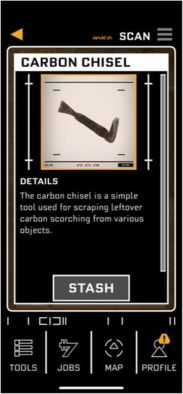
While they utilize cell phones, most of these experiences are still evidently hybrid, using the interface as a conduit to the story but physical space as the apparatus that places guests within that story. One of the best examples of this mixed mode is Star Wars: Datapad. The app allows one to complete a number of tasks within Star Wars: Galaxy’s Edge: decode the Aurebesh script throughout the land, listen to intercepted transmissions, hack into areas in the land to disrupt the “other side,” scan barcodes on boxes to see their contents, buy supplies using the in-game currency, and take on jobs to increase loyalty to a particular faction (the Resistance, the First Order, or Scoundrels). See Figure 1 for images demonstrating the location of “scannable”
objects in real space, and Figure 2 to see scanning activity within the Datapad app. Like Sorcerers of the Magic Kingdom, the Datapad challenges can take days to complete, and there is a degree of user choice in which tasks to do based on the faction guests identify with and jobs that give the user a choice of responses. Multiple jobs are “fetch quests,” making the user feel like a player in a role-playing game, and all of the jobs feature Star Wars characters, some rather obscure, so bigger fans are rewarded. There is a clear transmedia narrative element, as one character in the game is Vi Moradi, who appears in the book Phasma and in Galaxy’s Edge: Black Spire, a novel written to establish the lore of the planet Batuu. Characters from the game are from the recent films (like Rey or Rose Tico) and others are from the animated series The Clone Wars or Rebels (like Hondo Ohnaka). Each of these characters texts the user directly (employing the user’s chosen name), so it involves guests in a universe they may already have an affinity towards.
Figure 1: A screenshot of Star Wars: Datapad assisting the
user in finding the location of scannable “creature stall crates,” along with a photo of the physical crates. The arrow
denotes the location of an icon to be scanned.
Figure 2: Screenshots of Star Wars: Datapad scanning an
object and displaying the results.
One of the strongest quests in terms of its intensity and detail is in the Resistance Encampment, the queue for Star Wars: Rise of the Resistance. This quest can only be completed inside the queue and dynamically ends based on when one gets to the front of the line. The objective if fighting for the Resistance is to help Finn escape from a Star Destroyer. The movement of the people in line and the tight corridors of the queue assist with a sense of urgency and authenticity. Helping Finn break out provides a narrative bridge to the ride’s story, and it is appealing to fans to communicate with and perform tasks to help the chosen faction. A similar set up exists in the queue for Avatar Flight of Passage, where one chats with scientists and scans for Pandoran flora and fauna. While not as intrinsically narrative, it connects to the lore of the themed land and the mobile device interfaces fit these technologically-advanced story worlds.
The park-based Galaxy’s Edge game is reliant on the mapping between game elements and real-world geography through modern smartphones’ global positioning system (GPS) capabilities. The geocaching community made use of this technology to build communities around discovery: Ihamaki’s study of geocaching communities notes that the channels built around the searching (such as Trible and Groundspeak) create much of the play experience [6]. These types of games offer what Jason Farman calls “the perfect example of the blending of material and virtual interfaces,” offering players a way to advertise their “presence” at the locations of the discovered caches through physically logging their signature [4]. Such locative play has even been described in Harry Potter-esque terms to describe the sense of the play experience as exclusive; Farman notes that non-gamers are excluded from the play, referred to as “muggles,” with caches hidden from their sight [4]. The metaplay of hiding the game from those muggles enhances the experience, creating a sense of secrecy and exclusivity. Such scalable play benefits from user enhancement, as the terrain is ever-shifting and relies upon player-inputted data. Caches are established and players observe changes in the landscape of play, distributing what Neustaedter, Tang, and Judge note could otherwise be prohibitive problems of scale and maintenance [10]. This model demands a different approach to game design, driven by shared customs and norms, as Nuestaedter et al observe: players can become content creators through both making “lightweight” and “elaborate” creations, as well as by monitoring other players (and “muggles”) and sharing the labor of maintenance on others’ creations [10].
There have been several ARGs that are predominantly or fully virtual. A few of these, like Europa-Park's Voletarium Sky Explorers or a couple of the games in Play Disney Parks, can be played at home and are not location locked. Sky Explorers, a flying game, can still interact with the ride queue, but it is primarily meant to be a transmedia expansion of the ride’s storyline. The twin games Battle for Cedar Point and Battle for Kings Dominion are interesting examples of primarily virtual iterations. In both of these, guests choose which team to be on (represented by personified versions of the major roller coasters at the parks) and then fight for the rest of the day to take over
the most park territory. While there are AR-enabled billboards in the park, where one fights virtual creatures in real time, the rest of the experience is virtual, from answering trivia questions to logging rides taken to playing a tower-toppling video game. Like Play Disney Parks and a few of the others, badges are given for completing different tasks, generating a desire for guests to return to the park and maybe ironically, to continue to play games on a cell phone instead of giving full attention to the parks’ physical environments.
Certain AR experiences are obviously individual quests, like Sorcerers of the Magic Kingdom or Harry Potter Wands, though they are often played with groups of family or friends. However, the “Battle for” games are very competitive, with a constant struggle to overtake territory from other in-park players. Datapad has a competition component between the Resistance and First Order. PearlMasters has a daily leader board. The competitive nature of these ARGs changes the motivation to one of earning rewards that others may not get. While exploration and information are the rewards of many of these quests, others are firmly rooted in a conflict narrative, again furthering the fantasy game tropes of the genre and the social nature of mixed reality experience design.
3.3 Between Transparent and Disruptive
Somewhere in the middle between transparent technologies and disruptive ones are a pair of fairly in-depth games that utilize wristbands to trigger story elements and special effects: A Pirate’s Adventure: Treasures of the Seven Seas at Magic Kingdom and PearlMasters Quest at Yas Waterworld. In the Pirate’s Adventure game, guests choose from five maps that will bring them to stops throughout Adventureland. The MagicBand or plastic admission ticket is tapped on icons within the land that activate different physical and some media-based effects, with each quest ending when the treasure is attained. PearlMasters Quest, referred to as a “live action video game adventure,” uses a wristband to initiate storyline segments and special effects by touching a compass icon. This game uses the vendor Creative Kingdoms’ technology package (in this case SplashQuest, a water park model) that has been used in earlier-mentioned MagiQuest, DinoQuest at the Discovery Cube museum, and Cosmic Quest at Kennedy Space Center. A booklet with clues and even poetry helps guide guests to different spots to eventually win the treasure.
3.4 Physical and Theoretical Augmented Reality
Though perhaps not fitting the traditional definition, all-physical interactive gaming experiences would still be palimpsest and mixed reality using Sandvik’s definition. One of the richest of these is the quest of The Raven at Knott’s Berry Farm’s immersive theatre experience Ghost Town Alive! All of the Ghost Town Alive! offerings are scalable in both time and level of engagement, so guests can partake in only a small amount of it (a show or a couple of interactions) or explore the depths of the town of Calico’s secrets through interacting with characters
all day, influencing the branch of the story through activities like voting in an election, or by cosplaying or creating a character in the town. The Raven’s quest is purely physical, as the mysterious character sends the guest on missions throughout the town to talk to people or find things, with the player slowly gathering enough information to understand the resolution of the town’s daily story. Clues are written on scraps of paper in books, and these are found through looking at a map and physically layering the map on top of symbols on windows. The symbols and messages are literally on top of these surfaces, making it the closest to a physical augmented reality one will find. The newspaper that is generated four times a day in Ghost Town Alive! links to the daily narrative arc, and The Raven character’s identity is revealed at the end-of-day Hoedown, tying together the experience of the guest and the external story.
The oldest AR experience in Table 1, Tokyo DisneySea’s Leonardo’s Challenge, involves reading maps and following clues throughout the Fortress Explorations walkthrough adventure. At different points within the area are hidden physical and media-based scenes tied to the ideas of 16th century discovery. What is perhaps most fascinating is this attraction developing the global palimpsest, the Society of Explorers and Adventurers (or S.E.A.), a storytelling device hidden to most guests but known to Disney park fans who search for the story’s breadcrumbs at many Disney locations. While not strictly technological, it is nonetheless mixed reality, with the same physical space containing extra layers for particular visitors. Other parks have done this kind of thing on a smaller scale, for example hiding references to an intellectual property in the queue of an attraction. All of the iterations in this article indicate that parks seek to enrich the experience of guests by encouraging exploration and engagement with the space itself.
4 Discussion
The wild success of mobile augmented reality games has led to their increased presence in various environments. As we have shown, theme parks are certainly one of the more prevalent areas of expansion for these types of play experiences, not only in number, but also in creativity and innovation. From the designer’s perspective, the incorporation of this type of play into the park might be viewed through a lens of pragmatism, not only narrative, as the literature of theme park management reveals: unsurprisingly, the longer a guest waits in a queue the less favorably they will evaluate a service [34]. Given that waiting has become an almost unavoidable part of the tourist and theme park experience [8, 14], companies are concerned about its negative effect on satisfaction [9]. AR games are likely to increase as parks perceive their value as a way to relieve boredom while waiting in a queue that requires only minimal additional infrastructure [38]. AR games, by being immersive, can lead to distorted perception of time [7], and the player may suddenly notice that the line is over. If the game was particularly fun, a guest may even be disappointed that the line is done as they were enjoying the game. AR games then have the potential to turn a negative in the form of waiting in line, into a positive
in the form of getting to play the game. This can lead to an interesting choice for a theme park guest: do I stand in the line and get to play the game, or use a priority line option and get a shorter line, but miss the game? If more people stand in line to play the game this can even lead to an increased perception of the value of the attraction [21], as the line is perceived as a proxy for the quality of the attraction experience. Through AR games theme parks might be able to turn a long line into an experience that guest seek.
Increased engagement with a theme park has financial consequences for the park. Increased referral behavior, crowd distribution, repeat visitation, unit synergy and related item profit, word of mouth, engagement in social media marketing, purchase behavior, loyalty, reputation and brand building are a few of the positive impacts to the firm of a positive increase in guest engagement [2, 10]. All of the preceding engagement behaviors can increase the profitability and long term success of a theme park; brand loyalty in and of itself has been shown to increase customer spending [33]. AR facilitates visitor engagement in theme parks to even go beyond transactional behavior, satisfaction, and brand loyalty to the point of customer co-creation. With the addition of AR experiences to theme parks, the guest is involved in co-designing and shared production of the experience. The customer-driven, sometimes spontaneous, behaviors facilitated by AR allow a customized experience beyond what the theme park can provide on its own [10, 22, 32].
This corporate focus on short, rather than sustained, play means such experiences have historically been under-realized compared to what is possible in locative narrative design. Rebecca Rouse and Evan Barba’s survey of mixed reality designers noted that typically such experiences fall within a matrix of potential approaches following on a “opportunistic-deterministic spectrum” as well as a “storytelling-sensationalizing spectrum” [26]. Charting the narratives examined here on this spectrum suggests a historical emphasis on opportunistic and sensationalized design, as well as an inevitable dependence on familiarity with previous media franchises. This is consistent with the emphasis in theme park design on applying existing franchises. This allows designers to rely upon a fan’s desire for transportation, to craft an impact through creating authenticity in the imaginary, and to provide a social space for occupying a familiar, desirable setting [36].
However, this type of play has implications well beyond the fiscal and offers the potential to provide player-guests with a different type of engagement in transmedia narratives. The naturally performative space of the theme park offers insight into emerging notions of MRx. They are rich texts that cover each area of Rouse et al.’s framework by being simultaneously “deeply locative,” integrated into specific sites, and experiential [28]. Ultimately, the designed play of locative narrative games and theme park games are converging. Nowhere is this more obvious than in Universal’s Wizarding World of Harry Potter, where fans host meet-ups to play both Niantic’s Wizards Unite and “play” at wizardry, through wands, cosplay, and occupying a
shared setting [36]. Such games become a lens for a shared imaginative world – a theme park that can be carried with you, and perhaps thus the truest realization of DisneyQuest’s original goal of meeting the theme park audience closer to home through the intervention of virtual and mixed reality [23]. The Galaxy’s Edge experience offers a similar type of engagement, with Disney’s own efforts to sell Jedi robes and encourage the costume-adjacent “Disneybounders” to immerse themselves in fandom through play. Both theme park designers and games designers will benefit from recognizing, and building on, this intersection: similarly, as scholars we must bring both perspectives to understanding the player interactions and reimagined social spaces these games provide. As theme park AR games grow in number and complexity, they will continue to transform guest expectations of theme parks and broaden our understanding of locative play going forward.
References
[1] Acharya, D. and Wardrip-Fruin, N. 2019. Building worlds together: understanding collaborative co-creation of game worlds. Proceedings of the 14th International Conference on the Foundations of Digital Games - FDG ’19 (San Luis Obispo, California, 2019), 1–5.
[2] Baker, C.A. 2016. Creative choices and fan practices in the transformation of theme park space. Transformative Works and Cultures. 22, (Sep. 2016).
[3] Barba, E. 2014. Toward a language of mixed reality in the continuity style. Convergence: The International Journal of Research into New Media Technologies. 20, 1 (Feb. 2014), 41– 54. DOI:https://doi.org/10.1177/1354856513514336.
[4] Bolter, J.D. and Grusin, R. 1999. Remediation : Understanding New Media. The MIT Press.
[5] Chess, S. 2017. Ready Player Two: Women Gamers and Designed Identity. U of Minnesota Press.
[6] Chess, S. 2013. The Mystery of the Hidden Gamer: Women, Leisure, and Hidden Object Games. AoIR Selected Papers of Internet Research. 3, 0 (2013).
[7] Conti, R. 2001. Time flies: Investigating the connection between intrinsic motivation and the experience of time. Journal of Personality. 69, 1 (Feb. 2001), 1–26.
[8] Dawes Jillian and Rowley Jennifer 1996. The waiting experience: towards service quality in the leisure industry. International Journal of Contemporary Hospitality Management. 8, 1 (Feb. 1996), 16–21. DOI:https://doi.org/10.1108/09596119610108608.
[9] Dickson, D., Ford, R.C. and Laval, B. 2005. Managing real and virtual waits in hospitality and service organizations. Cornell Hotel & Restaurant Administration Quarterly. Sage Publications, Inc.
[10] van Doorn, J., Lemon, K.N., Mittal, V., Nass, S., Pick, D., Pirner, P. and Verhoef, P.C. 2010. Customer engagement behavior:Theoretical foundations and research directions. (2010). DOI:https://doi.org/10.1177/1094670510375599.
[11] Francaviglia, R. 1995. History after Disney: The Significance of “Imagineered” Historical Places. The Public Historian. 17, 4 (Oct. 1995), 69–74. DOI:https://doi.org/10.2307/3378386.
[12] Gallup.com: 2020. https://news.gallup.com/businessjournal/172637/whycustomer-engagement-matters.aspx. Accessed: 2020-04-01.
[13] Gander, P. 1999. Two myths about immersion in new storytelling media. Lund University Cognitive Studies.
[14] Gnoth, J., Bigné, J.E. and Andreu, L. 2006. Waiting time effects on the leisure experience and visitor emotions. In Progress in tourism marketing. Eds. Metin Kozak and Luisa Andreu. Oxford: Elsevier.
[15] Hargood, C., Hunt, V., Weal, M.J. and Millard, D.E. 2016. Patterns of Sculptural Hypertext in Location Based Narratives. Proceedings of the 27th ACM Conference on Hypertext and Social Media (New York, NY, USA, 2016), 61– 70.
[16] Harry Potter: Wizards Unite is Pokemon Go with magic wands: 2019. https://www.cnet.com/how-to/harry-potterwizards-unite-is-pokemon-go-with-magic-wands/. Accessed: 2019-06-26.
[17] Ioannidou, E. 2018. Neo-Victorian Hidden Object Games, Participatory Culture, and the Interaction Between Past and Present. Adaptation. 11, 2 (Aug. 2018), 159–170. DOI:https://doi.org/10.1093/adaptation/apx008.
[18] Jackson, K.M. and West, M.I. 2010. Disneyland and Culture: Essays on the Parks and Their Influence. McFarland & Company.
[19] Javanshir, R., Carroll, B. and Millard, D. 2018. A Model for Describing Alternate Reailty Games. Interactive Storytelling: 11th International Conference on Interactive Digital Storytelling, ICIDS 2018, Dublin, Ireland, December 5–8, 2018, Proceedings. R. Rouse, H. Koenitz, and M. Haahr, eds. Springer International Publishing.
[20] Kari, T., Arjoranta, J. and Salo, M. 2017. Behavior change types with Pokémon GO. Proceedings of the International Conference on the Foundations of Digital Games - FDG ’17 (Hyannis, Massachusetts, 2017), 1–10.
[21] Koo, M. and Fishbach, A. 2010. A Silver Lining of Standing in Line: Queuing Increases Value of Products. Journal of Marketing Research. 47, 4 (2010), 713.
[22] Kumar, V., Aksoy, L., Donkers, B., Venkatesan, R., Wiesel, T. and Tillmanns, S. 2010. Undervalued or Overvalued Customers: Capturing Total Customer Engagement Value. Journal of Service Research. 13, 3 (Aug. 2010), 297–310. DOI:https://doi.org/10.1177/1094670510375602.
[23] Mine, M. 2003. Towards virtual reality for the masses: 10 years of research at Disney’s VR studio. Proceedings of the workshop on Virtual environments 2003 - EGVE ’03 (Zurich, Switzerland, 2003), 11–17.
[24] Nakamura, R., Sargent, L., Matsuura, J. and Nishiyama, A. 1998. Serial Experiments Lain.
[25] Newman, J. 2015. The Future of Family Play at Epcot. Play, performance, and identity: how institutions structure ludic spaces.
[26] Rouse, R. and Barba, E. 2017. Design for Emerging Media: How MR Designers Think About Storytelling, Process, and Defining the Field. Interactive Storytelling (2017), 245–258.
[27] Rouse, R., Engberg, M., JafariNaimi, N. and Bolter, J.D. 2015. MRX: an interdisciplinary framework for mixed reality experience design and criticism. Digital Creativity. 26, 3–4 (October 2015), 175–181. DOI: https://doi.org/10.1080/14626268.2015.1100123.
[28] Rouse, R., Engberg, M., JafariNaimi, N. and Bolter, J.D. 2015. MRx design and criticism: the confluence of media studies, performance and social interaction. Digital Creativity. 26, 3–4 (October 2015), 221–227. DOI: https://doi.org/10.1080/14626268.2015.1100124.
[29] Sandvik, K. 2010. Crime Scenes as Augmented Reality:Models for Enhancing Places Emotionally by Means of Narratives, Fictions and Virtual Reality. Channel View Publications.
[30] Senita, J. 2017. The Disruptive Impact of Game Design, Mobile Technology, Social Networks and Emerging Media on Theme Parks. (Aug. 2017).
[31] Shilkrot, R., Montfort, N. and Maes, P. 2014. nARratives of augmented worlds. 2014 IEEE International Symposium on Mixed and Augmented Reality - Media, Art, Social Science, Humanities and Design (IMSAR-MASH’D) (Germany, Sep. 2014), 35–42.
[32] Shiri D. Vivek, Sharon E. Beatty and Robert M. Morgan 2012. Customer Engagement: Exploring Customer Relationships Beyond Purchase. Journal of Marketing Theory and Practice. 20, 2 (2012), 127. DOI:https://doi.org/10.2753/MTP1069-6679200201.
[33] Srivastava, M. and Kaul, D. 2016. Exploring the link between customer experience–loyalty–consumer spend. Journal of Retailing and Consumer Services. 31, (Jul. 2016), 277–286.
[34] Taylor, S. 1994. Waiting for Service: The Relationship between Delays and Evaluations of Service. Journal of Marketing. 58, 2 (Apr. 1994), 56–69. DOI:https://doi.org/10.1177/002224299405800205.
[35] Trowbridge, S. and Stapleton, C. 2009. Melting the Boundaries Between Fantasy and Reality. Computer. 42, 7 (Jul. 2009), 57–62. DOI:https://doi.org/10.1109/MC.2009.228.
[36] Waysdorf, A. and Reijnders, S. 2018. Immersion, authenticity and the theme park as social space: Experiencing the Wizarding World of Harry Potter. International Journal of Cultural Studies. 21, 2 (Mar. 2018), 173–188. DOI:https://doi.org/10.1177/1367877916674751.
[37] Wolf, M.J.P. 2013. Building imaginary worlds : the theory and history of subcreation. Routledge.
[38] Youm, D., Seo, S. and Kim, J.-Y. 2019. Design and development methodologies of Kkongalmon, a locationbased augmented reality game using mobile geographic information. (2019). DOI:https://doi.org/10.1186/s13640-0180395-2.
[39] 2016. Westworld. Bad Robot, Jerry Weintraub Productions, Kilter Films.


Do you like what you are reading? Subscribe to receive updates.
Unsubscribe anytime