
Authors: Cameron Tolentino, Matthew Mosher
Abstract
Kurios is a smartphone web application for saving and sharing audio stories embedded in physical objects. People can use Kurios to preserve their memories sparked by family photos, heirlooms, travel souvenirs, and trophies into the objects themselves. By creating this easily accessed semantic platform, the project seeks to not only preserve past stories but also promote the bonds and sense of community that come with storytelling itself.
CCS CONCEPTS
•Human-centered computing ~Ubiquitous and mobile computing ~Ubiquitous and mobile computing systems and tools •Information systems ~Information systems applications ~Digital libraries and archives •Information systems ~World Wide Web ~Web applications
KEYWORDS
Audio; memory; tangible; storytelling; preservation; narrative
ACM Reference format: Cameron Tolentino and Matthew Mosher. 2020. Kurios: A Web App for Saving and Sharing Audio Memories with Physical Objects. In Proceedings of ACM Hypertext conference (HT’20). ACM, New York, NY, USA, 2 pages. https://doi.org/10.1145/3372923.3404811
1 Introduction
For thousands of years, storytelling has existed as a means of communication and bonding between persons. Both as an oral and written practice there are times when stories are recalled by mementos traded between family or friends. These personable objects often lose their original memories through the generations when the story keepers perish. Kurios was created to aid in the preservation of these memories, and to create a system that allows users to easily engage others through creating and sharing stories. By simply scanning a labeled object with their phone, a user can access all the precious narratives stored within.
Permission to make digital or hard copies of part or all of this work for personal or classroom use is granted without fee provided that copies are not made or distributed for profit or commercial advantage and that copies bear this notice and the full citation on the first page. Copyrights for third-party components of this work must be honored. For all other uses, contact the Owner/Author. HT '20, July 13–15, 2020, Virtual Event, USA © 2020 Copyright is held by the owner/author(s). ACM ISBN 978-1-4503-7098-1/20/07. https://doi.org/10.1145/3372923.3404811
2 Interface
Kurios exists as a text-driven web-based application built using HTML, CSS, JavaScript, PHP, and MySQL. A preview of the application is available at https://kurios.app/ This application relies on custom generated QR labelling to register items within the system. While anyone can listen to stories by scanning a labeled object with their phone, they need a free account to record new stories. Each object can hold multiple stories by multiple authors,

figure 1. This allows for fluid sharing of objects and narratives between people.
To access Kurios’s deeper capabilities, a user must first tag an
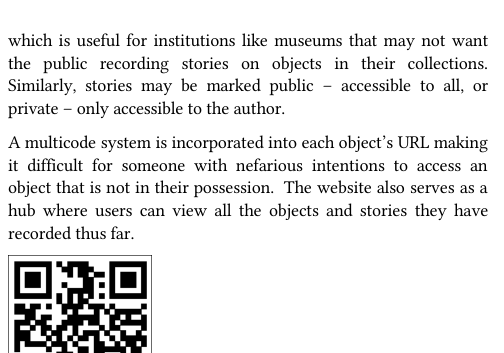
object with one of our archival quality QR labels, figure 2. The labels are available in a variety of formats, such as stickers and hanging tags, through the web app. The QR codes themselves are generated uniquely, meaning that every object has its own identity in the system’s database. Scanning a label with a QR reader directs a user to the webpage for that object.
When a user first names an object in the database they become the ‘owner’ of it, which allows them to set its mode. In communal mode, anyone capable of scanning the object can also record stories to it. This is useful for families and friends who might all want to record their own story about grandpa’s clock, for instance. In individual mode, only the objects ‘owner’ can record to it,
which is useful for institutions like museums that may not want the public recording stories on objects in their collections. Similarly, stories may be marked public – accessible to all, or private – only accessible to the author.
A multicode system is incorporated into each object’s URL making it difficult for someone with nefarious intentions to access an object that is not in their possession. The website also serves as a hub where users can view all the objects and stories they have recorded thus far.
points to interactive demo
3 Related Work
The idea of embedding audio narrative into physical objects is not new. Tangible memory was pioneered in The Memory Box and The Living Memory Box [3, 9]. These systems established guidelines for work with physical-digital mementos, such as using audio as a narrative media, being able to tag any object, and including editable metadata [8]. Mementos uses Radio Frequency Identification (RFID) to tag physical souvenirs with photos from vacation travels, which can be displayed in a public kiosk or home computer [2]. One of the second author’s previous research projects also uses RFID tags for an audio memory interface specific to a rock collection [5]. Sonic Gems demonstrates a need for preserving audio memories in physical form, particularly around special events, and emphasizes the need for immediacy and intuition in the systems user interface [6]. Sonic Souvenirs shows that sound is evocative and intimate when paired with physical objects and reiterates the need for simple record and playback controls [1]. Petrelli and Whitiker prove that despite our contemporary digitized lives, physical mementos are still more meaningful though their stories re often lost [7]. Tales of Things implements the most comprehensive system for tagging physical objects with text and photos using a combination of NFC and QR codes [4]. This desktop system is most similar to Kurios but asks for additional data from the user that may not be necessary. Further, their archive is available for public browsing regardless of proximity to the objects contained within, which compromises privacy. Kurios distinguishes itself from these projects by having an intuitive user interface and accessible hardware. We have elected to use QR codes in Kurios because we believe they have the greatest potential longevity.
4 Future Work
While the web application is fully functional as is, it will not scale appropriately, and as such, the system will be migrated to online cloud computing and hosting. We are also pursuing partnerships with local museums to showcase the technology as an alternative to audio guides. As Kurios does not rely on proprietary hardware it should present museums with significantly reduced equipment and maintenance costs. And as each person has their own listening device the system reduces the chance of spreading disease. Once these trials are in place, we will be able to conduct a user study. As a result, the system will not only be capable of sharing stories between family and friends, but also between communities and cultures.
ACKNOWLEDGMENTS
Research on Kurios was funded in part by Fulbright Austria and the University of Central Florida’s Strategic Plan Innovation Awards.
REFERENCES
[1] Lina Dib, Daniela Petrelli, and Steve Whittaker. 2010. Sonic souvenirs: exploring
the paradoxes of recorded sound for family remembering. In Proceedings of the 2010 ACM conference on Computer supported cooperative work (CSCW ’10). Association for Computing Machinery, New York, NY, USA, 391–400. DOI:https://doi.org/10.1145/1718918.1718985
[2] Augusto Esteves and Ian Oakley. 2010. Mementos: a tangible interface
supporting travel. In Proceedings of the 6th Nordic Conference on HumanComputer Interaction: Extending Boundaries (NordiCHI '10). ACM, New York, NY, USA, 643-646. DOI=http://dx.doi.org/10.1145/1868914.1868994
[3] David Frohlich and Rachel Murphy. 2000. The Memory Box. Personal Ubiquitous
Comput. 4, 4 (January 2000), 238-240. DOI=http://dx.doi.org/10.1007/PL00000011
[4] Martin L. de Jode, Ralph Barthel, and Andrew Hudson-Smith. 2011. Tales of things: the story so far. In Proceedings of the 2011 international workshop on Networking and object memories for the internet of things (NoME-IoT '11). ACM, New York, NY, USA, 19-20. DOI=http://dx.doi.org/10.1145/2029932.2029940
[5] Matthew Mosher. 2017. If These Walls Could Speak: Tangible Memories. In
Proceedings of the 12th International Audio Mostly Conference on Augmented and Participatory Sound and Music Experiences (AM ’17). Association for Computing Machinery, New York, NY, USA, Article 13, 1–4. DOI:https://doi.org/10.1145/3123514.3123562
[6] Gerard Oleksik and Lorna M. Brown. 2008. Sonic gems: exploring the potential of
audio recording as a form of sentimental memory capture. In Proceedings of the 22nd British HCI Group Annual Conference on People and Computers: Culture, Creativity, Interaction - Volume 1 (BCS-HCI ’08). BCS Learning & Development Ltd., Swindon, GBR, 163–172.
[7] Daniela Petrelli and Steve Whittaker. 2010. Family memories in the home:
contrasting physical and digital mementos. Personal Ubiquitous Comput. 14, 2 (February 2010), 153–169. DOI:https://doi.org/10.1007/s00779-009-0279-7
[8] Molly M. Stevens, Gregory D. Abowd, Khai N. Truong, and Florian Vollmer.
Getting into the Living Memory Box: Family archives & holistic design.
Personal Ubiquitous Comput. 7, 3–4 (July 2003), 210–216. DOI:https://doi.org/10.1007/s00779-003-0220-4
[9] Molly Stevens, Florian Vollmer, and Gregory D. Abowd. 2002. The living
memory box: function, form and user centered design. In CHI '02 Extended Abstracts on Human Factors in Computing Systems (CHI EA '02). ACM, New York, NY, USA, 668-669. DOI=http://dx.doi.org/10.1145/506443.506537
---
This full-text Seed edition preserves attribution to the ACM Hypertext 2020 version of record. Formatting was converted from that version under the supplied ACM authorization.
Do you like what you are reading? Subscribe to receive updates.
Unsubscribe anytime