
ACM source attribution. Complete text, page facsimiles, figures, tables, captions, equations, footnotes, and references were converted from the authorized ACM archival PDF for 10.1145/3511095.3536366. © 2022 Association for Computing Machinery.
Exploring Semantically Interlaced Cultural Heritage Narratives
Authors: Noemi Mauro, Angelo Geninatti Cossatin, Ester Cravero, Liliana Ardissono, Guido Magnano, Marco Giardino
Import kind: fulltext
Complete visual source pages



Complete text
Source page 1
Exploring Semantically Interlaced Cultural Heritage Narratives
Noemi Mauro University of Torino
Angelo Geninatti Cossatin
Ester Cravero University of Torino
University of Torino
Torino, Italy noemi.mauro@unito.it
Torino, Italy angelo.geninattic@edu.unito.it
Torino, Italy ester.cravero271@edu.unito.it
Liliana Ardissono
Guido Magnano University of Torino
Marco Giardino University of Torino
University of Torino
Torino, Italy liliana.ardissono@unito.it
Torino, Italy guido.magnano@unito.it
Torino, Italy marco.giardino@unito.it
ABSTRACT
While traditional mobile guides propose itineraries underlying the presentation of individual narrations, a broad view of Cultural Heritage should take into account that Points of Interests, historical characters and objects are frequently related in different stories linking art, history and science. Moreover, stories could be associated through their common themes. Thus, a focus on individual narrations is not enough to provide users with a holistic view of the places they visit.
In this paper, we investigate the presentation of interlaced Cultural Heritage information to make users aware about the connections among such stories. For this purpose, we propose an exploration model that enables the user to take side walks in semanticallyrelated narrations concerning Points of Interest. This is based on a semantic knowledge representation where two types of relations connect entities within individual stories, and stories through their common themes. Based on this representation, we developed the Triangolazioni mobile guide that presents multimedia information about Cultural Heritage in Torino city. A user study has shown that participants perceived the app, and its "side walking" support, as highly usable. Moreover, they appreciated the storytelling capabilities of the app.
CCS CONCEPTS
• Human-centered computing →Hypertext / hypermedia; Interaction techniques; • Information systems →Geographic information systems; Web searching and information discovery.
KEYWORDS
hypertext models, mobile guides, Cultural Heritage
ACM Reference Format: Noemi Mauro, Angelo Geninatti Cossatin, Ester Cravero, Liliana Ardissono, Guido Magnano, and Marco Giardino. 2022. Exploring Semantically Interlaced Cultural Heritage Narratives. In Proceedings of the 33rd ACM Conference on Hypertext and Social Media (HT ’22), June 28-July 1, 2022,
Permission to make digital or hard copies of part or all of this work for personal or classroom use is granted without fee provided that copies are not made or distributed for profit or commercial advantage and that copies bear this notice and the full citation on the first page. Copyrights for third-party components of this work must be honored. For all other uses, contact the owner/author(s). HT ’22, June 28-July 1, 2022, Barcelona, Spain © 2022 Copyright held by the owner/author(s). ACM ISBN 978-1-4503-9233-4/22/06. https://doi.org/10.1145/3511095.3536366
Barcelona, Spain. ACM, New York, NY, USA, 6 pages. https://doi.org/10. 1145/3511095.3536366
1 INTRODUCTION
Most mobile guides for Cultural Heritage (CH) exploration organize the presentation of stories about CH items as a location-based hypertext that specifies the paths that the user can traverse within an individual story. Path traversal is based on contextual conditions concerning the user’s location and interests [1, 2, 11, 19, 27, 30], and possibly further elements such as weather conditions and available time [7, 10]. Thus, tours focus on the items near the user and prescribe exploration paths focused on specific interests, failing to provide an integrated viewpoint on the available stories. However, Cultural Heritage has a multi-faceted nature that might involve, e.g., the history of science, culture, and technology about a Point of Interest. We claim that, to make people aware of this richness, mobile guides should support the exploration of a network of interconnected stories rather than individual narrations.
The suggestion of thematically related stories can enrich the visit experience with an interconnected view that enriches the tour experience by highlighting the existence of common themes among temporally and spatially distributed stories. Our idea is that, during a tour, the mobile guide might enrich the visit experience by proposing side stories centered around two orthogonal exploration dimensions, i.e., the Point of Interest in the user’s focus of attention and the topic of the story. We thus propose to support the presentation of interlaced narratives by using semantic links to relate, at a finer-grained level, places, people and objects into individual stories and, at a coarse-grained one, thematically related narrations. Our presentation model is based on:
(1) The specification of groups of thematically related narratives
that deal with common topics and could represent opportunities to broaden the user’s knowledge about Cultural Heritage. (2) The management of "side walks" from story to story, and the
provision of structured bread crumbs that enable users to go back and forth among narrations without losing control.
We implemented side walking in the "Triangolazioni" (Triangulations) mobile guide that supports the interlaced exploration of Cultural Heritage in Torino city. To understand its impact on users, we carried out a preliminary user study in which 25 participants (some with previous experiences with mobile guides and other ones who were novices) used the app. The participants perceived the
Source page 2
HT ’22, June 28-July 1, 2022, Barcelona, Spain Mauro et al.
app as usable, interesting and novel, as well as capable to narrate stories about places and associated characters/objects. Moreover, by grouping participants according to their motivation to seek out knowledge and new experiences (Stretching component of the Curiosity and Exploration Inventory-II questionnaire), we found that the people having a higher Stretching score appreciated the presentation of links between entities, and of thematically related stories, more than the other participants. These results encourage the adoption of side walking in mobile guides. However, they suggest the development of customization features to adapt content presentation to different information exploration attitudes.
Narrative
Narrativescluster
Title + Description + URLvideo
Title + Description + URLvideo
belongstonarrativescluster
In the following, Section 2 positions our work in the related one. Sections 3 and 4 describe our approach and the Triangolazioni app. Section 5 presents the user study and Section 7 closes the paper.
2 RELATED WORK
Bernstein defined patterns of hypertext that describe the building blocks of the systems based on static links between components [4]. Millard et al. introduced Sculptural Hypertext models [23] to dynamically determine the links between components. Hargood et al. described novel hypertext patterns suitable for Sculptural Hypertexts [14]. We exploit traditional patterns, based on fine-grained semantic relations between entities, to organize the individual stories. Moreover, we introduce coarse-grained semantic relations between stories, based on topic similarity, to support side walking.
Location-based hypertext underlies most mobile guides. For instance, GUIDE [10] delivered information about places by taking the user’s geo-location into account. Riot! [5] presented locationsensitive interactive plays. PIL [19] advanced hypertext with multimedia content preparation and ubiquitous user modeling to personalize the visit and information presentation. Braunhofer and Ricci extended the context-aware mobile guides to consider weather conditions, user’s emotions, and so forth [7]. CHIP [29] used semantic web technologies to enrich the presentation of CH items. While these works base the management of exploration paths on the existence of semantic relations between individual entities, we extend semantic relatedness to the level of the stories themselves, which are treated as high-level structured entities and can be related to one another thought topic similarity.
Researchers have experimented smart objects [3], Augmented Reality with story telling [13], haptic interaction with the system [25], IoT [22] and Virtual Reality [9] for immersive storytelling. We exclude these technologies to make the guide accessible to all end-user devices. Moreover, we do not assume that CH objects are equipped with technology supporting their interaction with the user because, different from the above listed works, which are instantiated within museums or small archaeological sites, we accommodate narratives covering large geographical areas.
3 SEMANTIC REPRESENTATION OF CULTURAL HERITAGE INFORMATION
We base the specification of individual narrations, and of clusters of thematically related stories, on the definition of an ontology that represents the entities of a story, and the story itself, as concepts related through semantic relations expressed at different granularity levels; i.e., relations within a specific story vs. topic similarity.
belongstonarrative
Item
Title + Description + Pivot + URLimage + URLvideo + Resources + References
iteminplace
itemtoitem matchespivot
subclassof subclassof subclassof
Person Place
Object
Latitude + Longitude
Figure 1: Ontology underling our mobile app. The colored boxes represent concepts, narratives and clusters. The attributes of concepts are reported within the boxes. Arrows denote semantic and subclass (IS-A) relations.
Figure 1 shows the OWL [28] ontology we built to represent the information presented by the Triangolazioni app. Based on this semantic representation, Triangolazioni dynamically generates the views presenting Cultural Heritage information to the user. The ontology is generic to accommodate different types of stories. We defined it by eliciting the narrative requirements from a multidisciplinary group of researchers dealing with science, arts, and history:
• The Item concept defines the entities described in the narratives, i.e., people, objects (e.g., paintings), and places, respectively represented by the Person, Object and Place subconcepts. For simplicity, we assimilate buildings to places because the former are frequently used to describe Points of Interest or places where historical objects are stored. Item specifies the attributes inherited by all entities. It includes the Pivot flag that specifies whether the item represents a conjunction point between different stories (e.g., those passing through the same place) or not. • Items can be associated with each other through the itemtoitem relation that represents the links between entities within an individual story. Items can also be associated with places through the iteminplace relation to specify where they are located. • The Narrative concept represents the stories and supports their association in clusters of narratives having a common theme. An instance of the concepts represents an individual story and aggregates the items belonging to it through the belongstonarrative relation. • The Narrativescluster defines the groups of thematically related stories. To specify that an individual story might touch different topics, a narrative can be associated with one or more clusters through relation belongstonarrativecluster. However, the ontology is not only a way to formalize knowledge, but also to support the authoring of stories within the mobile guide.
Source page 3
Exploring Semantically Interlaced Cultural Heritage Narratives HT ’22, June 28-July 1, 2022, Barcelona, Spain
Measuring time – Palazzo Madama
Measuring time – Palazzo Madama
Show the place on the map
Around Palazzo Madama there are three stories that extraordinarily connect the measurement of time with the Turin society of the 17th- 19th centuries. The first one concerns a small mechanical clock, …
(a) Visualization of images and description of a Point
of Interest within story "Misurare il tempo".
Specifically, we used the ontology to develop the authoring tool for the designers of the stories, leveraging the Omeka-S semantic Content Management System (https://omeka.org/s/).
We currently base the specification of thematically related stories on a manual selection of the stories having specific topics in common. However, we plan to apply automated topic extraction techniques, such as, e.g., Latent Semantic Analysis [12], to identify the common themes from the textual descriptions associated to the entities involved in the stories.
4 TRIANGOLAZIONI
Our mobile guide supports the interaction with smartphones, tablets and laptops. Due to space constraints we only describe the portion of the user interface supporting side walking. For more information about the mobile guide see [21].
When the user selects a story (e.g., "Misurare il tempo" - measuring time), and a Point of Interest (e.g., "Palazzo Madama" in Figure 2a), the guide presents its textual description. As shown in Figure 2b, the guide shows the links to explore the entities of the story that are semantically related to the place ("Altri luoghi di Misurare il tempo" - other places of the story) and the widgets supporting side walking ("Altri percorsi suggeriti"). The user can expand such widgets to discover the narratives passing through the Point of Interest and those thematically related to the current story. For instance, as shown in the figure, Palazzo Madama is also involved in tour "Misure e rivoluzioni". Moreover, the current story inspected by the user, "Misurare il tempo", is thematically related to the "Misurare la
Other suggested tours
Other tours that start from Palazzo Madama
Measures and revolutions
Other tours related to Measuring time (video) (description)
Measuring the earth
(b) List of tours related to story "Misurare il tempo".
The places of the story are hidden.
Tours you have previously explored
Close
Figure 3: Visual breadcrumbs.
Terra" (Measuring the Earth) narrative thorugh theme "Measures". By selecting one of such stories, the user can start a new tour to go to the involved places, or to visit them virtually.
During the navigation of a narrative, the user can go back to a previously explored story by using visual bread crumbs that include one item for each pending story, in reverse chronological order; see Figure 3. The breadcrumbs specify the names of all the stories
Figure 2: Presentation of the details of a Point of Interest.
Source page 4
HT ’22, June 28-July 1, 2022, Barcelona, Spain Mauro et al.
that the user started during the interaction session. Therefore, they support a flexible navigation, back and forth, from story to story.
with a mean value M = 4.57 (SD = 0.15). However, they are less motivated to embrace the novel, uncertain, and unpredictable nature of everyday life (Embracing): M = 3.18 (SD = 0.59).
5 STUDY DESIGN
We carried out a preliminary user test to check the usability of Triangolazioni, and the user experience with it, with a specific interest in side walking. In the study, we followed literature guidelines on controlled experiments [16, 26]. People joined the user study on a voluntary basis, without any compensation. The experiment took place live. The participants used their own mobile phones to interact with the app and we collected their feedback through online questionnaires. The study was organized in three phases:
Users had to declare that they were 18 years old, or over, and they had to accept an online consent to participate in the experiment. The text of the consent is available here: https://bit. ly/31HPBTp. To continue the study, we attributed each person a numerical ID used throughout the experiment. We did not associate IDs to people’s names to keep data anonymous. We asked participants to fill in a questionnaire that inquires demographic information, cultural background and their familiarity with ICT tools. We also asked them if they had ever used any mobile guides for tourism. Moreover, we asked them to fill in the Curiosity and Exploration Inventory-II (CEI-II) questionnaire [15].
Participants freely used the mobile guide to explore the information about Palazzo Madama, and the stories related to it, in the context of a tourist visit to Torino city. To comply with diverse backgrounds and levels of confidence with technology, we did not impose any time limits to complete the experiment.
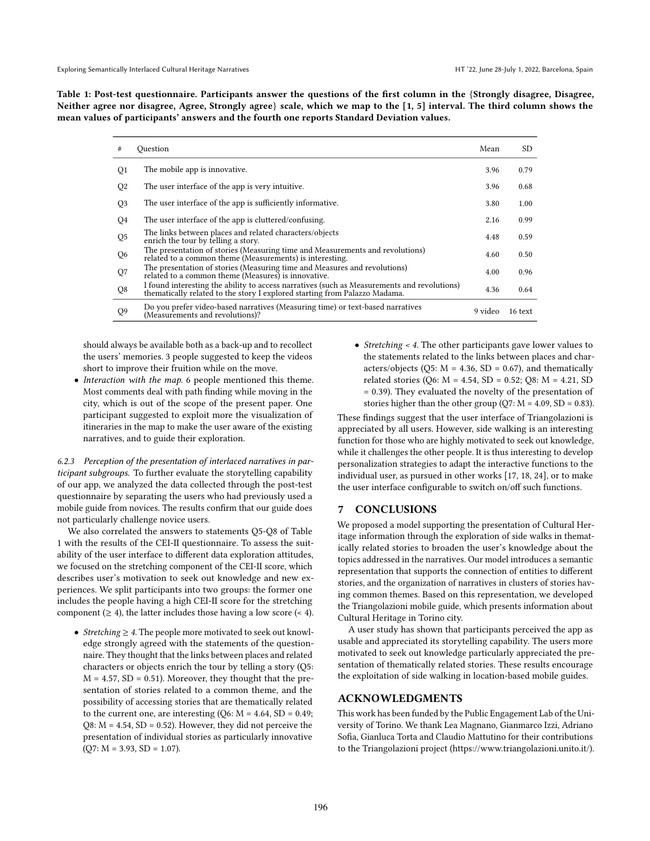
At last, participants filled in a post-test questionnaire aimed at assessing the following aspects: (a) Perceived usability - the first part of the questionnaire contains the statements of the System Usability Scale (SUS) [8], which we used to understand whether the user interface of the mobile app is usable or needs improvements. (b) Perceived user interface adequacy - in the second part of the questionnaire we investigated participants’ appreciation of the app and of its user interface; see statements Q1-Q4 in Table 1. (c) Perception of the interaction with the mobile app - we also focused on how participants perceived the navigation and storytelling features provided by the app (Q5-Q8). Moreover, we asked participants whether they preferred video or text-based narratives (Q9) to compare user preferences towards presentation modalities. Finally, we collected textual comments to improve the guide.
6 EXPERIMENTAL RESULTS 6.1 Participants Characteristics
25 people, aged between 18-30, participated in the study (10 females, 15 males, 0 non-binary, 0 did not answer). Regarding their background (they could select multiple choices), 19 participants have a scientific background, 3 a humanities one and 3 a technical one. 11 declared that they have low familiarity with ICT technologies, 7 medium, and 7 advanced. 15 people declared that they had previously used a mobile guide and 10 that they had never used one. The answers to the CEI-II questionnaire show that participants are motivated to seek out knowledge and new experiences (Stretching)
6.2 Post-test Results
6.2.1 Post-test questionnaire. Perceived Usability. By analyzing participants’ answers to the System Usability Scale questionnaire, we obtained a SUS score equal to 80.1/100 (SD = 9.31). A SUS score higher than 68/100 is considered a promising result; therefore, we can consider our value as a good one. While SUS was only intended to measure the perceived ease-of-use, Lewis and Sauro [20] showed that it provides a global measure of system satisfaction and sub-scales of learnability (items 4 and 10) and usability (other 8 items). We obtained a learnability value equal to 91/100 (SD = 11.13). This means that users did not have to put a lot of effort the first time they used the mobile app; in other words, Triangolazioni is easy to learn. The usability value is 77.38/100 (SD = 10.14), which denotes good usability.
Perceived User Interface Adequacy. The third and fourth columns of Table 1 show participants’ perception of the mobile guide in the [1, 5] scale. Overall, the app was evaluated as fairly innovative (Q1: M = 3.96, SD = 0.79) and intuitive (Q2: M = 3.96, SD = 0.96). Moreover, the user interface was considered as sufficiently informative (Q3: M = 3.80, SD = 1.00) and it was not evaluated as cluttered or confusing (Q4: M = 2.16, SD = 0.99).
Perception of the Interaction with the Mobile App. Participants agreed that the links between places and characters/objects enriched the tour by telling a story about such entities (Q5: M = 4.48, SD = 0.59). They perceived the presentation of thematically related stories as interesting (Q6: M = 4.60, SD = 0.50) and innovative (Q7: M = 4, SD = 0.96). They thought that the ability to access narratives that are thematically related to the story they started from Palazzo Madama was interesting (Q8: M = 4.36, SD = 0.64). Concerning the preferences for textual or video-based narratives (Q9), 19 participants said that they prefer reading text while 6 people declared that they prefer to watch a video.
6.2.2 Free-text feedback. 19 people provided textual feedback about the layout and interaction features of the app. We identified the main themes emerging from the collected answers through Thematic Analysis [6]:
• Perception of narratives. 5 participants mentioned this theme: 2 of them declared that the provision of links to relate places to each other, and to navigate information through stories, were interesting and novel. Other participants proposed extensions to the user interface to highlight the connections among entities within a story, or to give a preview of it. • Search for information. 4 participants mentioned this theme. Some of them suggested to extend the mobile guide with a free exploration of CH items by relying on keyword-based search and dynamically generated itineraries. • Fruition of text and video. The opinions about this theme are mixed. 4 people suggested that it would be good to have an audio guide while walking in the city. However, 3 people pointed out that, while moving around, the fruition of videos and audio might be difficult, e.g., because of the noisy environment and light conditions. Thus, textual descriptions
Source page 5
Exploring Semantically Interlaced Cultural Heritage Narratives HT ’22, June 28-July 1, 2022, Barcelona, Spain
Table 1: Post-test questionnaire. Participants answer the questions of the first column in the {Strongly disagree, Disagree, Neither agree nor disagree, Agree, Strongly agree} scale, which we map to the [1, 5] interval. The third column shows the mean values of participants’ answers and the fourth one reports Standard Deviation values.
should always be available both as a back-up and to recollect the users’ memories. 3 people suggested to keep the videos short to improve their fruition while on the move. • Interaction with the map. 6 people mentioned this theme. Most comments deal with path finding while moving in the city, which is out of the scope of the present paper. One participant suggested to exploit more the visualization of itineraries in the map to make the user aware of the existing narratives, and to guide their exploration.
6.2.3 Perception of the presentation of interlaced narratives in participant subgroups. To further evaluate the storytelling capability of our app, we analyzed the data collected through the post-test questionnaire by separating the users who had previously used a mobile guide from novices. The results confirm that our guide does not particularly challenge novice users.
We also correlated the answers to statements Q5-Q8 of Table 1 with the results of the CEI-II questionnaire. To assess the suitability of the user interface to different data exploration attitudes, we focused on the stretching component of the CEI-II score, which describes user’s motivation to seek out knowledge and new experiences. We split participants into two groups: the former one includes the people having a high CEI-II score for the stretching component (≥4), the latter includes those having a low score (< 4).
• Stretching ≥4. The people more motivated to seek out knowledge strongly agreed with the statements of the questionnaire. They thought that the links between places and related characters or objects enrich the tour by telling a story (Q5: M = 4.57, SD = 0.51). Moreover, they thought that the presentation of stories related to a common theme, and the possibility of accessing stories that are thematically related to the current one, are interesting (Q6: M = 4.64, SD = 0.49; Q8: M = 4.54, SD = 0.52). However, they did not perceive the presentation of individual stories as particularly innovative (Q7: M = 3.93, SD = 1.07).
• Stretching < 4. The other participants gave lower values to the statements related to the links between places and characters/objects (Q5: M = 4.36, SD = 0.67), and thematically related stories (Q6: M = 4.54, SD = 0.52; Q8: M = 4.21, SD = 0.39). They evaluated the novelty of the presentation of stories higher than the other group (Q7: M = 4.09, SD = 0.83). These findings suggest that the user interface of Triangolazioni is appreciated by all users. However, side walking is an interesting function for those who are highly motivated to seek out knowledge, while it challenges the other people. It is thus interesting to develop personalization strategies to adapt the interactive functions to the individual user, as pursued in other works [17, 18, 24], or to make the user interface configurable to switch on/off such functions.
7 CONCLUSIONS
We proposed a model supporting the presentation of Cultural Heritage information through the exploration of side walks in thematically related stories to broaden the user’s knowledge about the topics addressed in the narratives. Our model introduces a semantic representation that supports the connection of entities to different stories, and the organization of narratives in clusters of stories having common themes. Based on this representation, we developed the Triangolazioni mobile guide, which presents information about Cultural Heritage in Torino city.
A user study has shown that participants perceived the app as usable and appreciated its storytelling capability. The users more motivated to seek out knowledge particularly appreciated the presentation of thematically related stories. These results encourage the exploitation of side walking in location-based mobile guides.
ACKNOWLEDGMENTS
This work has been funded by the Public Engagement Lab of the University of Torino. We thank Lea Magnano, Gianmarco Izzi, Adriano Sofia, Gianluca Torta and Claudio Mattutino for their contributions to the Triangolazioni project (https://www.triangolazioni.unito.it/).
Question Mean SD
Q1 The mobile app is innovative. 3.96 0.79
Q2 The user interface of the app is very intuitive. 3.96 0.68
Q3 The user interface of the app is sufficiently informative. 3.80 1.00
Q4 The user interface of the app is cluttered/confusing. 2.16 0.99
Q5 The links between places and related characters/objects enrich the tour by telling a story. 4.48 0.59
Q6 The presentation of stories (Measuring time and Measurements and revolutions) related to a common theme (Measurements) is interesting. 4.60 0.50
Q7 The presentation of stories (Measuring time and Measures and revolutions) related to a common theme (Measures) is innovative. 4.00 0.96
Q8 I found interesting the ability to access narratives (such as Measurements and revolutions) thematically related to the story I explored starting from Palazzo Madama. 4.36 0.64
Q9 Do you prefer video-based narratives (Measuring time) or text-based narratives (Measurements and revolutions)? 9 video 16 text
Source page 6
HT ’22, June 28-July 1, 2022, Barcelona, Spain Mauro et al.
REFERENCES
Heidelberg, Berlin, Heidelberg, 94–103. [21] Noemi Mauro, Angelo Geninatti Cossatin, Ester Cravero, Liliana Ardissono,
[1] Liliana Ardissono, Anna Goy, Giovanna Petrone, Marino Segnan, and Pietro
Guido Magnano, Marco Giardino, and Claudio Mattutino. 2022. A Mobile Guide to Explore Interconnections between Science, Art and Territory. In Adjunct Proceedings of the 30th ACM Conference on User Modeling, Adaptation and Personalization (UMAP ’22 Adjunct). ACM, Barcelona, Spain, to appear. https://doi.org/10.1145/3511047.3537649 [22] Konstantinos Michalakis, Yannis Christodoulou, George Caridakis, Yorghos
Torasso. 2003. INTRIGUE: personalized recommendation of tourist attractions for desktop and handset devices. Applied Artificial Intelligence, Special Issue on Artificial Intelligence for Cultural Heritage and Digital Libraries 17, 8-9 (2003), 687–714. https://doi.org/10.1080/713827254 [2] Liliana Ardissono, Daniela Petrelli, and Tsvi Kuflik. 2012. Personalization in
Cultural Heritage: The Road Travelled and the One Ahead. User Modeling and User-Adapted Interaction. Special Issue on Coming of Age: Celebrating a Quarter Century of User Modeling and Personalization 22, 1-2 (2012), 73–99. https://doi. org/10.1007/s11257-011-9104-x [3] Carmelo Ardito, Paolo Buono, Giuseppe Desolda, and Maristella Matera. 2018.
From smart objects to smart experiences: An end-user development approach. International Journal of Human-Computer Studies 114 (2018), 51–68. https://doi. org/10.1016/j.ijhcs.2017.12.002 Advanced User Interfaces for Cultural Heritage. [4] Mark Bernstein. 1998. Patterns of Hypertext. In Proceedings of the Ninth ACM Con-
ference on Hypertext and Hypermedia: Links, Objects, Time and Space—Structure in Hypermedia Systems: Links, Objects, Time and Space—Structure in Hypermedia Systems (Pittsburgh, Pennsylvania, USA) (HYPERTEXT ’98). Association for Computing Machinery, New York, NY, USA, 21–29. https://doi.org/10.1145/276627.276630 [5] Mark Blythe, Josephine Reid, Peter C. Wright, and Erik Geelhoed. 2006. In-
terdisciplinary criticism: Analysing the experience of Riot! a location-sensitive digital narrative. Behaviour & Information Technology 25, 2 (2006), 127–139. https://doi.org/10.1080/01449290500331131 [6] Virginia Braun and Victoria Clarke. 2006. Using thematic analysis in psychology.
Qualitative Research in Psychology 3 (01 2006), 77–101. https://doi.org/10.1191/ 1478088706qp063oa [7] Matthias Braunhofer and Francesco Ricci. 2016. Contextual Information Elic-
itation in Travel Recommender Systems. In Information and Communication Technologies in Tourism 2016, Alessandro Inversini and Roland Schegg (Eds.). Springer International Publishing, Cham, 579–592. https://doi.org/10.1007/978- 3-319-28231-242 [8] John Brooke. 1996. SUS: A quick and dirty usability scale. Usability Evaluation In
Industry 189 (11 1996). https://doi.org/10.1201/9781498710411-35 [9] Magus Cagliostro. 2020. Art of Escape, Magic, and immersive storytelling: The
Museum as a Limitless Escape Game. In MW2020: MuseWeb 2020. Online. [10] Keith Cheverst, Nigel Davies, Keith Mitchell, and Paul Smith. 2000. Providing
Tailored (Context-Aware) Information to City Visitors. In Proceedings of the International Conference on Adaptive Hypermedia and Adaptive Web-Based Systems. Springer-Verlag, London, UK, UK, 73–85. https://doi.org/10.1007/3-540-44595- 18 [11] Berardina De Carolis, Giovanni Cozzolongo, Sebastiano Pizzutilo, and Vincenzo
Silvestri. 1999. MyMap: generating personalized tourist descriptions. Applied Intelligence 26 (1999), 111–124. https://doi.org/10.1007/s10489-006-0012-4 [12] Susan T. Dumais. 2007. LSA and Information Retrieval. Routledge. https: //doi.org/10.4324/9780203936399.ch16 [13] Cristina Fenu and Fabio Pittarello. 2018. Svevo tour: The design and the experi-
mentation of an augmented reality application for engaging visitors of a literary museum. International Journal of Human-Computer Studies 114 (2018), 20–35. https://doi.org/10.1016/j.ijhcs.2018.01.009 Advanced User Interfaces for Cultural Heritage. [14] Charlie Hargood, Verity Hunt, Mark J. Weal, and David E. Millard. 2016. Patterns
of Sculptural Hypertext in Location Based Narratives (HT ’16). Association for Computing Machinery, New York, NY, USA, 61–70. https://doi.org/10.1145/ 2914586.2914595 [15] Todd Kashdan, Matthew Gallagher, Paul Silvia, Beate Winterstein, William Breen,
Daniel Terhar, and Michael Steger. 2009. The Curiosity and Exploration Inventory- II: Development, Factor Structure, and Psychometrics. Journal of research in personality 43 (12 2009), 987–998. https://doi.org/10.1016/j.jrp.2009.04.011 [16] Roger E. Kirk. 2013. Experimental design: Procedures for the behavioral sciences.
SAGE Publications, Inc. https://doi.org/10.4135/9781483384733 [17] Pigi Kouki, James Schaffer, Jay Pujara, John O’Donovan, and Lise Getoor. 2019.
Personalized explanations for hybrid recommender systems. In Proceedings of the 24th International Conference on Intelligent User Interfaces (Marina del Ray, California) (IUI ’19). Association for Computing Machinery, New York, NY, USA, 379–390. https://doi.org/10.1145/3301275.3302306 [18] Pigi Kouki, James Schaffer, Jay Pujara, John O’Donovan, and Lise Getoor. 2020.
Generating and Understanding Personalized Explanations in Hybrid Recommender Systems. ACM Transactions on Interactive Intelligent Systems 10, 4, Article 31 (nov 2020), 40 pages. https://doi.org/10.1145/3365843 [19] Tsvi Kuflik, Oliviero Stock, Massimo Zancanaro, Ariel Gorfinkel, Sadek Jbara,
Shahar Kats, Julia Sheidin, and Nadav Kashtan. 2011. A Visitor’s Guide in an "Active Museum": Presentations, Communications, and Reflection. ACM Journal of Computers and Cultural Heritage 3, 3 (2011), 175–209. https://doi.org/10.1145/ 1921614.1921618 [20] James R. Lewis and Jeff Sauro. 2009. The Factor Structure of the System Us-
ability Scale. In Human Centered Design, Masaaki Kurosu (Ed.). Springer Berlin
Voutos, and Phivos Mylonas. 2021. A Context-Aware Middleware for Context Modeling and Reasoning: A Case-Study in Smart Cultural Spaces. Applied Sciences 11, 13 (2021). https://doi.org/10.3390/app11135770 [23] David E. Millard, Charlie Hargood, Michael O. Jewell, and Mark J. Weal. 2013.
Canyons, Deltas and Plains: Towards a Unified Sculptural Model of Location- Based Hypertext. In Proceedings of the 24th ACM Conference on Hypertext and Social Media (Paris, France) (HT ’13). Association for Computing Machinery, New York, NY, USA, 109–118. https://doi.org/10.1145/2481492.2481504 [24] Martijn Millecamp, Cristina Conati, and Katrien Verbert. 2022. “Knowing me,
knowing you”: personalized explanations for a music recommender system. User Modeling and User-Adapted Interaction (2022). https://doi.org/10.1007/s11257- 021-09304-9 [25] Elena Not and Daniela Petrelli. 2018. Blending customisation, context-awareness
and adaptivity for personalised tangible interaction in cultural heritage. International Journal of Human-Computer Studies 114 (2018), 3–19. https://doi.org/10. 1016/j.ijhcs.2018.01.001 Advanced User Interfaces for Cultural Heritage. [26] School of Technology. 2022. Controlled experiments. www.tech.cam.ac. uk/research-ethics/school-technology-research-ethics-guidance/controlledexperiments. [27] Oliviero Stock, Massimo Zancanaro, Paolo Busetta, Charles Callaway, Anto-
nio Krueger, Michael Kruppa, Tsvi Kuflik, Elena Not, and Cesare Rocchi. 2007. Adaptive, Intelligent Presentation of Information for the Museum Visitor in PEACH. User Modeling and User-Adapted Interaction 17, 3 (2007), 257–304. https://doi.org/10.1007/s11257-007-9029-6 [28] W3C. 2017. Web Ontology Language (OWL). https://www.w3.org/OWL/. [29] Yiwen Wang, Natalia Stash, Lora Aroyo, Peter Gorgels, Lloyd Rutledge, and Guus
Schreiber. 2008. Recommendations based on semantically enriched museum collections. Journal of Web Semantics 6, 4 (2008), 283–290. https://doi.org/10. 1016/j.websem.2008.09.002 [30] Andreas Zimmermann and Andreas Lorenz. 2008. LISTEN: a user-adaptive audio-
augmented museum guide. User Modeling and User-Adapted Interaction 18, 5 (2008), 389–416. https://doi.org/10.1007/s11257-008-9049-x
Do you like what you are reading? Subscribe to receive updates.
Unsubscribe anytime