
Decolonizing and peripheralizing e-lit in Latin America: the case of the Acervo de Literatura Digital Mato-Grossense, Brazil
Vinicius Carvalho Pereira (vinicius.pereira@ufmt.br), Universidade Federal de Mato Grosso, Cuiabá, Mato Grosso, Brazil; Cristiano Maciel (cristiano.maciel@ufmt.br), Universidade Federal de Mato Grosso, Cuiabá, Mato Grosso, Brazil.
Published in HT '24: 35th ACM Conference on Hypertext and Social Media, Poznan, Poland, September 10-13, 2024 · DOI: 10.1145/3648188.3675131 · License: © Copyright held by the owner/author(s). Publication rights licensed to ACM.
Keywords: Curatorship, Decoloniality, Digital Literature, Hypertextual Archive, Latin America, Tainacan
Session: Critical Reading
Pages: 113–125
Abstract
Latin America has witnessed various initiatives over the past decade aimed at identifying, archiving, and curating digital literature, particularly on a continental or national scale. However, there remains a notable scarcity of archives focusing on a more localized (province/state/city) level within the continent. This deficiency hampers our comprehension of the dynamics within digital literature communities formed by creators and readers who share immediate geographical references, as well as closer personal and institutional connections. The primary aim of this paper is to undertake a comprehensive analysis and description of a digital literature archive that fills this gap: the hypertextual Acervo de Literatura Digital Mato-Grossense, showcasing digital literature produced by artists residing in or hailing from the state of Mato Grosso (Brazil). In contributing to similar endeavors, we document and expound upon the key decisions we made, considering the distinct characteristics of digital literature in a region distant from Brazil’s major urban centers (itself a peripheral country within the technocapitalist world system). We elucidate the decolonial concept of digital literature adopted, the archival and curatorial strategies tailored to accommodate these works’ realities, the selection of the opensource hypertextual repository platform Tainacan to structure our archive, and the exploratory methods employed to identify and select works for archiving. Subsequently, we provide an overview of the materials archived to date and outline the forthcoming phases of the project.
CCS Concepts
• Applied computing →Media arts.
Keywords
Digital Literature, Hypertextual Archive, Curatorship, Tainacan, Latin America, Decoloniality
ACM Reference Format: Vinicius Carvalho Pereira and Cristiano Maciel. 2024. Decolonizing and peripheralizing e-lit in Latin America: the case of the Acervo de Literatura Digital Mato-Grossense, Brazil. In 35th ACM Conference on Hypertext and
Cristiano Maciel cristiano.maciel@ufmt.br Universidade Federal de Mato Grosso Cuiabá, Mato Grosso, Brazil
Social Media (HT ’24), September 10–13, 2024, Poznan, Poland. ACM, New York, NY, USA, 13 pages. https://doi.org/10.1145/3648188.3675131
1 INTRODUCTION
Intermedia experimentations with literature and computational technologies are a growing phenomenon that began in the twentieth century and gained momentum in the first quarter of the twenty-first century. Alongside conventional print literature, contemporary projects increasingly blend written words with music, video, photography, installation, performance, hypertext, video games, and more. Florencia Garramuño [16] interprets this as contemporary literature’s venture into the unknown, embracing elements that would traditionally be considered alien to prose or poetry. Intermedia experimentation is not solely a modern/postmodern phenomenon, but rather a reflection of how literature can be produced, circulated, and consumed outside of traditional books, in processes that exist since Classical Antiquity but became much more popular in the massive technocultures of our time. Katherine Hayles, as a founding member of the Electronic Literature Organization (ELO), used the term "electronic literature" ("e-lit", in short) to refer to any "work with an important literary aspect that takes advantage of the capabilities and contexts provided by the stand-alone or networked computer" [19]. For decades, that term has been used by scholars and artists to refer to literary works made with generative algorithms, hypertextual architecture, hypermedia, video game elements, collaborative authoring platforms among other computational resources. Electronic literature, hypertext, and hypermedia have been inextricably intertwined since the inception of this field, as evidenced by [37], who delves into the historigraphies of hypertext writing; [23], who focused on hypertext authoring, writing and structuring; and [28], whose seminal paper on hypertext and literary deconstructionism stands as a cornerstone in electronic literature communities. From a historiographical perspective, Leonardo Flores [14] categorizes electronic literature into three generations. The first generation, which roughly spans from 1950 to 1995, comprises pre-internet works made in programming languages like BASIC and Pascal, or in software like Hypercard or Storyspace. The second generation, which spans from 1995 to the present day, includes works made for web 1.0, distributed on websites and e-zines, made with HTML and Javascript, or in software like Adobe Flash or Adobe Director. Many works from that generation are associated to what is called net-art [5], or web art [17], as literary practices that utilize web 1.0 as a medium or platform for creative expression. Finally, the third generation consists of works made for web 2.0, especially on social media platforms, produced and circulated in networks like Twitter, Facebook, Instagram, TikTok, Wattpad, etc., which claim
HT ’24, September 10–13, 2024, Poznan, Poland Anonymous
for new understandings of writing and reading as social [43] and database-driven [4] activities. Although both the second and third generations now coexist, their growth rates are disproportionate: the scene of electronic literature on social media platforms is much more popular among users than that made with Flash or Javascript and publicized on artists’, universities’ or galleries’ websites. Whereas any user of a social media platform is a potential reader of third-generation electronic literature produced or distributed within that space, the readership of second-generation e-lit are typically individuals within niche circles, primarily scholars or e-lit artists themselves, as discussed by [41]. Nevertheless, the most renowned electronic literature archives worldwide, including the four volumes of the Electronic Literature Collection1, the Anthology of European Electronic Literature2, the Multilingual African Electronic Literature Database & African Diasporic Electronic Literature Database3, and analogous Latin-American initiatives later discussed in this paper, focus solely or mostly on works from the first or second generation of e-lit, leading to an underrepresentation of third generation works4 in spaces endorsed by academic and artistic communities. In Latin America, the phrase "digital literature" is more popular among artists and scholars (therefore, it will be used from now on in this paper), and it tends to be broadly understood as a synonym of electronic literature, although, technically speaking, electronic literature should also encompass analog literature made with electronic devices, such as magnetic tapes or VHS. Chilean researcher Carolina Gainza [15] describes digital literature as follows: "Writings that not only use an electronic device as a medium but, and more importantly in their definition, are based on various forms of manipulation of computer codes, whether directly or indirectly. In this sense, the term "digital" helps define a literature specific to this era, which refers to practices related to experimentation with code language or digital media, such as social media networks". Her definition of digital literature includes not only works made by the direct programming of computer codes (traditionally privileged by ELO) but also literary productions developed with more massive digital technologies, especially social media platforms. In that sense, her definition somewhat aligns with the electronic literature generations described by Leonardo Flores [14], where "practices related to experimentation with code language" could refer to the first and second generations of e-lit, and "digital media, such as social media networks" applies to the third generation. In Latin America, a continent marked by unequal professional and academic opportunities, limited access to advanced technology, and scarce financial support for artists, it is important to broaden the scope of digital literature to include works that use widely available hardware and software, like smartphones and social media platforms. These works do not rely on significant financial backing, specialized technical skills, or extensive interdisciplinary teams – all harder to find in countries with weaker public policies or monetization systems for the art milieu.
1Available at https://collection.eliterature.org/. 2Available at https://anthology.elmcip.net/. 3Available at https://africanelit.org/index.php. 4Examples of third generation e-lit genres and forms include Instagram poetry, or "instapoetry"; novels on Twitter, or "twovels", poetry on TikTok, or "poettok"; podbooks, as a combination of audiobooks and podcasts in platforms such as Spotify, etc.
It is in such a scenario that we applied for funding from the Foundation for Research Support of Mato Grosso State and used it to develop the Acervo de Literatura Digital Mato-Grossense5, an open-access online archive launched in November 2023, intended to identify, preserve, and curate digital literature created by artists who live or were born in Mato Grosso, a state in the Midwest of Brazil. Due to technical, political and economic reasons explored in the next sections of this paper, the main body of works in the archive are digital literary contents produced, circulated, and read on social media platforms, that is, third-generation electronic literature according to the historiography proposed by Leonardo Flores[14]. This paper aims to undertake a comprehensive analysis and description of the Acervo de Literatura Digital Mato-Grossense and the materials archived in it. In each section, we will contrast data about the archive’s structure and the material archived with theoretical references from the fields of media studies, cultural studies, and digital literature, in order to properly address the Acervo de Literatura Digital Mato-Grossense as a medium. Our understanding of medium here aligns with that of Régis Debray [12], who stated that media are supports that articulate vectors of sensitivity (ways of seeing, understanding, or conceiving things) to matrices of sociability (the networks of relations within societies). To achieve this goal, we will examine the archive and its contents by employing the methodological approach known as "description," as proposed by the Argentine-Mexican anthropologist and cultural critic, Néstor García Canclini[8]. According to this scholar, describing cultural phenomena without predetermined theoretical frameworks is more relevant to cultural studies than explaining those phenomena, as explanations often involve imposing preconceived worldviews on the material reality, often formulated by researchers and scholars from the Global North. Brazilian scholar Rejane Rocha [36] understands that the descriptive approach defended by Canclini is a suitable standpoint to address the field of digital literature. This is because many concepts and methodologies from the realm of printed literature are not applicable to it, as they fail to account for the inscriptional materiality of digital literature. In our description and analysis, we will discuss how the specificities of digital literature in a region far from the big urban centers of Brazil (a peripheral country on its own in the technocapitalist world system) affected the design and implementation of the archive. We will cover the concept of digital literature we adopted; the archival and curatorial choices we made to adapt to the reality of the works of digital literature from Mato Grosso, mostly third-generation e-lit; the open-source hypertextual repository platform we chose to structure our archive, Tainacan; and the methods we adopted to identify and select works. Then, we present an overview of the material archived so far and conclude by describing the next steps of the project. The paper is composed of section 1. Introduction; section 2. The macrostructure of the Acervo de Literatura Digital MatoGrossense: a medium for third-generation e-lit; section 3. Curating the Acervo: identifying and selecting texts; section 4. The material archived so far in the Acervo de Literatura Digital Mato-Grossense; section 5. Concluding remarks; and references.
5Available at https://literaturadigitalmt.com/.
Decolonizing and peripheralizing e-lit in Latin America: the case of the Acervo de Literatura Digital Mato-Grossense, Brazil HT ’24, September 10–13, 2024, Poznan, Poland
2 THE MACROSTRUCTURE OF THE ACERVO DE LITERATURA DIGITAL MATO-GROSSENSE: A MEDIUM FOR THIRD-GENERATION E-LIT
This section will discuss the specificities of digital literature from the Brazilian state of Mato Grosso (mostly social media platforms) and then proceed to elucidate the technological solution that serves as the foundation for structuring the Acervo as a medium.
2.1 An Archive for Digital Literature Primarily from Social Media Platforms
The Acervo de Literatura Digital Mato-Grossense is the main outcome of a project carried out from August 2022 to May 2024, originally aimed to analyze texts of digital poetry from the state of Mato Grosso and store them in two existing free-access archives (instead of creating a new one): i. the international ELMCIP (Electronic Literature as a Model of Creativity and Innovation in Practice) Knowledge Base6; and ii. the national Atlas da Literatura Digital Brasileira7. However, after the first semester of activities, the researchers found out that none of those archives would suit the material collected during the project, so that we would need to build a new archive. The ELMCIP Knowledge Base was initially considered a promising option due to its widespread use among ELO members and the fact that it is flexible enough to accommodate a great diversity of literary genres and e-lit formats, since records mainly consist of open-coded non-required fields. However, it was discarded as an option for our project after two 1-hour focus groups with Modern Language students who were asked to navigate six records of Brazilian digital literature in that Knowledge Base and discuss their user experience. The first focus group involved 10 undergraduate students and the second involved 14 graduate students, and both were held during digital literature classes in regular courses of the Federal University of Mato Grosso. In both groups, participants felt discouraged by the interface to engage with the archive and the archived texts. The interface of the ELMCIP Knowledge Base was thought to be more suitable for researchers than common readers or students, as it has plenty of verbal information in tables, but few non-verbal signs. Besides, it is in English, a foreign language many Brazilians cannot read proficiently. As one of the contributions expected from the Acervo de Literatura Digital Mato-Grossense is to provide not only the archival of works but also their use as educational materials in Brazil, the ELMCIP was then discarded. Consequently, we reached out to Rejane Rocha, the leader of the biggest digital literature archive in Brazil, Atlas da Literatura Digital Brasileira, requesting if the material from Mato Grosso we had gathered by then could be archived in the Atlas. By discussing the technical and archival possibilities of doing so (adding the works we had either to the main set of the Atlas or as a subset of it) and considering the specificities of the works we had collected (almost all poetic or narrative individual posts on social media platforms), both project leaders understood that the architecture of the Atlas
6Available at https://elmcip.net/. 7Available at https://www.observatorioldigital.ufscar.br/#atlas.
and its archival taxonomies would not fit the material from Mato Grosso we had collected. Among other reasons, this is because the records in the Atlas da Literatura Digital Brasileira are close-coded, and the main taxonomies of that database come from the international network CELL (Consortium on Electronic Literature), which aims at providing the "information architecture needed for making born digital creative works and scholarly criticism findable across databases, world-wide" [10]. The CELL network plans to unify taxonomies employed by different research, curation, and archiving projects, systematizing the labeling of digital literature works according to the following attributes: publication type (the means and channels through which a work is made public), procedural modalities (actions that occur between the work and the user), mechanisms (devices that provide input or output to a computer), formats (material and intermedial dimensions of the work and its relationships with other works and contexts) [10]. The parameters defined by the CELL consortium were considered only as a starting point for the Atlas da Literatura Digital Brasileira, so the group responsible for that project made adaptations to the initial CELL model as they deemed appropriate for the purposes of their archive. Even so, these adapted taxonomies in the Atlas are not suitable for most of the texts from Mato Grosso, as these are works from the third generation of electronic literature [14], whereas most works in the Atlas (and in similar archives in Latin America, such as the Cartografía de Literatura Digital Latinoamericana8 and the Antología LiteLat – v.1.9) are made in Javascript, HTML, Adobe Flash, or similar technologies, typical of the second generation of electronic literature. The mismatch between the texts from Mato Grosso and the taxonomies of those digital literature archives partially comes from the fact that we adopted a broader understanding of what digital literature is. For example, one of the most popular genres in our archive is poetry shared on Instagram (or Instapoetry), which does not necessarily have characteristics traditionally associated with electronic/digital literature, such as non-trivial reading or traversing effort [3]; alignment with an aesthetic of difficulty, typical of digital modernism [33]; or interaction between a work’s physical properties and its semantic strategies in reflexive loops [18]. However, in the periphery of Brazil (a peripheral country itself), a region without a long tradition of digital experimentation with literature, it seemed more socially relevant to adopt an inclusive stance upon determining our corpus, thus focusing on how local authors creatively used digital technologies in their poetry and prose, instead of drawing an arbitrary line dividing what is and what is not digital literature. That is especially important when it comes to literary attempts in social media platforms, which do not require financial support, technical programming knowledge, or multidisciplinary creation teams – the reality of almost all authors in the state of Mato Grosso we have identified. In a region where professional and academic training opportunities are more unequal, access to cutting-edge technology is less democratic, and financial incentives for artists are scarcer, whether through public grants or private investment lines, it makes perfect sense to include in
8Available at https://www.cartografiadigital.cl/. 9Available at https://antologia.litelat.net/.
HT ’24, September 10–13, 2024, Poznan, Poland Anonymous
the scope of digital literature works that make use of more massive and accessible hardware and software, such as smartphones and applications like Facebook, Instagram, TikTok, etc. By that, we advocate for a situated understanding of digital literature in peripheral scenarios, which might be a good starting point for similar local archives in the Global South. It is important to notice that there are also researchers from the Global North, like Kathi Inman Berens, who understand that Instapoetry, Twitterature (literature on Twitter) or other forms of literature produced, shared and read in social media platforms are digital literature. It is not necessarily their literariness [38] that comes from digital affordances, but the technocapitalist dynamics which lie beneath the algorithmic circulation of those texts, and all the big data harvested from the interactions in those platforms. Berens [7] conceptualizes Instapoetry as "a watershed moment in bibliography, where scholars writing about digital literary interactivity must reckon not only with the gestures we can see — the ‘likes,’ comments, reposts or ‘@s’ — but the platform code and data harvesting we cannot see. Perhaps we could agree that a ‘like’ is ‘trivial’ engagement. But what about the terabytes of data shed by and then harvested from Instapoetry fans? (...) The datafication of reader response is an essential part of the poem, one whose effects are visible to readers only indirectly in ads prompted by the reader’s engagement with the poem. This is a new kind of ‘reader response’, where algorithms are agentic: the human reader is herself ‘read’ by behavioral targeting algorithms, parsed for commercial susceptibility, and served new information or ads designed to entice transaction, even if that transaction is only a click". Whether in the Global South or North, it is undeniable that “the arrival of social media has changed private lives, business operations, and relational interactions within various communities tremendously” [29]. The 2023 report by We Are Social [42] highlights that there are 5.16 billion internet users, representing 64% of the world’s population. The report also indicates that 40% of users’ internet time is spent on social media platforms. In Brazil, the numbers reinforce the presence of social media platforms in the country: according to the Brazilian Internet Steering Committee [11], in 2022, nearly 60 million Brazilian households had Internet access, and 80% of Internet users in the country were active users of social media platforms, such as Facebook, Instagram, or TikTok. If the most common uses of social media platforms involve watching, seeing, and reading third-party content, as well as liking and sharing it, Brazil has also experienced a significant increase in content creation for social media. The posting of texts, images, or videos of own authorship (43%) increased by 12 percentage points compared to 2021 (31%), and was higher among those with a family income between five and ten minimum wages (from 37% in 2021 to 62% in 2022) and among individuals aged 35 to 44 (from 32% to 47%) [11]. If that reality affects different dimensions of social life, with education, work, finances, gaming and other fields being transformed by the ideological and technological foundations of Web 2.0 [22], the same holds true for literature, which is proved by the materials archived in the Acervo de Literatura Digital Mato-Grossense.
2.2 The technological foundation for the Acervo as a medium
Confronting the unique characteristics of a corpus largely comprised of third-generation electronic literature, rather than the traits traditionally associated with the second generation of electronic literature prevalent in works found in other archives, we determined the necessity of constructing our own local archive tailored for Brazilian users, including scholars, artists, students, and general readers. As our funding was limited and our project schedule was tight, we resorted to Tainacan, an open source and flexible repository platform for creating digital archives in WordPress. As a WordPress plugin, Tainacan has its backend developed in PHP and MySQL/MariaDB database. The frontend of the administrative panel is a single-page application developed in JavaScript, more specifically using the Vue.js framework, consuming data from the database via JSON API. The Gutenberg blocks, in addition to Vue, also use React [1]. Tainacan was developed by the Network Intelligence Laboratory of the University of Brasilia, with the support of the Federal University of Goiás, the Brazilian Institute for Information in Science and Technology, and the Brazilian Institute of Museums, which makes it a fully Brazilian free software project, with no installation or upgrade costs, and it can be used, copied, studied, modified, and redistributed without any restrictions [2]. Since the Tainacan project was launched, its development goes hand in hand with the discussion of public policies for digital cultural archives in Brazil. As with any other piece of open-source code, opting for Tainacan over alternative options entails making a decision regarding software license policies, community development, ideology, and involvement in a social movement [21]. As a 100% Brazilian free software, Tainacan also aligns with the decolonial proposal of our archive, as digital literature from a peripheral area should be better archived in software developed in a similar context, thus delinking literary criticism, research, and preservation from technocultural Eurocentric standards. According to Aníbal Quijano [34], the colonization of Latin America “involved a long period of the colonization of cognitive perspectives, modes of producing and giving meaning, the results of material existence, the imaginary, the universe of intersubjective relations with the world: in short, the culture”. Decoloniality, understood by Quijano [34] as the ongoing process of refusing Eurocentric knowledge hierarchies imposed through colonization, is a key concept in Latin American cultural studies today, which is a cornerstone for our archive, in alignment with the approaches to Latin American digital literature defended by Argentinian researcher Claudia Kozak [24]. Besides our political reasons for choosing Tainacan, this repository platform had also been successfully implemented in other important digital literature archives, such as the Atlas da Literatura Digital Brasileira and the Cartografía de Literatura Digital Latinoamericana. By employing the same tool as them, the Acervo de Literatura Digital Mato-Grossense becomes an artifact embraced by a Latin American digital literature "community around a product that can be freely consumed" - a positive impact free software can have to community development, as posited by [39]. The fact that these three archives are built with Tainacan creates evident similarities among them, although their taxonomies are not
Decolonizing and peripheralizing e-lit in Latin America: the case of the Acervo de Literatura Digital Mato-Grossense, Brazil HT ’24, September 10–13, 2024, Poznan, Poland
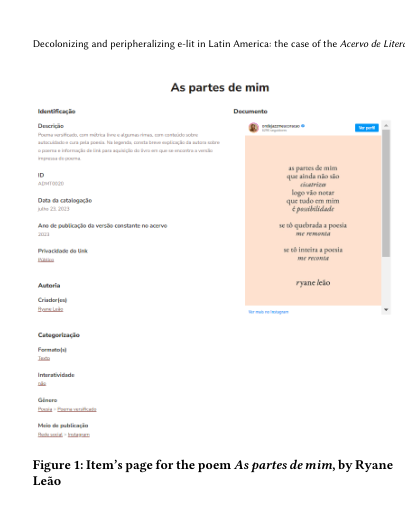
Figure 1: Item’s page for the poem As partes de mim, by Ryane Leão
identical, and the platform is flexible enough to accommodate all differences. To do so, the platform offers a number of customizable features such as collection creation, metadata, items, filters, etc. [2]. Dozens of physical museums in Brazil like the Historical National Museum, the Villa Lobos Museum, and the Inconfidência Museum also use Tainacan to build digital versions of their catalogues.10
The flexible architecture of Tainacan allows teams to create different kinds of collections, which are conceptual groups of items – the digital objects to be archived. In the case of digital literature archives, the items archived can be: the source-code of the very digital texts stored on a server and available for downloads; links to other websites or platforms where those pieces of digital literature are available; screen captures or screen recordings that document the interface of the works. In the case of the Acervo de Literatura Digital Mato-Grossense, as almost all works archived are posts on social media platforms, we do not have access to any source-code, so we decided to archive each literary text both by sharing the link to the original post (and embedding it on of the item’s page, as can be seen in Figure 1) and by storing screen captures of it when embedding is not possible. Tainacan also empowers collection curators to describe archived items through metadata, streamlining information retrieval, enabling hypertextual navigation within the archive, and furnishing users with pertinent contextual details about the archived material. The primary formats of metadata accepted by the platform comprise: simple text, long text, number, date, selection list, taxonomy, relationship, user, and compound. Table 1 delineates the
10The full list of Brazilian museums using Tainacan can be found at https://www.gov.br/museus/pt-br/assuntos/os-museus/acervos-online/acervosibram-tainacan.
fields within each work record in the Acervo de Literatura Digital Mato-Grossense, along with the format of these metadata and a brief description of their purpose for the archive. Each record is structured into three sections: Identification, Authorship, and Categorization, as illustrated in Tables 1, 2, and 3, respectively.
Field Format of metadata
Purpose in the archive
Title Short text Commonly utilized data for uniquely identifying texts in numerous literary contexts. In cases where a text lacked an explicit title, we repeated its first line for identification purposes.
Description Long text Brief description of literary form, content and design of the text archived.
ID Number Unique identification code in the archive.
Record date Date Date when the text was archived.
Publication year
Number The year of the archived version, not necessarily the first publication of the text, due to frequent reposting of contents on various platforms.
Privacy Taxonomy This taxonomy enumerates two privacy configurations that the archived texts may possess on the platforms where they were initially published, contingent upon the account settings of the profile where they were posted: private or public.
Table 1: Fields and metadata in the Identification section of an item’s page
Notice that the list of fields in our archive was determined after a thorough analysis of the Dublin Core Metadata Element Set [20], the taxonomies in the CELL project and the metadata in other digital literature archives from Latin America (such as the Antología LiteLat – v.1, the Cartografía de Literatura Digital Latinoamericana, and the Atlas da Literatura Digital Brasileira), making adaptations to those examples whenever necessary. Those decisions were also made in consultation with the WordPress developer and Tainacan specialist whom we hired to assist in structuring the archive and designing its website. Some of the fields in our archive are similar to those in many other digital literature archives, such as Title, Description, Year, Creator, Technology, etc. However, due to the specificities of the texts we identified, most of which are from the third generation of electronic literature [14], we decided to include fields we had not seen in other archives, such as Privacy (a crucial issue in social
HT ’24, September 10–13, 2024, Poznan, Poland Anonymous
Field Format of metadata
Purpose in the archive
Creators Taxonomy This taxonomy compiles all creators documented in the database, facilitating hypertextual navigation to the individual pages of each creator. These pages include a short bio, photograph, and links to other works.
Collaborators Simple text Since numerous works entail texts written by their creators paired with illustrations or photos from third parties, the contributors of these materials are acknowledged and listed as collaborators.
Table 2: Fields and metadata in the Authorship section of an item’s page
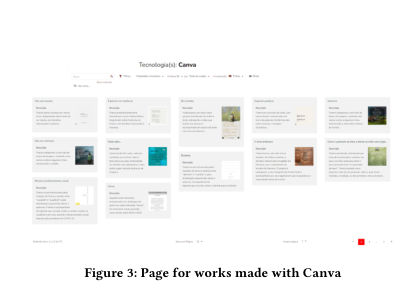
media platforms, but not in websites that do not require user login before navigation) and Hashtags (as hyperlinks that track content on social media and allow creators to categorize their works, indicating if they should be read as #poetry, #contemporarypoetry, #instapoetry, etc.). A key functionality of Tainacan that affects the structure of the archive is its ability to populate a field with multiple elements from a list when the metadata is a taxonomy. This feature was especially useful in fields like Creators, in cases where a work is created by more than one author (such as in the visual poems Contrapoemas and Anfipoemas, by Regina Pouchain and Wlademir Dias-Pino); in the Format field, as any multimodal work can combine text, audio, image, and video (as in the videopoem Poemargens, by Anna Maria Moura and Sol Ferreira); or in the Hashtags field, as any individual post can have many hashtags associated with it (like the poem Soneto à Ofélia, by Allan Kenayt, tagged with #allankenayt, #cuiabá, #decassílabo, #decassílabos, #hamlet, #janelasdomeuquarto, #literatura, #literaturabrasileira, #literaturabrasileiracontemporanea, #literaturacontemporânea, #matogrosso, #ofélia, #poema, #poesia, #poesiaautoral, #shakespeare, #soneto, #williamshakespeare). The hypertextual architecture of Tainacan is also a significant feature in the Acervo de Literatura Digital Mato-Grossense. We aimed for the archive to be a platform not only for data storage and retrieval, but also for discovery through association of thoughts and similarities between records, as hypertext was initially conceived by Vannevar Bush [40]. Therefore, the fact that every element in a taxonomy is clickable in Tainacan and leads the user to a page with all other records involving the same element is a crucial feature in an archive that is intended for digital literature scholars, teachers, and students alike, assisting them in exploring the recorded texts and making sense of the possible associations among them. An example of hypertextual navigation in Tainacan can be seen in Figures 2 and 3. In Figure 2, if we click on the link "Canva", in the
Field Format of metadata
Purpose in the archive
Format Taxonomy This taxonomy lists all semiotic formats that works may present: text, image, audio, and video.
Interactivity Taxonomy This taxonomy lists two possibilities: whether a work is interactive (changing its materiality in response to users’ input) or not.
Genre Taxonomy This taxonomy lists both traditional literary genres (prose, poetry, and their subgenres, such as short stories, epistolary prose, sonnets, haikai, etc.) and genres of literature in an expanded field [25], such as webcomics, pod books, and videopoems.
Hashtags Taxonomy This taxonomy lists all hashtags accompanying the original posts on social media platforms.
Technologies Taxonomy This taxonomy lists all technologies used to produce or design the digital literature texts in the archive, including word processors, slide presentation apps, graphic design apps, video editors, generative AI, etc.
Publication medium
Taxonomy This taxonomy lists all platforms from which the texts were gathered, spanning from artists’ blogs and personal websites to social media platforms such as TikTok, Instagram, Facebook, YouTube, etc.
Table 3: Fields and metadata in the Categorization section of an item’s page
Technologies field of the record for the poem Universo, by Elisângela Saboia, we are directed to another page (Figure 3) listing all works made with the same tag. Before concluding this section, it is crucial to emphasize the importance of discussing the specificities of digital literature from the state of Mato Grosso (mostly social media platforms), the architectural features of our archive, and the technical and political implications of opting for Tainacan as a tool, when considering our archive as a medium, as conceptualized by Régis Debray [12]. According to Debray, a medium is both an organized matter (OM), namely a materiality that is given shape by intentional formal procedures (such as a printed book, a handwritten letter, or a digital literature archive) and a materialized organization (MO), i.e.,
Decolonizing and peripheralizing e-lit in Latin America: the case of the Acervo de Literatura Digital Mato-Grossense, Brazil HT ’24, September 10–13, 2024, Poznan, Poland
Figure 2: Item’s page for the poem Universo, by Elisângela Saboia
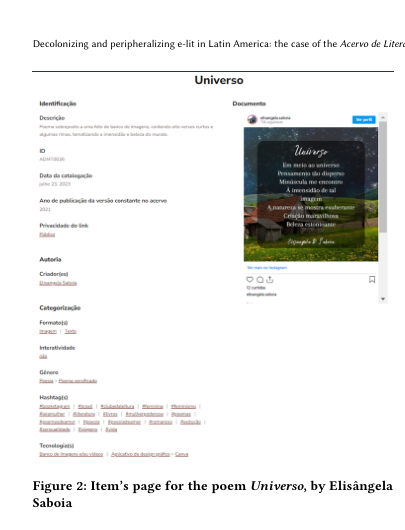
Figure 3: Page for works made with Canva
the values and principles guiding communication mediated by the medium. In this context, our political and axiological choices regarding the definition of digital literature and our archive’s inclusive and decolonial approach represent materialized organization. These choices are intertwined with the archival, curatorial, and technical decisions reflected in the design of the Acervo as an organized matter.
3 CURATING THE ACERVO: IDENTIFYING AND SELECTING TEXTS
In this section, we provide a detailed description of how texts and authors were identified and selected for the archive, thereby preparing our digital literary medium to effectively mediate the interaction between users and the archived material. Our initial corpus, established prior to submitting the Acervo project in response to the call for applications from the Foundation for Research Support of Mato Grosso State, consisted of twelve authors, whose literary texts had been serendipitously discovered by research members browsing their social media platform feeds. Among those authors, five could be considered somewhat canonical poets, well-known among local scholars and literary critics, while the other seven only occasionally posted digital literature texts on their Instagram accounts. Once the project was approved for funding and we commenced construction of the archive, our team initiated the search for texts that met our inclusion criteria: digital literature produced by artists from or residing in Mato Grosso. To do so, after agreeing on the definition of digital literature for our project (discussed in detail in section 2), team members explored the most popular social media platforms in Brazil (Instagram, Twitter, Facebook, TikTok, YouTube, and Wattpad), beginning with their own friends, followers, and users they followed. Although this method introduced a clear bias to our sample, it proved to be very effective, especially considering the local scope of our archive and the fact that all research members are either born in or live in Mato Grosso and are actively involved in the literary scene as students, teachers, writers, researchers, or critics - much like the authors they sought. Additionally, team members conducted exploratory research on these social media platforms using hashtags that could index digital literature produced in Mato Grosso, such as #literaturamatogrossense (literature from Mato Grosso), and all variations in genre (literature, poetry, prose, etc.), toponymy (the name of the Brazilian state, its acronym, or references to its mains cities), or metonymy (references to some of its most popular symbols, as cashew fruit and mango). However, the results from searches based on such hashtags were very limited, either because many artists did not use any hashtags, or because they used hashtags unrelated to their city, state, or region. That may be attributed to the lack of a well-established digital literature culture in the state, or because many creators prefer to maintain a literary persona not necessarily tied to a regionalist identity, using more de-localized hashtags instead, such as #poemadeamor (love poem), #microconto (micro-tale), or #fanfic. Regionalism, whether as a literary style or an identity claim in the creation of literary personas, is a significant phenomenon in the study of literature produced in regions of Latin America distant from major urban centers. In Brazil, for example, literature originating in places outside Rio de Janeiro, São Paulo, and Brasília – the country’s primary economic and political hubs –is often read, analyzed and critiqued from a regionalist perspective. However, this approach has been subject to debate and criticism, as it may lead to oversimplified assertions, as highlighted out by Brazilian researchers Vinícius Pereira [31], Everton Barbosa [6] and Antonio Candido [9]. Such assertions include the belief that: i. authors from
HT ’24, September 10–13, 2024, Poznan, Poland Anonymous
non-urban centers can only speak about their local conditions, nature, and culture; ii. regionalist texts are only of high quality if their localist approach opens up to universal truths and feelings; iii. regionalist styles or motifs represent an essential rather than performative aspect of the authors’ identity. While a comprehensive discussion of this phenomenon is beyond the scope of this paper, it is important to acknowledge that dilemmas of regionalist literature affected our exploratory search for authors from Mato Grosso on social media platforms through hashtags. To identify more authors in Mato Grosso who produced digital literature, we employed additional strategies such as sharing a Google Form and an Instagram poll open to contributions from third parties. However, we received no responses to the Instagram poll and only one response to the Google Form, where an author submitted links to her own texts, which unfortunately fell outside the definition of digital literature our project adopted, as they were commercial e-books made for conventional e-readers. We believe that, once again, due to the lack of a well-established digital literature culture in the state, people who encountered the poll and form might have been unfamiliar with the concept of digital literature and felt hesitant to contribute. After conducting these extensive exploratory procedures to uncover digital literature from Mato Grosso, we amassed a corpus encompassing thousands of texts, spanning various creators, genres, platforms, and technologies. This abundance aligns with trends identified by Luís Vicente Mora[27] in creative writing on social media platforms, which is a part of what he called "literature of the millions", a vast body of work produced, shared, and consumed in quantities unprecedented in the print editorial market, often flouting traditional aesthetic norms and literary canons. Our limitations in terms of project schedule, budget, workforce, and space in server prevented us from archiving all the material we collected from the "literature of the millions" in Mato Grosso, which imposed on us the need to make further curatorial choices for the archive. Drawing inspiration from [27], we opted not to dismiss texts based on traditional notions of "literary quality" or other aesthetic standards typical of conventional literary circles. Instead, we opted for another restriction: no more than eight texts by the same author would be archived. While arbitrary, this limit has proven effective in showcasing a diverse array of styles, technologies, motifs, and more from individual authors. The results from all the previously described curatorial choices, along with an overview of the archived material, is described in section 4.
4 THE MATERIAL ARCHIVED SO FAR IN THE ACERVO DE LITERATURA DIGITAL MATO-GROSSENSE
Jacques Derrida [13] argues that archives function as spaces of dual consignation: the archived material is consigned (entrusted) to the archivist, who is responsible for its preservation, organization and curation, while also being consigned in an etymological sense, as an archive serves as a repository where signs from different times and spaces converge (con, meaning "together", and signum, meaning "sign").
Similarly, the Acervo de Literatura Digital Mato-Grossense fulfills this dual role, by both preserving the recorded texts and establishing connections among them and authors through its hypertextual navigation tools and database. Regarding the hypertextuality of the archive, it manifests on two levels: a. embedded within each entry as a feature facilitated by Tainacan, enabling users to navigate between elements of any taxonomy, as elaborated in section 2.2; and b. within the website’s structure. Figure 4 shows the homepage of page of the Acervo de Literatura Digital Mato-Grossense, where hypertextual strategies were implemented to encourage users to explore the archive critically. The upper part of the homepage provides users with options to search for specific terms in the search box, access the project’s social media accounts, contact the project via e-mail, access the database in Tainacan, or visit a secondary page with information about the project’s goals, team members, and photos and videos from the project’s launch ceremony. The middle and lower parts of the homepage allow users to navigate the archive through specific filters, such as text titles, creators, genre, or technology. By clicking on "Explore the Archive ", the user is redirected to the database (Figure 5), where they can utilize various filters for a faceted search (including creators, format, genre, technologies, publishing mediums, interactivity, or hashtags). Users can also select which metadata to display on the screen, sort results in ascending or descending order, and choose from different view modes, such as grid, card, stack, masonry, and list. Additionally, users have the option to request other view modes, such as Tainacan API in JSON format, HTML spreadsheet, CSV file, or simple JSON. As of March 3rd, our archive contains 304 text records, by 72 different creators: 272 are categorized as poetry, 36 as prose, and 6 as comics. The prevalence of poetry over other genres mirrors trends observable in other digital literature archives: as stated by Vinícius Pereira [32] in a research paper on digital poetry archival procedures in Latin American anthologies and repositories, 68% of all works in the Cartografía de Literatura Digital Latinoamericana, and 70% of all works in the Atlas da Literatura Digital Brasileira are poetry. The percentage in the Acervo de Literatura Digital MatoGrossense is still significantly higher, 89%, which might be due to the fact that social media platforms not originally devised for literary expression are more open to experimentation with shorter texts (which is also typical of contemporary poetry), aligning with prevalent fast reading practices on social network feeds. In that sense, it is important to highlight that 99.3% of the works recorded in our archive were originally published on social media platforms. The four exceptions that are not from social media platforms are the Contrapoemas and Anfipoemas, by Wlademir DiasPino and Regina Pouchain (two series of thousands of visual poems made with Adobe Photoshop and intended to be presented in physical exhibitions by means of projectors), Novaleva, by Caio Ribeiro (a hypertextual and hypermedia piece of poetic prose published on a personal website), and Homempoema, also by Caio Ribeiro (a poem coauthored in Google Docs by the audience of a performance led by Caio in the launch ceremony of the Acervo). The discrepancy between interactive (2%) and non interactive works (98%) is also worth of attention. Most works are non interactive because they are individual posts on social media platforms,
Decolonizing and peripheralizing e-lit in Latin America: the case of the Acervo de Literatura Digital Mato-Grossense, Brazil HT ’24, September 10–13, 2024, Poznan, Poland
Figure 4: Homepage interface of the Acervo de Literatura Digital Mato-Grossense

which do not allow readers to affect the materiality of the texts read besides liking, sharing, or commenting. Exceptions to that include the aforementioned Novaleva and Homempoema, by Caio Ribeiro, and poems composed of Instagram polls, such as Para Crianças, by Daniel Ianae, or Impulsopoemas, by Caio Ribeiro, originally posted as stories and later archived as highlights. In these stories, poets addressed readers through polls requesting input they would later incorporate into poems published on the same highlights section. A similar disparity can be found between private works (5.2%) and public works (94.8%), defined by the privacy settings of the original publishing accounts. However, this disparity primarily affects accessibility rather than the aesthetics of texts themselves.
Figure 5: Database interface of the Acervo de Literatura Digital Mato-Grossense
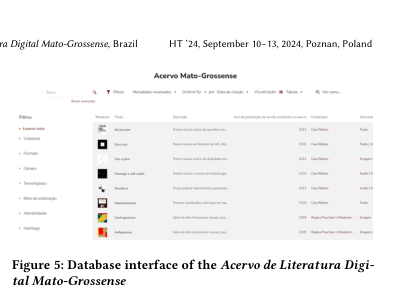
Figure 6: Word cloud with hashtags associated to texts in the archive
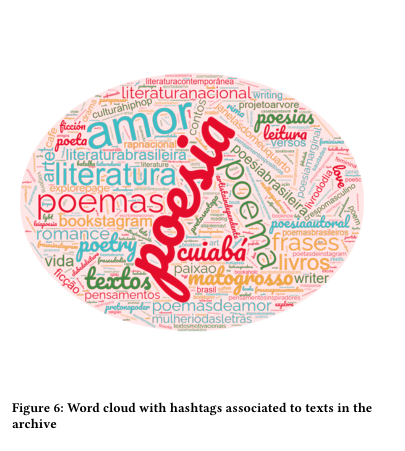
As a collateral impact to our archive, private texts cannot be embedded directly on the archive’s page, requiring users to access the original social media platform and often add the creator as a friend to view the content. Regarding hashtags, 44% of the works in the archive included them. A word cloud in Figure 5 showcases the most common hashtags, which can be broadly categorized as: i. genre hashtags – #poesia (poetry) #poema (poem), #literatura (literature), #rapnacional (national rap) etc.; ii. thematic hashtags – #paixão (passion), #romance, #vida (life) etc.; iii. geographical hashtags – #cuiaba, #matogrosso, #poemasbrasileiros (Brazilian poems), #literaturabrasileira (Brazilian literature) etc.; and iv. intersectional hashtags – #mulheriodasletras (a Brazilian collective of women writers), #pretosnotopo (black at the top), #crespomasculino (masculine curls), etc. The words in the cloud are in Portuguese respecting how they were written as hashtags.
HT ’24, September 10–13, 2024, Poznan, Poland Anonymous
When it comes to the technologies used by creators, we encountered a challenge with this field, as we had to leave it blank in 36.2% of records. This was because many creators did not answer our questions about the technologies they had used and because social media platforms seldom allow users to check what software was used to produce images, texts, audios or videos. On the other hand, in the remaining 63.8% of records where we were able to retrieve this piece of information, we observed a significant diversity, as shown in Table 4. The total number of technology records slightly exceeds the number of works where this field was not left blank, as some works are associated with more than one technology. For example, in the case of the webcomics Lourrence, by João Victor Santos, the creator used Paint Tool Sai for drawing the comics and Canva for writing and composing images with texts. Similarly, in the videopoem Eu tentei tanto ficar contigo, by Leda Mcytsniy, Canva was used to design individual frames, while CapCut was employed for video editing.
Technology N of records
Graphic design tool (Canva) 73
Graphic design tool (PicsArt) 33
Image and video banks 20
Word processor tool (Notes) 12
Graphic design tool (Adobe Photoshop) 8
Native social media filters (Instagram) 6
Digital painting tool (Paint Tool Sai) 5
Native social media background editor (Facebook)
5
Graphic design tool (Adobe Première) 5
Video edit tool (CapCut) 5
Generative AI (SeaArt) 4
Graphic design tool (Illustrator) 4
Graphic design tool (Phonto) 4
Graphic design tool (Shotwell) 4
Video edit tool (Inshot) 4
Graphic design tool (Indesign) 3
Video edit tool (Movavi) 3
Word processor tool (Microsoft Word) 3
Graphic design tool (Desygner) 2
Graphic design tool (Photoshop CS6 Portable) 2
Graphic design tool (Procreate) 2
Native social media background editor (Instagram)
2
Native social media polls (Instagram) 2
Word cloud tool (WordArt) 2
Markup language (HTML) 1
Photo storage tool 1
Slide creation tool 1
Video edit tool (Videomaker) 1
Word processor tool (Google Docs) 1
Word processor tool (Keep) 1
Total 219
Table 4: Technologies used for creating works in the archive
100 99.6
80
59.5
Percentage (%)
60
40
17.1
20
12.1
0
Text Image Audio Video
Format
Figure 7: Percentage of different formats in the archive

Table 4 reveals a considerable range of technologies utilized among these works, with most tools mentioned in fewer than 5 entries. The table highlights that the most prevalent technologies include graphic design tools like Canva, Picsart, and Adobe Photoshop, primarily employed for creating images with embedded text, often shared as content on social media platforms. Additionally, it showcases image and video banks, where creators frequently source visuals to complement textual content, either as captions or overlaid on images. Word processing apps such as Notes are also prominent, serving as platforms for writing texts and capturing screenshots for sharing on social media. Notably, there is a diverse array of tools for similar functions, particularly graphic design and video editing apps. Many creators indicate that they perform the entire process on their smartphones, from content creation and design to posting and engaging with audiences on social media. This trend aligns with the demographic profile of most creators in the archive, many of whom are under 30 years old and may lack access to desktop or laptop computers due to financial constraints. Connected to the tools utilized by creators are the formats of the works in the Acervo de Literatura Digital Mato-Grossense: 99.6% of our archive consists of works utilizing text, 59.5% image, 17.1% audio, and 12.1% video, as observable in Figure 7. The total of these values surpasses 100% due to the majority of works (69.5%) involving more than one format. Of the 30.5% comprising a single format, 29.6% solely employ text, 0.6% exclusively audio, and 0.3% solely image. The dominance of text over other formats is to be expected in any literary archive. However, the digital nature of these works allows for diverse materialities and semiotic organizations of textual content. Some works comprise verbal content published on textual fields of platforms, such as the fanfic Tchapa e cruz, by Carolina Rodrigues, on the Spirit Fanfics platform. Others, like the haiku Saio Contente, by Eduardo Mahon, present verses formatted as images on Canva or similar apps, employing graphic design elements such as colors, typography, and images. Texts can also manifest as written
Decolonizing and peripheralizing e-lit in Latin America: the case of the Acervo de Literatura Digital Mato-Grossense, Brazil HT ’24, September 10–13, 2024, Poznan, Poland
signs (captions) in videopoems, like A sua voz me irrita, by Amelly Ruth, or as auditory signs in podbooks (audiobooks as podcasts) and declamatory videopoems, such as A casa do posto, by Larissa Campos, and Luto pelo mundo, by Malu Pimentel, respectively. The only work in the archive devoid of textual format is Contrapoemas, a series of three thousand visual poems by Regina Pouchain and Wlademir Dias-Pino. These images, produced with Adobe Photoshop from 1995 to 2008, contain no recognizable written words; they are products of distortions and blurs of vibrant-colored digital images. The inclusion of Contrapoemas in the Acervo de Literatura Digital Mato-Grossense as literary material, despite its lack of verbal matter, stems from the classification Pouchain and Dias-Pino gave to their work, as evident from the series title. Brazilian scholars like Isaac Ramos [35] and Vera Nova [30] concur and describe Contrapoemas as a digital extension of visual poetry avant-gardes that flourished in the state of Mato Grosso in the second half of the twentieth century. Images rank as the second most popular format used in the works in the archive, aligning with social media platforms and web 2.0 digital culture, where written materials are often accompanied by visuals, either through juxtaposing or overlaying words and images. 77.7% of the works in the archive were originally posted on Instagram, a platform centered on images, leading to the most common format combination in our archive being text + image (59.2% of the entire archive). Static images in these works can be original creations by artists (as the drawings illustrating the haiku Eu pólen, by Thaynara Andrade), by collaborators (as in the piece of poetic prose Querido presente, by Yves Pardin, accompanied by a photo by @liliwinxx), or by generative AI (as in Pai, by Rafael Vangelles, who used the app SeaArt to produce the drawing the goes along with the poem). They can also be taken from image banks (as in the poem Nada além, by Elisângela Saboia, who formatted her verses over an illustrated background downloaded from digital banks). If works published on Instagram are the vast majority in the archive, representativeness drastically decreases when it comes to social media platforms where images are optional elements in posts, such as Facebook (6%), Medium (1.2%), or Twitter (0.3%). The same applies to social media platforms limited to non-pictorial contents, such as SoundCloud (1.2%), Spotify (0.3%), and Apple Podcasts (0.3%). Audio, though not as prevalent in the archive, can manifest in different ways in the works. Some are purely spoken word poetry shared on audio-centered platforms, like the sound performance Carta para Vitória, by Morgana Poiesis, who recorded her whispering of a poetic text and shared it on SoundCloud. Others feature texts (with or without accompanying images) posted on platforms that have native features to add audio to a post. For instance, in the poem Identificação, by Ryane Leão, a snippet of the track "Espalhe amor", sung by Brazilian artist Anavitória, serves as background. Many videopoems in the archive come with their own soundtracks, ranging from songs to various forms of poetry declamation: in Ave poesia marginal, by Sol Ferreira, the audio features the poet’s oral performance; in Deslizes, by Divanize Carbonieri, a synthetic voice reads the short story. Video ranks as the least popular format in the archive, despite the rapid growth of short-video platforms like TikTok or Kwai among the youth. Most videos in the archive (84,2% of them) are reels
posted on Instagram, like the videopoem De instante, by Giancarlo M Costa. Other than Instagram reels, the archive features three videopoems or videonarratives posted on TikTok, like O evangelho segundo o sol, by Felipe Holloway; two videopoems on YouTube, like Poemargens, by Anna Maria Moura and Sol Ferreira; and one hypertextual narrative on HTML that uses video content: Novaleva, by Caio Ribeiro. Lastly, it is important to note that, as previously mentioned, our classification of formats was adapted from a taxonomy defined by the CELL consortium, and it benefits from the fact that concepts such as text, image, audio and video are of common knowledge. However, utilizing this taxonomy does not come without challenges and may involve arbitrary decisions concerning the boundaries between formats in multimedia works. Examples of that are videopoems with spoken words (like Anel, by Divanize Carbonieri), or written poems that include emojis (like Quando eu caí, by Ágatha Moraes). More precise classification models, particularly those grounded in Semiotics and Multimedia Theory, are uncommon in digital literature archives. For instance, Richard Meyer’s [26] model differentiates between modes of representation (verbal vs. pictorial) and information channels (auditory vs. visual), rather than relying solely on the concept of format.
5 CONCLUDING REMARKS
This paper described and analyzed the hypertextual archive Acervo de Literatura Digital Mato-Grossense, featuring digital literature created by artists living in or hailing from Mato Grosso, Brazil. Unlike continental or national initiatives, such as Cartografía de Literatura Digital Latinoamericana, Antología LiteLat – v.1, or Atlas da Literatura Digital Brasileira, our archive has a local scale, originally contributing to the documentation, preservation, and critique of digital literature in Latin America. This localized approach offers valuable insights for similar projects with limited resources and specialized teams. It also underscores the advantages of viewing Brazil or Latin America as multi-centric peripheral territories, each possessing its own centers and peripheries within their diverse land masses. Key decisions in our project were informed by the distinct characteristics of digital literature in a region distant from Brazil’s major urban centers. The concept of third generation electronic literature, by Leonardo Flores [14], and the idea that digital literature can be a product of experimentation with social media networks, as posited by Carolina Gainza [15], were particularly influential in describing digital literature from Mato Grosso. In regions with unequal access to education, technology, and limited financial support for artists, it is sensible to expand the definition of digital literature to include works created with widely available tools like smartphones and popular free applications, even if lacking some traditional e-lit features, such as interactivity or ergodicity. A situated approach enables us to examine digital literature from marginalized regions of the Global South for its intrinsic value, rather than through Eurocentric or Americentric lenses dictating what it ought to be. Consequently, we demonstrated the deep-rooted alignment of the Acervo de Literatura Digital Mato-Grossense with decolonial principles, informing both the conceptualization of digital literature within this project and the selection of Brazilian open repository
HT ’24, September 10–13, 2024, Poznan, Poland Anonymous
platform Tainacan for creating the archive. The ethos of this Brazilian free software project harmonized with our project, and the flexible affordances of the tool enabled the creation of an archive tailored to the unique characteristics of our corpus. Privacy and hashtags, for example, are taxonomies Tainacan permitted us to add to the archive, so as to curate important metadata on social media platforms, where most of the works in the Acervo come from. This paper also offered a comprehensive overview of the metadata presented on each item’s page within the Acervo, alongside discussions of its interfaces and hypertextual navigation functionalities. Furthermore, we reported the exploratory methods employed to identify and select works for the archive, including hashtag searches and examination of researchers’ social media connections. Searching by hashtags yielded limited results, as most creators either did not use hashtags or used hashtags unrelated to local references, which might be due to the controversial valuation of regionalism in Brazilian contemporary literature. Most creators whose works are recorded in the archive are social media connections of the research group members; while this undoubtedly introduced bias to the sample, it was the most efficient method given the local focus of the Acervo de Literatura Digital Mato-Grossense. We also provided an overview of the archived materials, organized by key metadata parameters such as creators, genres, publishing medium, interactivity, privacy, hashtags, technology and format. Graphs, tables and a word cloud were used to showcase the distribution of works in the archive. Limitations of the metadata categorization, inherited from the CELL consortium, were also discussed, especially concerning the taxonomy of formats. The subsequent phases of the project involve evaluating the usability and communicability of the website of the Acervo, as well as enhancing its visibility and retrievability by search engines. Considering that the Acervo de Literatura Digital Mato-Grossense is a relatively new archive, launched in November 2023, its analytics currently reflect modest metrics: within approximately nine months, it has attracted around 1,000 users. Of these, 53.5% came from direct traffic sources, 28.5% from organic search, 15.1% from organic social, 7.8% from referrals, 7% from unassigned sources, and 1% from organic video. These are features we have to work on by increasing the discoverability and accessibility of the platform. Our future plans also include expanding the archive by adding new records to it through both spontaneous online discoveries and induced demand via workshops on digital literature in the state of Mato Grosso. Additionally, strategies will be developed to utilize the Acervo as an educational tool across primary, secondary, and higher education levels. That will demand developing a syllabus and didactic sequences that invite students to critically explore the Acervo de Literatura Digital Mato-Grossense, with a view to fostering skills to read and create digital literature in its particularities. In the long term, we aim to establish partnerships with public physical libraries and archives in Mato Grosso, which house extensive collections of state literature, such as the Saber com Sabor Municipal Library in Cuiabá and the Estevão de Mendonça State Library. Our objective is to propose projects that bridge the gap between print and digital literature, fostering the development of a multimedia literary field in Mato Grosso.
Acknowledgments
The authors express their gratitude for the funding and support provided by FAPEMAT (the Foundation for Research Support of Mato Grosso State), to the research project "Criticism and preservation of digital poetry from Mato Grosso", and to CNPq (National Council for Scientific and Technological Development) for the research grant.
References
[1] 2023. Tainacan. Wikipedia. https://pt.wikipedia.org/wiki/Tainacan Accessed: March 16, 2024.
[2] 2024. Software livre brasileiro. Tainacan. https://tainacan.org/ Accessed: March 16, 2024.
[3] Espen Aarseth. 1997. Cybertext: Perspectives on Ergodic Literature. The Johns Hopkins University Press, Baltimore, MD.
[4] Hannah Ackermans. 2019. Narrating the Sociality of the Database: A Digital Hermeneutic Reading of The Atlas Group Archive and haikU. In Proceedings of the 30th ACM Conference on Hypertext and Social Media (Hof, Germany) (HT ’19). Association for Computing Machinery, New York, NY, USA, 117–121. https: //doi.org/10.1145/3342220.3343654
[5] Crispel Aude. 2006. Net-art, entre conflit et sensibilité de l’interface. In Proceedings of the 18th Conference on l’Interaction Homme-Machine (Montreal, Canada) (IHM ’06). Association for Computing Machinery, New York, NY, USA, 179–182. https: //doi.org/10.1145/1132736.1132763
[6] Everton Almeida Barbosa. 2011. A tendência regionalista da crítica literária e a posição do intelectual em Mato Grosso. In Tópicos de leitura: literatura e contexto, Luzia Olivia dos Santos (Ed.). Carlini & Caniato, Cuiabá.
[7] Kathi Inman Berens. 2019. E-Lit’s #1 Hit: Is Instagram Poetry E-literature? Electronic Book Review (2019). https://doi.org/10.7273/9sz6-nj80
[8] Nestor García Canclini. 2016. O Mundo Inteiro Como Lugar Estranho. Edusp, São Paulo.
[9] Antonio Candido. 1989. A educação pela noite & outros ensaios. Ática, São Paulo.
[10] CELL. 2021. Introducing CELL. Consortium on Electronic Literature. https:// cellproject.net/
[11] CETIC.br. 2023. Pesquisa sobre o uso das tecnologias de informação e comunicação nos domicílios brasileiros : TIC Domicílios 2022 (1 ed.). Núcleo de Informação e Coordenação do Ponto BR, Comitê Gestor da Internet no Brasil, São Paulo. https://cgi.br/publicacao/pesquisa-sobre-o-uso-das-tecnologias-deinformacao-e-comunicacao-nos-domicilios-brasileiros-tic-domicilios-2022/
[12] Régis Debray. 2000. Transmitir: O segredo e a força das ideias. Vozes, Petrópolis. [13] Jacques Derrida. 1996. Archive Fever. University of Chicago Press, Chicago. [14] Leonardo Flores. 2019. Third Generation Electronic Literature. Electronic Book Review (April 7 2019). https://doi.org/10.7273/axyj-3574
[15] Carolina Cortés Gainza. 2020. Nuevos escenarios literários: Hacia una cartografía de la literatura digital latino-americana. In World Editors: Dynamics of Global Publishing and the Latin American Case between the Archive and the Digital Age, Gustavo Guerreo, Benjamin Loy, and Gesine Müller (Eds.). De Gruyter, Berlin, 331–349.
[16] Florencia Garramuño. 2014. Frutos Estranhos: Sobre a Inespecificidade na Estética Contemporânea. Rocco, Rio de Janeiro.
[17] Tom Hapgood, Lucy Petrovich, Peter Briggs, Mike Holcomb, Charles Guerin, James Smith, and Cynthia Barlow. 2003. ArtStream: Web art in a curatorial setting. In ACM SIGGRAPH 2003 Web Graphics (San Diego, California) (SIGGRAPH ’03). Association for Computing Machinery, New York, NY, USA, 1. https://doi.org/ 10.1145/965333.965372
[18] Katherine Hayles. 2002. Writing Machines. MIT Press, Cambridge. [19] Katherine Hayles. 2008. Electronic Literature: New Horizons for the Literary. University of Notre Dame Press, Indiana.
[20] International Organization for Standardization. 2017. Dublin Core Metadata Element Set. Technical Report ISO 15836-1:2017. International Organization for Standardization.
[21] Teresa Jewell. 2010. Open to Everyone: How Open Source Communities Can Benefit from Diversity Without Disunity. Open Source Business Resource (August 2010). https://timreview.ca/article/369
[22] Andreas M. Kaplan and Michael Haenlein. 2010. Users of the world, unite! The challenges and opportunities of Social Media. Business Horizons 53, 1 (2010), 59–68. https://doi.org/10.1016/j.bushor.2009.09.003
[23] Sofia Kitromili, James Jordan, and David E. Millard. 2019. What is Hypertext Authoring?. In Proceedings of the 30th ACM Conference on Hypertext and Social Media (Hof, Germany) (HT ’19). Association for Computing Machinery, New York, NY, USA, 55–59. https://doi.org/10.1145/3342220.3343653
[24] Claudia Kozak. 2021. Experimental Electronic Literature from the Souths: A Political Contribution to Critical and Creative Digital Humanities. Electronic Book Review (3 January 2021). https://doi.org/10.7273/zd5g-zk30
Decolonizing and peripheralizing e-lit in Latin America: the case of the Acervo de Literatura Digital Mato-Grossense, Brazil HT ’24, September 10–13, 2024, Poznan, Poland
[25] Rosalind Krauss. 1985. Sculpture in Expanded Field. The Originality of the Avant-Garde and other Modernist Myths (1985).
[26] Richard Meyer. 2009. Multimedia Learning. Cambridge University Press, Cambridge.
[27] Vicente Luís Mora. 2021. La escritura a la intemperie: Metamorfosis de la experiencia literaria y la lectura en la cultura digital. Universidad de León, León.
[28] S. Moulthrop. 1989. Hypertext and “the hyperreal”. In Proceedings of the Second Annual ACM Conference on Hypertext (Pittsburgh, Pennsylvania, USA) (HYPERTEXT ’89). Association for Computing Machinery, New York, NY, USA, 259–267. https://doi.org/10.1145/74224.74246
[29] Eric W.T. Ngai, Spencer S.C. Tao, and Karen K.L. Moon. 2015. Social media research: Theories, constructs, and conceptual frameworks. International Journal of Information Management 35, 1 (2015), 33–44. https://doi.org/10.1016/j.ijinfomgt. 2014.09.004
[30] Vera Casa Nova. 2009. Os Infopoemas de Wlademir Dias-Pino. Sibila. Revista de Poesia e Crítica Literária (06 dez 2009). https://sibila.com.br/critica/osinfopoemas-de-wlademir-dias-pino/3281 [21 fevereiro 2023].
[31] Vinícius Carvalho Pereira. 2017. As Des-Reterritorializações de Cuiabá Na Obra de Silva Freire. Línguas & Letras 18, 40 (2017), 7–25. https://doi.org/10.5935/19814755.20170011
[32] Vinícius Carvalho Pereira. 2022. A Poesia Digital em Arquivos Online LatinoAmericanos: Convergências e Divergências. Revista Brasileira de Literatura Comparada 24, 46 (January-April 2022), 224–244. https://doi.org/10.1590/2596304x20222446vcpA
[33] Jessica Pressman. 2014. Digital Modernism: Making it New in New Media. Oxford University Press, Oxford.
[34] Aníbal Quijano. 2000. Coloniality of Power, Eurocentrism, and Latin America. Nepantla 1, 3 (2000), 533–580.
[35] Isaac Newton Almeida Ramos. 2011. Vanguardas Poéticas em Permanência: A Revalidação de Wlademir Dias-Pino e Silva Freire. PhD thesis in Portuguese Language Comparative Literature Studies. Faculdade de Filosofia, Letras e Ciências
Humanas, Universidade de São Paulo.
[36] R. Rocha. 2023. Uma proposta crítico-metodológica para a análise da literatura digital brasileira. Todas as Letras – Revista de Língua e Literatura 25, 3 (September/December 2023), 1–17. https://doi.org/10.5935/1980-6914/eLETDO16557
[37] Simon Rowberry. 2023. Historiographies of Hypertext. In Proceedings of the 34th ACM Conference on Hypertext and Social Media (Rome, Italy) (HT ’23). Association for Computing Machinery, New York, NY, USA, Article 41, 10 pages. https: //doi.org/10.1145/3603163.3609038
[38] Viktor Shklovsky. 1965. Art as Technique. In Russian Formalist Criticism: Four Essays, Lee T. Lemon and Marion J. Reis (Eds.). University of Nebraska Press, Lincoln.
[39] Igor Steinmacher, Gustavo Pinto, Igor Wiese, and Marco Aurelio Gerosa. 2020. Software Livre. In Computação e Sociedade: A Tecnologia - Volume 3 (1st ed.), Cristiano Maciel and José Viterbo (Eds.). EdUFMT Digital, Cuiabá-MT.
[40] The Atlantic 1945. As We May Think. The Atlantic Monthly 176, 1 (1945), 101– 108 pages.
[41] Yra van Dijk. 2015. Amateurs Online: Creativity in a Community. Center for Literary Computing and ELMCIP.
[42] We Are Social and Meltwater. 2023. Digital 2023 Global Overview Report. Available online. https://datareportal.com/reports/digital-2023-global-overviewreport
[43] Huiwen Zhang, Dana McKay, and George Buchanan. 2021. I’ve Got All My Readers With Me: A Model of Reading as a Social Activity. In Proceedings of the 2021 Conference on Human Information Interaction and Retrieval (Canberra ACT, Australia) (CHIIR ’21). Association for Computing Machinery, New York, NY, USA, 185–195. https://doi.org/10.1145/3406522.3446022
Received 20 February 2024; revised 12 March 2024; accepted 5 June 2024
Do you like what you are reading? Subscribe to receive updates.
Unsubscribe anytime