
Using ChatGPT in Content Marketing: Enhancing Users' Social Media Engagement in Cross-Platform Content Creation through Generative AI
Kholoud Aldous (Qatar Computing Research Institute, Doha, Qatar; kkaldous@hbku.edu.qa) · Joni Salminen (University of Vaasa, Vaasa, Finland; jonisalm@uwasa.fi) · Ali Farooq (University of Strathclyde, Glasgow, Scotland; afk@ieee.org) · Soon-gyo Jung (Qatar Computing Research Institute, Doha, Qatar; sjung@hbku.edu.qa) · Bernard J. Jansen (Qatar Computing Research Institute, Doha, Qatar; jjansen@acm.org)
Published in HT '24: 35th ACM Conference on Hypertext and Social Media · DOI: 10.1145/3648188.3675142 · License: CC BY 4.0
Authors: Ali Farooq, Kholoud Aldous, Soon-gyo Jung, Joni Salminen, Bernard J. Jansen
Keywords: Facebook, Generative AI, Instagram, Social media, Twitter
Session: Practitioners
Pages: 376–383
Conference: HT'24
Abstract
As the integration of artificial intelligence into social media continues to attract attention, the key impacts on content marketing are still undefined. Initial studies have shown that language models are capable of producing content that is competitive with content created by humans. However, how can such content be tailored for different social media platforms as part of an organization's content marketing strategy? To address this question, we evaluate the effectiveness of using GPT-4, to generate cross-platform content for Facebook, Instagram, and Twitter (currently X). Participants ($N = 892$) evaluated 30 AI-created content (ACC) and human-created content (HCC). Findings show that ACC scored higher on preference by users, call-to-action, and emotional responses than HCC for Facebook. However, AI's advantage wanes on Twitter and Instagram, where posts are terser. The results imply that GPT-4 comprehends what type of content to create for different platforms, making it a useful tool for cross-platform content creation.
CCS Concepts
Human-centered computing → Collaborative content creation; Social media.
Keywords
Social media, Facebook, Instagram, Twitter, Generative AI
ACM Reference Format
Kholoud Aldous, Joni Salminen, Ali Farooq, Soon-gyo Jung, and Bernard J. Jansen. 2024. Using ChatGPT in Content Marketing: Enhancing Users' Social Media Engagement in Cross-Platform Content Creation through Generative AI. In 35th ACM Conference on Hypertext and Social Media (HT '24), September 10–13, 2024, Poznan, Poland. ACM, New York, NY, USA, 8 pages. https://doi.org/10.1145/3648188.3675142
1 INTRODUCTION
Social media is a fundamental part of how people communicate, share, and interact online [13, 61]. Social media platforms, such as Facebook (FB), Instagram (IG), and Twitter (TW) (currently "X"), have their unique features and user bases, creating challenges for companies and other organizations producing content [2] as part of their content marketing[^1]. To maximize their reach, organizations create cross-platform content as a social media marketing strategy [49, 68]. Cross-platform content refers to digital content (i.e., posts including text, images, and video) adapted to suit different social media platforms' features and user demographics.
Generative artificial intelligence (Gen AI) technology offers new ways to customize cross-platform content for different social media platforms, notably using large language models (LLMs) [28]. We refer to this capability of customizing content for different social media platforms as the generation of cross-platform content. In general, LLM technologies, such as OpenAI's GPT-4, demonstrate remarkable capabilities in understanding and generating text [24]. Consequently, users' interaction with AI-generated content is raising significant interest within fields like computer science, consumer psychology, and marketing [11, 12, 35, 68]. However, questions remain about how effective generative AI is in generating engaging cross-platform content, how the cross-platform content compares to content made by humans in terms of its impact on the users, and what the overall effects of AI-generated social media content are on user engagement and preferences. Though nascent work addresses these questions [35, 62, 68], much remains to be explored.
Gen AI can create original digital content from prompts (i.e., instructions, requests) provided by users [68]. These prompts can specify the desired output type and characteristics the user desires, and the AI will produce the requested content. It is, therefore, an intriguing question if we ask the AI to generate "engaging" content, is it able to do so? Addressing the problem of cross-platform content adaptation through LLMs, this research looks into how AI-created content, specifically using OpenAI's GPT-4, performs on specific social media platforms and how it affects user engagement and emotions. Collecting data from real users, we compare AI-created content (ACC) with human-created content (HCC) on three prominent social media platforms–FB, IG, and TW–to verify if LLMs can improve content marketing in social media. Because these three platforms each impose specific requirements on the type of content required to be successful in content marketing [7], we pose the following research questions (RQs):
RQ1: How effectively can ACC (vs. HCC) match specific platform requirements? Again, this is crucial for LLM-aided content marketing to be successful: it needs to demonstrate awareness of the distinct conditions in different platforms in terms of length, visuality, tone of voice, and so on.
RQ2: How do users' emotional responses to ACC compare with HCC? LLM-generated content might be perceived as robotic, stale, boring, or disengaging. Good online content evokes emotion–thus, we investigate this aspect of LLMs being able to create emotionally engaging content.
RQ3: How does users' engagement with ACC compare with HCC? "Engagement" is the primary motivation and goal for firms and other organizations engaging in content marketing [35]. In other words, these organizations expect reactions and responses from the audience. Therefore, measuring this aspect of LLM-generated content is crucial to our investigation.
RQ4: Do users prefer ACC or HCC? Preference relates to users' overall attitudes, perceptions, and liking of content [2, 6]. To add value to content marketing, LLM-generated content needs to perform well in terms of preference.
We formalize our expectations on the empirical investigation in the form of hypotheses. Our general expectation, which we then apply to the individual hypotheses, is that "AI does equally well or better than humans". This expectation is based on the growing evidence that LLMs have reached human-level or higher (superhuman) capabilities across a broad range of tasks [8, 62].
More specifically, for RQ01, we put forth the following hypotheses, all that deal with platform adaptability: ACC scores higher on topical interest (H01), clarity (H02), tone (H03), and call to action (CTA) (H04) than HCC.
For RQ02, we put forth the following hypothesis that deals with users' emotional responses to content: H05: ACC scores higher on positive emotional responses than HCC.
For RQ03, we put forth the following hypotheses, all that deal with individuals' engagement with social media content: ACC scores higher on reads (H06), views (H07), likes (H08), comments (H09), and shares (H10) than HCC.
For RQ4, we put forth a hypothesis that deals with users' preferences: H11: ACC scores higher on preference than HCC.
For each of the hypotheses, our premise is that ACC will outperform HCC given the reported potential of LLMs in content generation [28]. To address our RQs, we conducted a user study where participants evaluated the HCC and ACC for three prominent social media platforms: FB, IG, and TW. Participants were asked to assess the platform's adaptability, emotional responses, engagement, content preferences, and other factors for each post, without knowing if the post was created using HCC or ACC.
Our findings have implications for a broad range of stakeholders, including actors like content marketers, news and media organizations, political marketers, non-profits, advertising firms, and so on. In addition to organizations, individuals–called influencers or creators—also rely on content marketing on social media to generate income. The estimated annual value of the digital creator economy is $14 billion USD [19], involving creative workers such as writers, podcasters, artists, and musicians who use social media to reach their audiences and generate income. So, our research is relevant for several stakeholder groups.
2 LITERATURE REVIEW
Content creators often share similar content across multiple social media platforms, known as cross-platform content creation [52]. This approach is used to manage several social media profiles/channels efficiently. It typically involves tailoring content by platform to address each platform's unique features [34, 53, 57, 66]. For instance, FB attracts users looking for meaningful and personal connections [58]. IG is more about visuals and lifestyles, so it attracts users focused on personal and corporate branding [39]. TW is more about quick updates and news; i.e., concise microtext [32]. These unique aspects of each platform shape users' expectations and engagement. So, content that is engaging on one platform may not necessarily perform well on another, despite the similarities in the content [3]. However, creating cross-platform engaging content is both time-consuming and requires significant effort, which highlights the need to support creating engaging content for multiple platforms [2, 51].
Because social media platforms such as FB, IG, and TW each possess distinctive content ecosystems characterized by unique linguistic and stylistic norms that dictate user engagement and interaction [4], it is both a challenge and an opportunity for LLMs to adapt to these diverse content characteristics–ranging from topical interest and clarity to tone of voice and CTA–which are critical determinants of user engagement metrics in content marketing, including likes, comments, and shares [7, 65]. While research [1, 21, 42, 47] highlights LLMs' ability to adapt different writing styles and contextualizing content, a gap remains in understanding how these capabilities translate to platform-specific content creation, where each social media platform presents its own set of requirements and audience expectations. To address this gap, we propose hypotheses H01-H04, suggesting that ACC may exhibit superior adaptability in aligning with platform-specific demands.
Emotions are crucial in our daily lives, shaping how we define humanness, express ourselves, and communicate with others [36, 48]. Social media content is a profound reflection of personal expression, revealing insights into the private and public aspects of individuals' lives through their emotions, thoughts, and activities [43, 44, 56]. Emotions significantly impact our daily actions, beliefs, and motivations [36], and understanding emotional reactions is key to comprehending the motivations of social media users [20, 72]. Social media postings can trigger emotions in readers, leading to expressions of feelings through comments or other actions [71].
Research on emotional contagion suggests that users mirror emotions in social media, with positive content often leading to positive reactions [45], while negatively charged content can trigger negative emotions [31]. LLMs, like ChatGPT, can perform sentiment and emotion classification comparably to systems like IBM Watson without explicit training [17], aligning with human emotions [69]. Though emotional analysis in ACC using LLMs has been a subject of interest [26, 73], comparative studies between the emotional depth of ACC and HCC, especially in a social media context, are scarce. So, H05 suggests that ACC may evoke higher positive emotional responses than HCC, leveraging AI's proficiency in sentiment analysis and emotional tone replication.
User engagement is impacted by many factors, including the context, content, and creator [37, 50, 54]. User engagement is defined as "the emotional, cognitive, and behavioral connection that exists, at any point in time and possibly over time, between a user and a resource," with a resource being an online application or content [10]. Our approach involves analyzing user engagement through recorded user behaviors, as detailed in prior studies [9, 38, 46]. In social media, engagement metrics (e.g., likes, comments, and shares) are crucial for businesses and research to assess performance in terms of marketing objectives [59].
Empirical studies show that users struggle to discern between ACC and HCC, often unable to accurately identify the true author [40, 70]. Specifically, Henestrosa et al. [33] found no significant differences in the perceived credibility and trustworthiness between texts authored by AI and humans. Rezwana and Maher [60] found that AI-to-human communication significantly enhances user engagement, collaboration experience, and the perception of AI as a reliable, personal, and intelligent source. In light of the complex interplay between content characteristics and user engagement behaviors, H06-H10 explore the potential of ACC to surpass HCC in engaging users, driven by its adaptability and emotional depth. In H11, we investigate whether the nuanced capabilities of AI in content generation might lead to a preference for ACC over HCC.
3 METHODOLOGY
3.1 Participants
To secure a broad and varied sample for investigating our RQs, we recruited 892 participants through CloudResearch, an online participant pool [18]. Our invitations targeted US-based social media users who fulfilled three criteria: (1) active usage of one of the studied platforms (FB, IG, or TW); (2) passing the quality check questions; and (3) currently engaged in some form of employment–whether full-time, part-time, self-employed (both full-time and part-time) or studying. We applied a bucketed data collection to ensure a reasonably sized sample from each platform under investigation. For FB, the sample consisted of 301 regular users ($M_{age}$ = 41.76 years). Of these, 36.88% (n = 111) were male, and 63.12% (n = 190) were female. Participants reported spending 4.58 hours per day on the platform. For IG, the sample consisted of 305 regular users ($M_{age}$ = 48 years). Among these participants, 40.66% (n = 124) were male, and 59.34% (n = 181) were female. Participants reported spending 5.08 hours per day on the platform. For TW, the sample consisted of 286 regular users ($M_{age}$ = 41.81 years). Among these participants, 42.66% (n = 122) were male, and 57.34% (n = 164) were female. Participants reported spending 5.19 hours per day on the platform.
3.2 Procedure
We first collected and prepared 90 pairs of HCC and ACC, 30 pairs per platform (i.e., FB, IG, and TW). These pairs relate to 30 cross-platform content, where each post is shared on three platforms. We conducted three separate surveys, each tailored to a specific social media platform, on Qualtrics. The study pipeline is shown in Figure 1. To ensure participant attentiveness and genuine engagement, we integrated 30 quality control questions, spread at one per post. Participants who failed any of the quality check questions were excluded from the study. After getting their consent, participants were assigned the task of evaluating three posts specific to one platform: FB, IG, or TW.
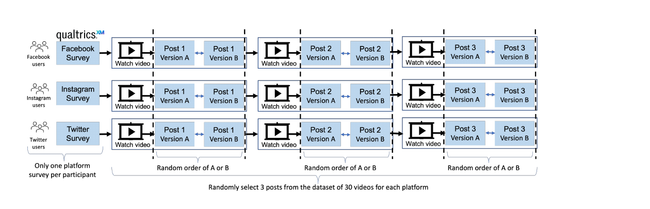
Figure 1: The study pipeline shows the process of FB, IG, and TW users starting the Qualtrics corresponding survey. Each participant sees three randomly selected content. Each post has a video, version A, HCC, and version B, ACC, which is displayed to users randomly.
This study employed a within-subjects design [30, 41]. Each participant was presented with two versions of a post related to the same video on a single social media platform, HCC and ACC, with the versions counterbalanced across all participants. The participants were directed to read each post with a link to the original video to watch. The participants were not informed about the origin of each post, whether it was created by a human or by GPT-4. This ensures that every evaluation is a paired comparison within the same platform and related to the same content. Participants were exposed to a random selection of three posts from a pool of 30 posts. With the help of Qualtrics' balanced distribution option, we ensured that each post received nearly equal evaluations from different participants and equal ordering. Each post was evaluated on average 30.1 times on FB, 30.5 times on IG, and 28.6 times on TW. Given that the impact of labeling ACC on user engagement behavior is significant [26], the current study adopts a method where we present participants with two versions of the same post in sequence, without indicating the source.
3.3 Data Collection
Collecting Video Content: We compiled a dataset of 30 video clips, cross-posted during June and July 2023 on FB, IG, and TW from a major international news and media organization focused on social media distribution and applying the cross-channel content strategy. We selected FB, IG, and TW based on their popularity and diverse user bases, ranking as the top three platforms widely used at the time of this study[^2]. Our study focused on video content to reduce biases from different content types [4].
All videos were sourced exclusively from the organization, AJ+ English, known for its contemporary approach to journalism, leveraging digital platforms to reach a global audience. Their content often covers hard-hitting news with social issues, presenting them in a format that appeals to the younger generation. AJ+ English had 11M followers on FB, 1.2M followers on TW, and 947K followers on IG at the time of the study. The collected videos are exactly the same across the platforms, with the same or different associated text descriptions or captions.
Across the three platforms, video engagement levels vary, even when the same content is cross-posted [3]. On FB, on average, a post had 4,173 likes, 445 comments, and 1,002 shares. On IG, on average, a post had 7,007 likes, 116 comments, and 1,420 shares. On TW, on average, a post had 117 likes, 5 comments, and 63 shares.
Video Transcription: We transcribed the 30 collected videos into text to serve as input for generating LLM content. At the time of this research, GPT-4 required text-based input. This transcription process guarantees that we grasp the precise phrasing and context vital for generating accurate and engaging LLM content. On average, a single video transcript contained approximately 493 terms, equivalent to roughly 2,998 characters. The range of terms per transcript was observed to be quite diverse, with a minimum of 186 terms (or approximately 1,093 characters) and reaching a maximum of 1,122 terms (or approximately 6,722 characters). All transcripts were manually checked for accuracy and consistency with the video content. For videos featuring non-English speakers, we integrated the translated text into the video transcripts. GPT-4 has a limit of 32,000 tokens, while our transcripts have a maximum of 1,122 terms, which is well within the limit.
GPT-4 Prompting: There are two approaches to prompting GPT-4 for cross-platform content generation: individual platform prompt and combined prompt. The choice between these approaches depends on the goals of the content strategy—whether it prioritizes uniformity and efficiency or customized engagement for each platform. This research simultaneously adopts the combined prompt for creating a uniform post across different platforms. We formulated a prompt for GPT-4 that specifically asked the model to create a tweet for TW, a caption for IG, and a post for FB. The prompt was structured as follows: "Please provide a Twitter tweet, an Instagram caption, and a Facebook post suitable for video content based on the following transcript: [transcript]" The concatenated prompt and a video transcript were fed into GPT-4, generating tailored content for each specified platform. As we have thirty videos, we repeated the prompting thirty times, one per video transcript.
All prompts were performed on the first of August, 2023, using GPT-4. The output for TW was the first segment of the response, designed to adhere to TW's character limit. The output for IG focused on generating interest and action, encouraging users to swipe left or click the video link. The FB post was extracted as a more descriptive or engaging post that would suit FB's audience and platform dynamics. The ACC contains hashtags for the three platforms, which serve as critical tools for categorizing, enhancing discoverability, and driving engagement.
ACC underwent a detailed manual review to remove any action-related text that did not align with our research focus. For example, even though we mentioned in the prompt it is a video, we still got 'Swipe ⇒' and '[link to the video]' on a few IG captions (5 out of 30). These were not relevant to our needs, so we manually removed them. For each video, we first took a screenshot of the HCC on the respective platforms. Then, we replaced the post text with the AI-created post and took another screenshot (AI-created) to create the survey. When taking the screenshots, we hide engagement metrics to eliminate any social effect during the evaluation. We ensured the two versions of the post, ACC and HCC, were the same format with only different text.
3.4 Measures
Platform Adaptability: For addressing RQ01, platform adaptability was evaluated through four aspects: topical interest, clarity, tone, and CTA. The following survey questions were used, with a five-scale semantic differential: (1) Topical Interest: The level of interest users had for the content (Not Interesting (1) to Very Interesting (5)); (2) Clarity (Very unclear (1) to Very clear (5)); (3) Tone (Very informal (1) to Very formal (5)); and (4) CTA: a statement motivating viewers to engage with the post (like, comment, share, etc.) (Very weak (1) to Very strong (5)).
Emotional Response: For addressing RQ02, we compared the participant's emotional responses to HCC and ACC using general sentiment (positive or negative) [16]. The participants were asked about their general sentiment through the question, "How did the post make you feel?" with the responses collected on a Likert scale from 1 (Very negative) to 5 (Very positive).
Engagement: For measuring user engagement, we used both the consumption (e.g., views and reads) and contribution measures (e.g., likes, comments, and shares) [25, 63]. Participant engagement was measured through a series of questions using a Likert scale ranging from Very unlikely (1) to Very likely (5). Participants were asked to rate their likelihood of reading the post, viewing the video based on the post content, liking, commenting, and sharing the ACC and HCC (addressing RQ03).
User Preferences: The measure used to address RQ04 was participants' post-preference. Participants were presented with pairs of content – one HCC and the other ACC. For each pair, they responded to the question, "If you had to select, which of the two posts do you prefer?". Their responses allowed us to determine which type of post (human vs. AI) was more preferred.
4 RESULTS
Table 1: Wilcoxon test results comparing the HCC with the ACC across measures. Significant results are in green color.
| RQ | Measure | M (HCC) | M (ACC) | Md (HCC) | Md (ACC) | W | p | N |
| --- | --- | --- | --- | --- | --- | --- | --- | --- |
| RQ01 | Topical (H01) | 3.807 | 3.924 | 4.0 | 4.0 | 20701.0 | 0.001 | 902 |
| RQ01 | Clarity (H02) | 4.264 | 4.433 | 5.0 | 5.0 | 17957.0 | 0.000 | 902 |
| RQ01 | Tone (H03) | 3.645 | 3.867 | 4.0 | 4.0 | 18818.0 | 0.000 | 902 |
| RQ01 | CTA (H04) | 3.614 | 3.847 | 4.0 | 4.0 | 23572.5 | 0.000 | 902 |
| RQ02 | Emotions (H5) | 3.494 | 3.574 | 3.0 | 4.0 | 17605.0 | 0.008 | 902 |
| RQ03 | Read (H06) | 3.650 | 3.766 | 4.0 | 4.0 | 20374.5 | 0.001 | 902 |
| RQ03 | View (H07) | 3.641 | 3.717 | 4.0 | 4.0 | 23083.0 | 0.014 | 902 |
| RQ03 | Like (H08) | 3.394 | 3.538 | 4.0 | 4.0 | 20405.0 | 0.000 | 902 |
| RQ03 | Comment (H09) | 3.155 | 3.251 | 3.0 | 3.0 | 19613.0 | 0.005 | 902 |
| RQ03 | Share (H10) | 3.194 | 3.329 | 3.0 | 4.0 | 18200.5 | 0.000 | 902 || RQ | Measure | M (HCC) | M (ACC) | Md (HCC) | Md (ACC) | W | p | N |
| --- | --- | --- | --- | --- | --- | --- | --- | --- |
| RQ01 | Topical (H01) | 3.998 | 4.007 | 4.0 | 4.0 | 18521.5 | 0.720 | 914 |
| RQ01 | Clarity (H02) | 4.423 | 4.454 | 5.0 | 5.0 | 20424.0 | 0.266 | 914 |
| RQ01 | Tone (H03) | 3.719 | 3.751 | 4.0 | 4.0 | 26310.5 | 0.203 | 914 |
| RQ01 | CTA (H04) | 3.822 | 3.898 | 4.0 | 4.0 | 32135.5 | 0.024 | 914 |
| RQ02 | Emotions (H5) | 3.469 | 3.564 | 3.0 | 4.0 | 15878.0 | 0.002 | 914 |
| RQ03 | Read (H06) | 3.784 | 3.807 | 4.0 | 4.0 | 21309.5 | 0.435 | 914 |
| RQ03 | View (H07) | 3.757 | 3.801 | 4.0 | 4.0 | 24257.0 | 0.197 | 914 |
| RQ03 | Like (H08) | 3.550 | 3.576 | 4.0 | 4.0 | 24359.0 | 0.347 | 914 |
| RQ03 | Comment (H09) | 3.328 | 3.341 | 4.0 | 4.0 | 17612.0 | 0.574 | 914 |
| RQ03 | Share (H10) | 3.291 | 3.319 | 4.0 | 4.0 | 19156.5 | 0.259 | 914 || RQ | Measure | M (HCC) | M (ACC) | Md (HCC) | Md (ACC) | W | p | N |
| --- | --- | --- | --- | --- | --- | --- | --- | --- |
| RQ01 | Topical (H01) | 3.943 | 3.980 | 4.0 | 4.0 | 21645.0 | 0.149 | 857 |
| RQ01 | Clarity (H02) | 4.381 | 4.429 | 5.0 | 5.0 | 21312.0 | 0.094 | 857 |
| RQ01 | Tone (H03) | 3.718 | 3.754 | 4.0 | 4.0 | 31205.5 | 0.258 | 857 |
| RQ01 | CTA (H04) | 3.693 | 3.868 | 4.0 | 4.0 | 27260.0 | 0.000 | 857 |
| RQ02 | Emotions (H5) | 3.542 | 3.578 | 4.0 | 4.0 | 23858.0 | 0.146 | 857 |
| RQ03 | Read (H06) | 3.744 | 3.793 | 4.0 | 4.0 | 22128.5 | 0.090 | 857 |
| RQ03 | View (H07) | 3.753 | 3.773 | 4.0 | 4.0 | 22657.0 | 0.576 | 857 |
| RQ03 | Like (H08) | 3.561 | 3.621 | 4.0 | 4.0 | 27759.5 | 0.070 | 857 |
| RQ03 | Comment (H09) | 3.253 | 3.321 | 4.0 | 4.0 | 20274.0 | 0.028 | 857 |
| RQ03 | Share (H10) | 3.360 | 3.418 | 4.0 | 4.0 | 20693.5 | 0.072 | 857 |4.1 RQ01
H01. AI-created content has better topical interest than human-created content. A Wilcoxon signed-rank test was conducted to compare HCC and ACC for FB, IG, and TW regarding topical interest. For FB, the results indicated that ACC had higher topical interest scores than HCC, W = 20701.0, p = 0.001. The IG and TW results were non-significant (see Table 1). Thus, H01 is partially supported: ACC shows better topical interest than HCC for FB.
H02. AI-created content has better clarity than human-created content. For FB, the results indicated that ACC had higher clarity scores than HCC, W = 17957.0, p <0.001. The IG and TW results were non-significant (see Table 1). Thus, H02 is partially supported: ACC shows better clarity than HCC for FB.
H03. AI-created content has better tone than human-created content. For FB, the results indicated that ACC had higher tone scores than HCC, W = 18818.0, p <0.001. The IG and TW results were non-significant (see Table 1). Thus, H03 is partially supported: ACC shows higher tone scores than HCC for FB.
H04: AI-created content has a better call to action than human-created content. For FB, the ACC had a higher CTA score than HCC, W = 23572.5, p <0.001. For IG, ACC had a higher CTA score than HCC, W = 32135.5, p = 0.024. For TW, ACC had a higher CTA score than HCC, W = 27260.0, p <0.001. Thus, H04 is fully supported: ACC has a better CTA than HCC for all platforms.
4.2 RQ02
H05. AI-created content results in higher positive emotional responses than human-created content. For FB, a Wilcoxon test indicated ACC had higher emotional response scores than HCC, W = 17605.0, p = 0.008. For IG, ACC had higher emotional response scores than HCC, W = 15878.0, p = 0.002. The result for TW was non-significant. Thus, H05 is partially supported: ACC scores higher on positive emotional responses than HCC (for FB and IG).
4.3 RQ03
H06: AI-created content will have higher reads than human-created content. For FB, ACC had higher reads than HCC, W = 20374.5, p = 0.001. The IG and TW results were non-significant. Thus, H06 is partially supported: ACC has higher reads than HCC for FB.
H07: AI-created content will have higher views than human-created content. For FB, ACC had a higher views score than HCC, W = 23083.0, p = 0.014. The IG and TW results were non-significant. Thus, H07 is partially supported: ACC has higher views than HCC for FB.
H08: AI-created content will have higher likes than human-created content. For FB, ACC had a higher likes score than HCC, W = 20405.0, p <0.001. The IG and TW results were non-significant. Thus, H08 is partially supported: ACC has higher likes than HCC for FB.
H09: AI-created content will have higher comments than human-created content. For FB, ACC had a higher comments score than HCC, W = 19613.0, p = 0.005. For TW, ACC had a higher comments score than HCC, W = 20274.0, p = 0.028. The IG result was non-significant. Thus, H09 is partially supported: ACC has higher comments than HCC for FB and TW.
H10: AI-created content will have higher shares than human-created content For FB, ACC had a higher share score than HCC, W = 18200.5, p <0.001. The IG and TW results were non-significant. Thus, H10 is partially supported: ACC has higher reads than HCC for FB.
4.4 RQ04
H11. AI-created content is preferred relative to human-created content. The Chi-square test of independence was performed to test the preference for ACC relative to HCC among participants on FB, IG, and TW. FB users had a higher preference for ACC, $chi^2(1, N = 903) = 35.48$, p <.001. The ACC (n = 541) was preferred more frequently than HCC (n = 362). TW users had a higher preference for ACC, $chi^2(1, N = 858) = 12.61$, p <.001. The ACC (n = 481) was preferred more frequently than HCC (n = 377). The result on IG was non-significant. Thus, H11 is partially supported: ACC is preferred to HCC for FB and TW.
5 DISCUSSION
5.1 Study Implications
Addressing RQ1, ACC demonstrated superior adaptability for FB, with better clarity, tone, and topical interest compared to HCC. For IG and TW, however, the advantages of ACC in matching platform-specific requirements were not as pronounced, with non-significant differences observed in most cases. Addressing RQ2, ACC elicited stronger positive emotional responses than HCC for FB and IG, indicating that AI has the potential to engage users emotionally more effectively on these platforms. TW did not show a significant difference in emotional response between ACC and HCC. Addressing RQ3, for FB, ACC consistently led to higher user engagement across various metrics, including reads, views, likes, comments, and shares. This suggests that ACC can more effectively drive engagement on this platform. For IG and TW, the impact of AI on engagement was less clear, with most measures not showing significant differences. Addressing RQ4, users showed a preference for ACC over HCC for FB and TW, indicating a general favorability towards the former in terms of content preference. IG users did not exhibit a significant preference between ACC and HCC.
In summary, our findings demonstrate that GPT-4 effectively generates cross-platform content that is preferable to HCC on FB and TW and has similar preferences compared to HCC on IG. This finding highlights the changing nature of LLMs [15], which adapt to different social media platforms with varying content styles and audience engagement strategies. In other words, ACC is at least as good (on IG) and statistically better on FB and TW based on our study results. For FB, all the tested hypotheses showed significant results. Participants perceived the ACC as more adapted to the FB platform, which is evident in relevance, clarity, tone, and CTA. They also responded more emotionally to ACC, increasing engagement through increased reads, views, likes, comments, and shares.
Our findings indicate that ACC exhibits a notable advantage in evoking emotional responses on platforms such as FB and IG, as compared to its performance on TW, where human creators maintain a competitive edge. This distinction may be attributed to the nature of the content; we leveraged news content, which has been demonstrated to elicit varying emotional responses across different social media platforms [6].
For FB, ACC consistently outperformed HCC across all user engagement metrics. The highest gaps were observed in the 'Likes' and 'Shares' metrics, indicating that ACC might be more likable and share-worthy on FB than HCC. Also, ACC encourages more comments than HCC on TW, but similar reads, views, likes, and shares. Different types of content work better on different platforms [5]. As a result, it is possible that the nature of ACC is more suited to FB's content preferences (e.g., narrative content), which results in higher engagement, while on TW, where concise and timely content is often key, ACC performs similarly to HCC.
The CTA is where AI does best across FB, IG, and TW. For instance, for a single video post, ACC CTAs varied as follows: on FB, the call was "We invite you to share your thoughts on the narratives that shape our world," on IG, it encouraged "Don't forget to leave a comment and let us know which artifact you'd like us to explore next!," and on TW, it was "Join us as we explore the captivating yet controversial history behind these artifacts." In contrast, HCC for the same video lacked any form of CTA.
It is important to highlight that we did not explicitly instruct GPT-4 to include CTA statements; this was automatically included on most of the ACC. One reason could be that GPT-4 is trained on a vast array of text data, which includes countless examples of successful social media posts, marketing content, and other forms of marketing communication that effectively use CTAs. As CTAs were found to encourage users to engage with social media posts [55]. This training enables the AI to learn which CTAs effectively engage audiences. Also, the fact that these CTAs were included without explicit instructions suggests that the AI has learned to recognize the value of CTAs in digital content as a best practice. This demonstrates the AI's ability to apply learned concepts in practical applications, even when not directly prompted to do so.
Additionally, we observe that although the CTA is more pronounced in ACC across the three studied platforms, the engagement metrics on IG and TW do not significantly differ from those of HCC, except for TW's comments. This difference may be due to several factors explored in the literature, including the audience's pre-existing relationship with the content creator [55]. For example, on IG, a CTA motivates followers to participate in eWOM, but not non-followers [55]. The reader should observe that the mean scores of ACC (Table 1) were consistently higher than those of HCC across all studied measures. However, the differences were not statistically significant in most cases for IG (8 out of 10) and TW (8 out of 10). This consistent, though not statistically significant, higher performance of AI suggests that the study might require more power to validate the findings, implying a need for a larger sample size. This is an area for future research.
5.2 Limitations and Future Work
Our participant base was primarily from the US, potentially not capturing the diverse global attitudes. This geographical limitation might mean we missed out on varied cultural interpretations, especially if the AI models are mostly trained on Western datasets. Although our study focused on data from a single organization that posts across FB, IG, and TW, it is important to note that organizations may utilize different platforms. To gain a more comprehensive understanding of the adaptability of the LLM, future evaluations on multiple user groups outside of the US and multiple platforms such as YouTube and LinkedIn would be valuable.
We employed a combined prompt for generating cross-platform content from a single prompt, yet future research could explore the effects of using separate prompts for each platform,. While LLMs incorporate knowledge of platform-specific characteristics, using just platform names for prompting may lead to biased outputs; an alternative is to use real-world examples and user profiles for each platform to minimize inherent biases, a method future research could evaluate. Additionally, we relied solely on video content transcripts to generate social media content. While this is suitable for videos, it does not consider other content types, such as IG photo albums, photo captions, and images with overlaid text. Future studies could explore different content sources.
The study asked people to read social media content carefully, but users might usually glance quickly in real life. This might affect how the study's findings relate to what happens in real social media. One way to improve future research is by trying out two versions of the same post on the organization's social media and seeing how people engage with it. This could involve making a post in one way and then making a similar one with a slight difference. By comparing how people interact with both, we can get insights into what kind of content gets more attention and why. This real world experiment would be a worthwhile extension of our research.
The findings could partially be affected by the post lengths due to the longer post lengths observed in ACC compared to HCC. There is a noticeable trend that the impact of AI is less effective on shorter social media posts, like those on TW and IG. This suggests that the length of content affects how people evaluate it [22, 23, 29]. Also, there could be different platform-specific dynamics, which affect how content generation methods impact user engagement. Factors like the nature of the platform, its user demographics, and typical content consumption patterns could all play a role in how users perceive and engage with ACC [14, 27, 64, 67]. More research on these human factors is needed.
Finally, we employed GPT-4 to generate social media content. In future research, exploring and assessing the performance of other LLMs like Gemini, Claude, and Llama would be beneficial.
References
Mohammad Awad AlAfnan and Siti Fatimah MohdZuki. 2023. Do artificial intelligence chatbots have a writing style? An investigation into the stylistic features of ChatGPT-4. Journal of Artificial intelligence and technology 3, 3 (2023), 85–94.
Kholoud Khalil Aldous, Jisun An, and Bernard J. Jansen. 2019. The Challenges of Creating Engaging Content: Results from a Focus Group Study of a Popular News Media Organization. In Extended Abstracts of the 2019 CHI Conference on Human Factors in Computing Systems (CHI EA '19). Association for Computing Machinery, New York, NY, USA, 1–6. https://doi.org/10.1145/3290607.3312810
Kholoud Khalil Aldous, Jisun An, and Bernard J. Jansen. 2019. Predicting Audience Engagement Across Social Media Platforms in the News Domain. In Social Informatics (Lecture Notes in Computer Science). Springer International Publishing, Cham, 173–187. https://doi.org/10.1007/978-3-030-34971-4_12
Kholoud Khalil Aldous, Jisun An, and Bernard J Jansen. 2019. Stylistic features usage: Similarities and differences using multiple social networks. In Social Informatics: 11th International Conference, SocInfo 2019, Doha, Qatar, November 18–21, 2019, Proceedings 11. Springer, 309–318.
Kholoud Khalil Aldous, Jisun An, and Bernard J Jansen. 2019. View, like, comment, post: Analyzing user engagement by topic at 4 levels across 5 social media platforms for 53 news organizations. In Proceedings of the International AAAI Conference on Web and Social Media, Vol. 13. 47–57.
Kholoud Khalil Aldous, Jisun An, and Bernard J. Jansen. 2022. Measuring 9 Emotions of News Posts from 8 News Organizations across 4 Social Media Platforms for 8 Months. Trans. Soc. Comput. 4, 4, Article 15 (mar 2022), 31 pages. https://doi.org/10.1145/3516491
Kholoud Khalil Aldous, Jisun An, and Bernard J. Jansen. 2023. What really matters?: characterising and predicting user engagement of news postings using multiple platforms, sentiments and topics. Behaviour & Information Technology 42, 5 (April 2023), 545–568. https://doi.org/10.1080/0144929X.2022.2030798
Mostafa M. Amin, Erik Cambria, and Björn W. Schuller. 2023. Will Affective Computing Emerge From Foundation Models and General Artificial Intelligence? A First Evaluation of ChatGPT. 38, 2 (2023), 15–23. Publisher: IEEE.
Jisun An and Ingmar Weber. 2018. Diversity in online advertising: a case study of 69 brands on social media. In Social Informatics: 10th International Conference, SocInfo 2018, St. Petersburg, Russia, September 25-28, 2018, Proceedings, Part I 10. Springer, 38–53.
Simon Attfield, Gabriella Kazai, Mounia Lalmas, and Benjamin Piwowarski. 2011. Towards a science of user engagement (position paper). In WSDM workshop on user modelling for Web applications. 9–12.
Claus Atzenbeck, Sam Brooker, and Daniel Roßner. 2023. Storytelling Machines. In Proceedings of the 6th Workshop on Human Factors in Hypertext (Rome Italy, 2023-09-04). ACM, 1–9. https://doi.org/10.1145/3603607.3613481
Navid Ayoobi, Sadat Shahriar, and Arjun Mukherjee. 2023. The Looming Threat of Fake and LLM-generated LinkedIn Profiles: Challenges and Opportunities for Detection and Prevention. In Proceedings of the 34th ACM Conference on Hypertext and Social Media (Rome Italy, 2023-09-04). ACM, 1–10. https://doi.org/10.1145/3603163.3609064
Fabrício Benevenuto, Tiago Rodrigues, Meeyoung Cha, and Virgílio Almeida. 2012. Characterizing user navigation and interactions in online social networks. Information Sciences 195 (2012), 1–24.
Aparajita Bhandari and Sara Bimo. 2022. Why's everyone on TikTok now? The algorithmized self and the future of self-making on social media. Social Media+ Society 8, 1 (2022), 20563051221086241.
Michael Bossetta and Rasmus Schmøkel. 2022. Cross-Platform Emotions and Audience Engagement in Social Media Political Campaigning: Comparing Candidates' Facebook and Instagram Images in the 2020 US Election. Political Communication 40 (2022), 48–68. https://doi.org/10.1080/10584609.2022.2128949
Erik Cambria, Dipankar Das, Sivaji Bandyopadhyay, and Antonio Feraco. 2017. Affective Computing and Sentiment Analysis. In A Practical Guide to Sentiment Analysis. Springer International Publishing, Cham, 1–10. https://doi.org/10.1007/978-3-319-55394-8_1
David Carneros-Prado, Laura Villa, Esperanza Johnson, Cosmin C Dobrescu, Alfonso Barragán, and Beatriz García-Martínez. 2023. Comparative Study of Large Language Models as Emotion and Sentiment Analysis Systems: A Case-Specific Analysis of GPT vs. IBM Watson. In International Conference on Ubiquitous Computing and Ambient Intelligence. Springer, 229–239.
Jesse Chandler, Cheskie Rosenzweig, Aaron J. Moss, Jonathan Robinson, and Leib Litman. 2019. Online panels in social science research: Expanding sampling methods beyond Mechanical Turk. Behavior Research Methods 51, 5 (Oct. 2019), 2022–2038. https://doi.org/10.3758/s13428-019-01273-7
David De Cremer, Nicola Morini Bianzino, and Ben Falk. 2023. How Generative AI Could Disrupt Creative Work. (2023). https://hbr.org/2023/04/how-generative-ai-could-disrupt-creative-work Section: AI and machine learning.
Alberto Dafonte-Gómez. 2018. News Media and the Emotional Public Sphere Audiences as Medium: Motivations and Emotions in News Sharing. International Journal of Communication 12 (2018), 20.
Mariano de Rivero, Cristhiam Tirado, and Willy Ugarte. 2021. FormalStyler: GPT based Model for Formal Style Transfer based on Formality and Meaning Preservation.. In KDIR. 48–56.
Qi Deng, Michael J. Hine, Shaobo Ji, and Yun Wang. 2021. Understanding consumer engagement with brand posts on social media: The effects of post linguistic styles. Electronic Commerce Research and Applications 48 (July 2021), 101068. https://doi.org/10.1016/j.elerap.2021.101068
Qi Deng, Yun Wang, Michel Rod, and Shaobo Ji. 2021. Speak to head and heart: The effects of linguistic features on B2B brand engagement on social media. Industrial Marketing Management 99 (Nov. 2021), 1–15. https://doi.org/10.1016/j.indmarman.2021.09.005
Weiping Ding, Mohamed Abdel-Basset, Hossam Hawash, and Ahmed M Ali. 2022. Explainability of artificial intelligence methods, applications and challenges: A comprehensive survey. Information Sciences 615 (2022), 238–292.
Rebecca Dolan, Jodie Conduit, Catherine Frethey-Bentham, John Fahy, and Steve Goodman. 2019. Social media engagement behavior: A framework for engaging customers through social media content. European Journal of Marketing 53, 10 (Jan. 2019), 2213–2243. https://doi.org/10.1108/EJM-03-2017-0182
Duo Du, Yanling Zhang, and Jiao Ge. 2023. Effect of AI Generated Content Advertising on Consumer Engagement. In International Conference on Human-Computer Interaction. Springer, 121–129.
Brooke Erin Duffy, Urszula Pruchniewska, and Leah Scolere. 2017. Platform-Specific Self-Branding: Imagined Affordances of the Social Media Ecology. In Proceedings of the 8th International Conference on Social Media & Society (#SMSociety17). Association for Computing Machinery, New York, NY, USA, 1–9. https://doi.org/10.1145/3097286.3097291
Yunhe Feng, Pradhyumna Poralla, Swagatika Dash, Kaicheng Li, Vrushabh Desai, and Meikang Qiu. 2023. The Impact of ChatGPT on Streaming Media: A Crowdsourced and Data-Driven Analysis using Twitter and Reddit. In 2023 IEEE 9th Intl Conference on Big Data Security on Cloud (BigDataSecurity), IEEE Intl Conference on High Performance and Smart Computing, (HPSC) and IEEE Intl Conference on Intelligent Data and Security (IDS). 222–227. https://doi.org/10.1109/BigDataSecurity-HPSC-IDS58521.2023.00046
Dimitris C Gkikas, Katerina Tzafilkou, Prokopis K Theodoridis, Aristogiannis Garmpis, and Marios C Gkikas. 2022. How do text characteristics impact user engagement in social media posts: Modeling content readability, length, and hashtags number in Facebook. International Journal of Information Management Data Insights 2, 1 (2022), 100067.
Anthony G. Greenwald. 1976. Within-subjects designs: To use or not to use? Psychological Bulletin 83, 2 (1976), 314–320. https://doi.org/10.1037/0033-2909.83.2.314
Jeffrey T. Hancock, Kailyn Gee, Kevin Ciaccio, and Jennifer Mae-Hwah Lin. 2008. I'm Sad You'Re Sad: Emotional Contagion in CMC. In Proceedings of the ACM Conference on Computer Supported Cooperative Work (CSCW '08). ACM, 295–298.
Valerie Hase, Karin Boczek, and Michael Scharkow. 2023. Adapting to affordances and audiences? A cross-platform, multi-modal analysis of the platformization of news on Facebook, Instagram, TikTok, and Twitter. Digital Journalism 11, 8 (2023), 1499–1520.
Angelica Lermann Henestrosa, Hannah Greving, and Joachim Kimmerle. 2023. Automated journalism: The effects of AI authorship and evaluative information on the perception of a science journalism article. Computers in Human Behavior 138 (2023), 107445.
Tim Highfield and Tama Leaver. 2016. Instagrammatics and digital methods: studying visual social media, from selfies and GIFs to memes and emoji. Communication Research and Practice 2 (2016), 47–62. https://doi.org/10.1080/22041451.2016.1155332
Linda D. Hollebeek, Choukri Menidjel, Marko Sarstedt, Johan Jansson, and Sigitas Urbonavicius. 2024. Engaging consumers through artificially intelligent technologies: Systematic review, conceptual model, and further research. 41, 4 (2024), 880–898. https://doi.org/10.1002/mar.21957 _eprint: https://onlinelibrary.wiley.com/doi/pdf/10.1002/mar.21957.
Carroll E. Izard. 1991. The Psychology of Emotions. Springer Science & Business Media.
Roope Jaakonmäki, Oliver Müller, and Jan Vom Brocke. 2017. The impact of content, context, and creator on user engagement in social media marketing. In Proceedings of the Annual Hawaii International Conference on System Sciences, Vol. 50. IEEE Computer Society Press, 1152–1160.
Bernard Jansen. 2009. Understanding User-Web Interactions via Web Analytics. Synthesis Lectures on Information Concepts, Retrieval, and Services 1 (2009), 1–102.
Xiaoyan Jiang, Jie Lin, Chao Wang, and Lixin Zhou. 2024. How far is reality from vision: An online data-driven method for brand image assessment and maintenance. Information Processing & Management 61, 5 (2024), 103769. https://doi.org/10.1016/j.ipm.2024.103769
Jaemin Jung, Haeyeop Song, Youngju Kim, Hyunsuk Im, and Sewook Oh. 2017. Intrusion of software robots into journalism: The public's and journalists' perceptions of news written by algorithms and human journalists. Computers in human behavior 71 (2017), 291–298.
Gideon Keren. 2014. Between-or within-subjects design: A methodological dilemma. In A Handbook for Data Analysis in the Behaviorial Sciences. Vol. 1. Psychology Press, 257–272.
Jan Kocoń, Igor Cichecki, Oliwier Kaszyca, Mateusz Kochanek, Dominika Szydło, Joanna Baran, Julita Bielaniewicz, Marcin Gruza, Arkadiusz Janz, Kamil Kanclerz, et al. 2023. ChatGPT: Jack of all trades, master of none. Information Fusion (2023), 101861.
Michal Kosinski, Sandra C Matz, Samuel D Gosling, Vesselin Popov, and David Stillwell. 2015. Facebook as a research tool for the social sciences: Opportunities, challenges, ethical considerations, and practical guidelines. American psychologist 70, 6 (2015), 543.
Michal Kosinski, David Stillwell, and Thore Graepel. 2013. Private traits and attributes are predictable from digital records of human behavior. Proceedings of the national academy of sciences 110, 15 (2013), 5802–5805.
Adam D. I. Kramer, Jamie E. Guillory, and Jeffrey T. Hancock. 2014. Experimental evidence of massive-scale emotional contagion through social networks. Proceedings of the National Academy of Sciences 111, 24 (2014), 8788–8790.
Mounia Lalmas, Heather O'Brien, and Elad Yom-Tov. 2014. Measuring User Engagement. Synthesis Lectures on Information Concepts, Retrieval, and Services 6 (2014), 1–132.
Mina Lee, Percy Liang, and Qian Yang. 2022. Coauthor: Designing a human-ai collaborative writing dataset for exploring language model capabilities. In Proceedings of the 2022 CHI conference on human factors in computing systems. 1–19.
Michael Lewis, Jeannette M Haviland-Jones, and Lisa Feldman Barrett. 2010. Handbook of emotions. Guilford Press.
Fan Lu. 2024. Content Marketing Planning, Execution, and Measurement. In Digital Content Marketing. Routledge, 13–30. https://www.taylorfrancis.com/chapters/edit/10.4324/9781003346500-2/content-marketing-planning-execution-measurement-fan-lu
Guixun Luo, Zhiyuan Zhang, and Sumeng Diao. 2022. Empirical analysis and modelling social network user interaction behavior and time characteristics based on selection preference. Information Sciences 608 (2022), 1202–1220.
Renkai Ma. 2023. Conceptualizing and Rethinking the Design of Cross-platform Creator Moderation. In Extended Abstracts of the 2023 CHI Conference on Human Factors in Computing Systems (CHI EA '23). Association for Computing Machinery, New York, NY, USA, 1–4. https://doi.org/10.1145/3544549.3577049
Renkai Ma, Xinning Gui, and Yubo Kou. 2023. Multi-Platform Content Creation: The Configuration of Creator Ecology through Platform Prioritization, Content Synchronization, and Audience Management. In Proceedings of the 2023 CHI Conference on Human Factors in Computing Systems (Hamburg Germany, 2023-04-19). ACM, 1–19. https://doi.org/10.1145/3544548.3581106
N. Muhammad. 2019. An analysis to determine the most suitable type of multimedia used on Facebook social media platform. International Journal of Advance Research, Ideas and Innovations in Technology 5 (2019), 2146–2154.
Taberez Ahmed Neyazi, Sheryl Wei Ting Ng, Mitchell Hobbs, and Audrey Yue. 2023. Understanding user interactions and perceptions of AI risk in Singapore. Big Data & Society 10, 2 (2023), 20539517231213823.
Itziar Oltra, Carmen Camarero, and Rebeca San Jose Cabezudo. 2022. Inspire me, please! The effect of calls to action and visual executions on customer inspiration in Instagram communications. International Journal of Advertising 41, 7 (2022), 1209–1234.
Gregory Park, H Andrew Schwartz, Johannes C Eichstaedt, Margaret L Kern, Michal Kosinski, David J Stillwell, Lyle H Ungar, and Martin EP Seligman. 2015. Automatic personality assessment through social media language. Journal of personality and social psychology 108, 6 (2015), 934.
Mark J. Pelletier, Alexandra Krallman, F. Adams, and Tyler Hancock. 2020. One size doesn't fit all: a uses and gratifications analysis of social media platforms. Journal of Research in Interactive Marketing (2020). https://doi.org/10.1108/jrim-10-2019-0159
Giulio Perrotta. 2022. Psychopathological profiles and trends of Italian social network users (Facebook, Instagram, Twitter, and TikTok). Annals of Psychiatry and Treatment 6, 1 (2022), 053–061.
Kay Peters, Yubo Chen, Andreas M Kaplan, Björn Ognibeni, and Koen Pauwels. 2013. Social media metrics—A framework and guidelines for managing social media. Journal of interactive marketing 27, 4 (2013), 281–298.
Jeba Rezwana and Mary Lou Maher. 2022. Understanding user perceptions, collaborative experience and user engagement in different human-AI interaction designs for co-creative systems. In Proceedings of the 14th Conference on Creativity and Cognition. 38–48.
Dmitri Rozgonjuk, Cornelia Sindermann, Jon D. Elhai, and Christian Montag. 2020. Fear of Missing Out (FoMO) and social media's impact on daily-life and productivity at work: Do WhatsApp, Facebook, Instagram, and Snapchat Use Disorders mediate that association? Addictive Behaviors 110 (Nov. 2020), 106487. https://doi.org/10.1016/j.addbeh.2020.106487
Francesco Salvi, Manoel Horta Ribeiro, Riccardo Gallotti, and Robert West. 2024. On the Conversational Persuasiveness of Large Language Models: A Randomized Controlled Trial. https://doi.org/10.48550/arXiv.2403.14380 arXiv:2403.14380 [cs]
Bruno Schivinski, George Christodoulides, and Dariusz Dabrowski. 2016. Measuring Consumers' Engagement With Brand-Related Social-Media Content: Development and Validation of a Scale that Identifies Levels of Social-Media Engagement with Brands. Journal of Advertising Research 56, 1 (March 2016), 64–80. https://doi.org/10.2501/JAR-2016-004
Donghee Shin. 2020. User Perceptions of Algorithmic Decisions in the Personalized AI System: Perceptual Evaluation of Fairness, Accountability, Transparency, and Explainability. Journal of Broadcasting & Electronic Media 64, 4 (Oct. 2020), 541–565. https://doi.org/10.1080/08838151.2020.1843357
Andrew T Stephen, Michael R Sciandra, and Jeffrey J Inman. 2015. The effects of content characteristics on consumer engagement with branded social media content on Facebook. Marketing Science Institute Working Paper Series 15, 110 (2015), 1–51.
Mingfei Sun and Shaojing Sun. 2024. Users' engagement in WeChat-based support communities: A multilevel perspective. Information Processing & Management 61, 2 (2024), 103604. https://doi.org/10.1016/j.ipm.2023.103604
Briana M Trifiro and Jennifer Gerson. 2019. Social media usage patterns: Research note regarding the lack of universal validated measures for active and passive use. Social Media+ Society 5, 2 (2019), 2056305119848743.
Risqo Wahid, Joel Mero, and Paavo Ritala. 2023. Written by ChatGPT, illustrated by Midjourney: generative AI for content marketing. 35, 8 (2023), 1813–1822. https://www.emerald.com/insight/content/doi/10.1108/APJML-10-2023-994/full/html Publisher: Emerald Publishing Limited.
Xuena Wang, Xueting Li, Zi Yin, Yue Wu, and Jia Liu. 2023. Emotional intelligence of large language models. Journal of Pacific Rim Psychology 17 (2023), 18344909231213958.
Anja Wölker and Thomas E Powell. 2021. Algorithms in the newsroom? News readers' perceived credibility and selection of automated journalism. Journalism 22, 1 (2021), 86–103.
Borchuluun Yadamsuren and Jannica Heinström. 2011. Emotional reactions to incidental exposure to online news. Information Research 16, 3 (2011), 16–3.
Chen Yang, Xiaohong Chen, Lei Liu, and Penny Sweetser. 2021. Leveraging semantic features for recommendation: Sentence-level emotion analysis. Information Processing & Management 58, 3 (2021), 102543. https://doi.org/10.1016/j.ipm.2021.102543
Fattane Zarrinkalam, Havva Alizadeh Noughabi, Zeinab Noorian, Hossein Fani, and Ebrahim Bagheri. 2024. Predicting users' future interests on social networks: A reference framework. Information Processing & Management 61, 5 (2024), 103765. https://doi.org/10.1016/j.ipm.2024.103765
Notes
[^1]: Content marketing is the process of planning, creating, and distributing digital content to engage customers and improve marketing performance [68].
[^2]: https://www.similarweb.com/top-websites/united-states/computers-electronics-and-technology/social-networks-and-online-communities/
Do you like what you are reading? Subscribe to receive updates.
Unsubscribe anytime