
You Shall Know a Forum by the Words they Keep: Analyzing Language Use in Accessibility Forums for Blind Users
Nithiya Venkatraman (Old Dominion University, Norfolk, United States), Anand Aiyer (Stony Brook University, Stony Brook, United States), Yash Prakash (Old Dominion University, Norfolk, United States), and Vikas Ashok (Old Dominion University, Norfolk, United States)
Published in HT '24: 35th ACM Conference on Hypertext and Social Media · DOI: 10.1145/3648188.3675151 · License: CC BY 4.0
Authors: Anand Aiyer, Yash Prakash, Nithiya Venkatraman, Vikas Ashok
Keywords: Social media, accessibility online forums, blind, discussion forums, language usage, linguistic analysis, screen readers
Session: Scholarship
Pages: 230–238
Conference: HT'24
Abstract
Discussion forums are one of the favored platforms for knowledge sharing. Given their popularity, copious research exists on understanding linguistic and behavioral characteristics of forum conversations. However, prior investigations have mainly focused on general forums designed primarily for sighted users, and as such the applicability of their findings to the dedicated accessibility discussion forums frequented by blind individuals remains unanswered. To bridge this knowledge gap, and facilitate the development of better-informed assistive technologies for blind people, we investigated language use and identified the key semantic and cognitive characteristics of online accessibility forums. To aid our investigation, we collected a dataset of 1000 accessibility forum threads and a baseline of 1000 general forum threads. These threads were carefully curated to ensure similarity of topics discussed. We found the language in accessibility forum conversations to be more task-oriented and less abstract, with significantly higher number of descriptive action words than in general forum conversations. Results also showed an emphasis on sharing first-hand personal experiences in accessibility forums, relative to the general forums.
CCS Concepts
Human-centered computing → Accessibility technologies; Empirical studies in accessibility.
Keywords
Social media, accessibility online forums, discussion forums, language usage, linguistic analysis, screen readers, blind
ACM Reference Format
Nithiya Venkatraman, Anand Aiyer, Yash Prakash, and Vikas Ashok. 2024. You Shall Know a Forum by the Words they Keep: Analyzing Language Use in Accessibility Forums for Blind Users. In 35th ACM Conference on Hypertext and Social Media (HT '24), September 10–13, 2024, Poznan, Poland. ACM, New York, NY, USA, 9 pages. https://doi.org/10.1145/3648188.3675151
1 INTRODUCTION
The Forum in Ancient Rome was the center of public life. It was the most important outdoor meeting space, where issues were discussed and debated, moulding public opinion. Just like their ancient predecessor, online forums are platforms on the web that allow multiple participants to engage in long-form text based discussions on topics of interest. Online availability erases geographical limitations and allows participants from across the world access, connect, exchange ideas, and express opinions freely. There exist a spectrum of forums online, from general discussion forums to specialized forums catered to specific hobbies, occupations, and health conditions. Community Q&A (CQA) (StackOverflow, Quora), Social discussion platforms (Twitter, Reddit), Group Chat applications (IRC, Discord and Slack) all lie within this spectrum [32]. Given the popularity and wealth of user generated data, many researchers have previously investigated language use on forums (see Section 2). Key insights from these studies are that forums have deep discussion with relatively short response times; conversations result in the creation of shared artifacts; and diverse answers and opinions are valued by the community [55]. It is not clear the extent to which such insights derived from general forums where participants are predominantly sighted, are applicable to "accessibility forums" (see Figure 1) where the participants are predominantly visually impaired. Accessibility forums allow individuals with disabilities to find peer support, discuss accessibility issues, and collectively resolve them with assistive technology [3].
People with severe visual disabilities interact with computers using a screen reader. A screen reader (e.g., JAWS [76], NVDA [2], VoiceOver [6]) is an assistive software that enables blind individuals to listen to on-screen content and also simultaneously navigate content using special predefined keyboard shortcuts. Therefore, screen reader users have to sequentially listen to posts one-by-one and navigate with an assortment of keyboard shortcuts to search for desired information and also participate in conversations. User-generated content in forums are filled with out-of-vocabulary words, poor grammar, and missing punctuation [34, 45], and coupled with the complex web page structure that is typical of forum sites, it is quite tedious and difficult to follow and participate in conversations in the forum threads [3, 82]. Sighted users are more tolerant to the presence of such non-standard text and the overall web page content organization, as they rely on visual cues and context to understand and contribute to the conversations. Such interaction challenges and usability issues uniquely experienced by blind individuals can potentially shape their behavior and language use on accessibility forums in ways that may significantly differ from that of the typical sighted user on general forums. This paper aims to shed more light on this aspect by uncovering the similarities and differences between accessibility forums and general forums.
For this purpose, we created two datasets, each comprising 1000 software-related threads, where the first dataset threads were sampled from multiple dedicated accessibility forums and the second dataset threads were sampled from popular general forums. We then investigated multiple linguistic features of threads from both datasets to compare accessibility forums with general forums.
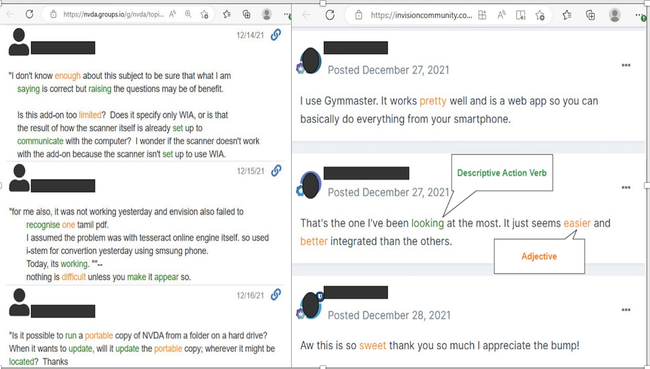
Figure 1: The language use in accessibility forum discussion threads (left) is differs from that in general forums (right).
2 RELATED WORK
People with severe visual disabilities interact with web content, including forums, predominantly using screen-reader assistive technology (e.g., JAWS, NVDA, VoiceOver). Screen readers assist blind individuals in navigating information-rich graphical user interfaces (GUI) via voice feedback (or tactile feedback) and specialized keyboard shortcuts (e.g., 'H' for next heading, 'P' for next paragraph) [48, 81, 91]. Specifically, a screen reader maps the existing two-dimensional GUI of a web page into a one-dimensional list of available on-screen elements (like headers, text, buttons, menus) for aural navigation. The one-dimensional press-and-listen screen-reader navigation have been shown to erect several accessibility and usability barriers for blind users [8, 10, 59]. Navigating web content, including discussion forum threads, have been shown to be tedious and frustrating for blind screen-reader users [3, 82]. Studies have also shown that poor response rate and unusable interface design contributes to a reluctance in using social media applications [15, 46]. Despite these usability issues, blind users still actively participate in social media web applications and discussion forums [3, 14, 46, 82, 88]. Studies have shown that blind users devise many interaction strategies to counter the various screen reader issues [12, 50, 72]. The encountered interaction issues and corresponding workaround strategies unique to blind screen-reader users can potentially influence their communication behavior and language use in discussion forums, thereby deviating from our current understanding of how users communicate in online forums, which are all based on research involving general forums dominated by sighted users [19, 54].
Online forums serve both as a medium of dialog and an archive of community knowledge [31, 60]. Discourse analysis of online forums [40, 41, 47] involves systematically studying the language use, communication patterns [1, 7, 39, 51, 58], and social dynamics within these platforms. It provides insights on linguistic features, conversation structure and information foraging strategies that are peculiar to forum conversations. The insights gained from discourse analysis of online forums have practical applications like development of recommendation systems for content discovery [7, 89], conversation disentanglement [26], moderation agents to detect and address toxic behavior [24, 35], and design of conversational agents [14, 68, 71, 86, 88]. Prior research [5, 62] has investigated inherent differences in written language between individuals with visual impairments and sighted users. Works have also found variations in creating narrative episodes [70], spelling abilities [29], comprehension of out-of-vocabulary words [46], and the acquisition of visual knowledge [42]. However, to the best of our knowledge, there are no in-depth linguistic explorations of the content generated by blind users on discussion forums. In this paper, we aim to uncover the significant linguistic similarities and differences between general forums and accessibility forums, highlighting the need for greater care in designing intelligent assistive technologies, especially conversational assistants for blind individuals.
3 DATASET
We built two custom datasets containing conversation threads from accessibility and general forums (e.g., see Figure 1). To ensure fair comparison between general forums and accessibility forums, we filtered the type of threads in both datasets to include only software-usability discussions, specifically those focused on issue resolution and seeking recommendations. The accessibility forum threads were sampled from the JAWS and NV Access discussion forums. The general forum threads were sampled from Reddit. All discussion threads were in English. For each discussion thread, we captured the thread URL, posts from every user in the thread, the chronological order of posts, the username for each post, and the date-time associated with each post. To collect the threads from the forums, we used the publicly available Web Scraper tool. All captured data was stored in .csv files and made publicly available on GitHub.
We aimed to maintain consistency of structure across datasets by choosing the same 8-attribute tuple for each individual posts in both accessibility and general discussion threads. These 8 attributes are thread name, thread id, thread url, username, user id, date time, post body and post id respectively. We initially utilized keywords like 'software, usability, accessibility, technology' to filter forum threads. We then manually verified the filtered discussion threads to ensure that they were focused on 'software usage, usability, or development among others'. For post-processing, we grouped posts according to threads and made use of python's string replacement functions to filter out non-ASCII characters and carriage returns. Each dataset had an overall 1000 threads. We limited our sample size to 1000 threads each in order to be able to manually check the topics were comparable, validating results on each corpus, and ensuring proper qualitative interpretation if the two forums diverge significantly on any metric. Additional details for both datasets are provided in Table 1.
| Descriptive | Accessibility | General |
| --- | --- | --- |
| Posts / Thread | 4.92 | 63.80 |
| Word Count | 411.09 | 1970.95 |
| Words / Sentence | 17.87 | 21.91 |
| 6 letter words | 18.32 | 22.17 |
Table 1: Descriptive analysis of datasets
4 ANALYSIS
We provide a comprehensive analysis of linguistic differences between general and accessibility forums. We used well-established measures from prior work [13, 63, 64] to analyze and compare both datasets. These measure a wide range of linguistic aspects of textual content, and they have been employed for different textual analyses by several prior related research efforts [33, 53, 73, 80].
Descriptive analysis: Table 1 shows that general forums had significantly longer discussions on average, while accessibility forums used simpler and more readable sentences. Figure 2 presents a t-SNE [84] plot of user generated forum thread titles (using RoBERTa [49] pre-trained word embeddings). It can be observed that accessibility forum threads covered a broader range of topics and discussed issues that were both exclusively about screen readers (areas in blue with no overlap) and issues that were about using software applications with screen readers (areas of overlap).
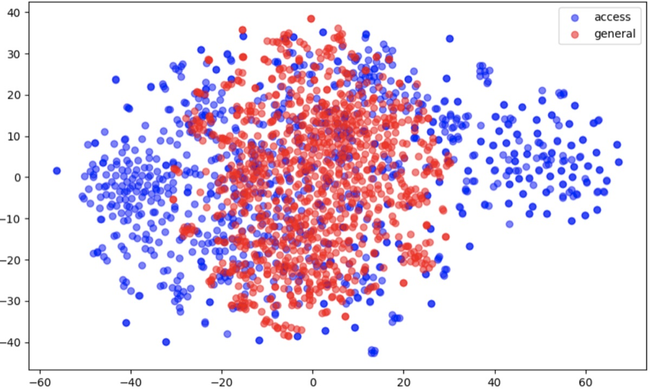
Figure 2: t-SNE plot of accessibility forum thread titles (in blue) and general forum thread titles (in red)
Statistical tests: We performed Normality tests (Shapiro-Wilk test) before comparing the results of different analysis variables and found the data not to be normally distributed. This prompted us to use a robust non-parametric test for independent population samples, i.e., the Mann-Whitney U test.
Words per Sentence (WPS): WPS is a proxy for readability, with lower scores indicating shorter sentences, being better for recall and understanding [57]. Mean WPS for accessibility forum dataset ($mu$=17.81) was significantly lower (Mann-Whitney U test, $U = 302578$, $p < 0.005$) than for general forums ($mu$=21.84), thereby indicating better readability of accessibility forum threads.
Readability: For our analysis, we used the popular Flesch-Kincaid (FK) grade level [27] and the Gunning FOG (GF) index [30] readability metrics. The Flesch-Kincaid grade level is computed based on the average number of words per sentence and the average number of syllables per word. The Gunning FOG index on the other hand is computed based on the average number of words per sentence and the proportion of complex words (words with ≥ 3 syllables) in the text.
Linguistic text features are strongly correlated with readability [66, 92] and readability metrics [11, 79] measure the ease of text comprehension [69]. For example, in a post – "All this talk about WordPad caused me to put it on my desktop so I can use it for short things.", the author uses simple and direct language with very few big words. This boosts the readability of the post.
We found a significant difference in the readability [9, 22, 23, 85] scores of accessibility forums compared to those of general forums according to the Flesch-Kincaid [27] and Gunning fog index [30] readability metrics. Specifically, the Flesch-Kincaid readability scores indicate that the accessibility forum threads were more readable on average ($mu$= 6.95) than general forum threads ($mu$= 7.41). The Gunning fog index for accessibility forums ($mu$= 9.45) were similarly lower than that for general forums ($mu$= 10.07). Readability indices like Gunning Fog measure the semantic richness of text corpora and the ease with which information can be conveyed. It is important to note that readability generalizes irrespective of the visual abilities of the individual responsible for authoring a particular post in a discussion thread.
Lexical density: Lexical Density (LD) using Ure's method [83] is computed as a ratio of the number of content words (CW) to the total number of words (TW) in a given discourse.
Higher Lexical Density [36, 87] indicates more information content per word [44]. The lexical density (see Figure 3) in accessibility forums ($mu$= 0.53) was considerably higher than general forums ($mu$= 0.51), thereby indicating more formal, informative with increased usage of content words and lesser pronouns. A Mann-Whitney test showed that this difference between forums was statistically significant ($U = 0.2059$, $p < 0.005$).
In this accessibility forum post, content words are higher in number leading to greater information content, viz. "Does nv-access keeps database regarding the aria-roles compatibility with the latest version off NVDA?". In comparison, the example shown here from general forums, has fewer content words: "i have noticed a problem which i consider a bug or at least a mistake.".

(a)

(b)
Figure 3: Box Plots for (a) Lexical Density (b) Proper Noun usage.
Parts of speech (POS): The sentences in posts were tokenized so that a series of words and punctuation marks were tagged appropriately by the Stanford POS tagger [56]. From the POS tagger output, we computed the frequency distribution of the POS tags.
From the distribution, we observed that Proper Noun (NNP) usage (see Figure 3) was significantly higher ($U = 538806$, $p < 0.001$) in accessibility forums ($mu$= 0.09) than in general forums ($mu$= 0.05). Users frequently indicated the product, screen reader, shortcuts, and platform they were discussing in accessibility forum posts. Differences in other POS tags between forums were not significant.
Personal pronouns: Pronoun usage reflects self-expression and sense of social-connection [38, 90]. Accessibility forums had greater usage of the first-person pronoun "I" with mean ($mu$=4.31) compared with general forums ($mu$=3.16). This indicates heightened personal involvement with the community. A Mann-Whitney test also confirmed differences observed were statistically significant ($U = 689985.5$ and $p < 0.005$).
Descriptive action verbs (DAV): DAV refer to a single activity that has a distinct beginning and end [74, 77, 78]. DAV words are usually clear, specific, concrete and observable physical actions. Accessibility forum posts had significantly more DAV ($mu$= 9.18) words than general forum posts ($mu$= 7.65). Accessibility forum posts also contained very concrete descriptive words like keyboard shortcuts that must be "pressed" or "held down", elements that must be "selected", "activated", and actions like "navigate" or "submit", to accomplish tasks of interest (see Figure 1).
Abstractness: The Linguistic Category Model (LCM) [21, 25, 52] assigns weights to different linguistic categories (verbs and adjectives) and computes an abstractness score [20]. Accessibility forums had lower abstractness score ($mu$ = 2.10) compared to general forums ($mu$ = 2.25). Higher abstractness score indicates greater prevalence of conceptual terms, while lower scores suggest use of more tangible language. An example from accessibility forums is "When it wants to update, will it update the portable copy, wherever it might be located?".
Temporal reference: The use of time markers like "yesterday", "now", and "later", the usage of tenses like "past", "present", and "future", and message sequence information, convey time to users of the forum. Effective temporal reference is important for coherent communication and to avoid misunderstandings [18, 75]. Accessibility forum posts predominantly focused on the resolution of issues faced in the past, indicated by mean of focus past ($mu$= 2.81). The discussion proceeds asynchronously with many later responses addressing posts that occurred in the past. General forums focus more on present events ($mu$= 5.73) rather than past events ($mu$= 2.79). The difference between groups were also found to be statistically significant ($U = 543976$, $p < 0.005$).
5 DISCUSSION
Our results revealed many differences in language use between accessibility forum threads and general forum threads. We specifically found that accessibility forums both fostered and greatly valued community engagement, and threads were peppered with task-oriented yet spontaneous and unguarded conversations. Analyzing the narrative of these discussions showed significant sharing of first-hand personal experiences. This understanding of various aspects of language use helped us derive the following insights.
Wider breadth of topics in accessibility forums: One would expect forums dedicated to accessibility not to have discussion on a wide range of topics, instead focus on specific screen reader issues. Counter-intuitively, participants were seen to discuss personal experiences, share best practices, and engaged in broader conversations related to use of assistive technologies and inclusion in the workplace [4, 16].
How do accessibility forums help information seekers forage for information? Stories and experiences shared on accessibility forum discussions were based on authentic, lived experience. This fostered empathy and greater connection between participants. Participants were self-aware, deeply engaged with their community, and took credit for their contributions on the forum using first-person personal pronouns. There were clear attribution statements to solutions that addressed the stated problems. Participants who posted helpful solutions were well known within the tight knit community, and therefore gained a level of trust-worthiness [65].
Synergy and an eagerness for collaborative problem solving: In the general forums, users often gave perfunctory responses to questions they deemed as very 'simple' and expected the information seeker to be competent enough to figure most of the answer themselves. We found many examples of this kind in the general forum dataset, e.g., posts like "Go to the support page in your ACP and you should see optional patches available to fix this.", in reply to questions like "This shows up repeatedly for all our admins. I already tried disabling all customizations and the problem persists.". In contrast, the users in accessible forums were typically more forgiving and accommodating, patiently describing steps in detail in response to questions, even if these questions were very 'naive' or had been asked many times prior in the forum.
Auditory vs visual descriptors: Blind users employed descriptors that were more auditory and task oriented, mentioning for example, "With NVDA and into reading a message, press delete and it goes to the next message; but then interrupts it to tell me about moving the old one to trash. It also interrupts to tell me it's downloading and how many. Quite a nuiscence. The interruption problem does not occur when using jaws. There must be a setting that I can make in NVDA." On the other hand, in general forums, users utilize more visual descriptors, e.g., "Whenever the software keyboard appears, it resizes the background image. Refer to the screenshot below: As you can see, the background is sort of squeezed. Anyone can shed a light on why the background resizes? My Layout is as follows:"
Action orientated language: Accessibility forum discussions tended to use tangible terms as screen reader users were highly focused on problem solving. The focus was on communicating steps to be performed with action verbs [37]. Adjectives were useful for adding depth, nuance and describing aesthetic qualities [20]. The lower number of adjectives and higher number of verbs led to direct communication that did not capture all technical details.
Higher focus on past events in accessibility forums: Previous query responses in-line using quoted text helped participants provide comprehensive and informed answers in accessibility forums. This ensured discussions were not limited to isolated responses but took into account the broader context of the discussion underway. Recall that past focus [93] metric in accessibility forums ($mu$ = 2.81) was significantly higher than in General forums ($mu$ = 2.79).
Accessibility forum challenges: Challenges in accessibility forums included outdated legacy interfaces, limited number of responses, and scarcity of domain experts. Moreover, linear web-interaction of screen readers, and greater reliance on voice-based text-entry posed additional hurdles, resulting in repetitive text and typographical errors [3, 82]. Addressing these challenges by providing direct and easy access to relevant answers is imperative for better accessibility of discussion forums.
6 LIMITATIONS
We made a conscious choice to focus on the analysis of linguistic features to demonstrate the unique nature of language use on accessibility forums. There were certain design choices we made to mitigate the effect of confounding factors while making comparisons between accessibility forums and general forums. These can be considered limitations of the present work and be addressed by others to build further upon on the framework for analysis, e.g., using psycho-linguistic [67, 93] and pragmatic features [43].
Dataset threads have individuals with differing abilities: Accessibility forum threads had sighted users like accessibility consultants, researchers, and other members of the a11y community that contributed to the conversations. Similarly, individuals with blindness authored many posts on general forums. However, we observe a sort of code-switching, where all participants speak a similar "dialect". Sighted users on accessibility forums used language similar to their blind counterparts, as did blind users who visited general forums. We will investigate this phenomenon in the future. It is very also difficult to identify the usage of screen readers as this could lead to other security and privacy challenges.
Controlling for software-related discussions: We curated the datasets to have roughly similar conversations around software to control for confounding variables. Further study is needed on language use across discussion topics to understand how these behaviors generalize. We believe they would hold in general as we have analyzed a statistically sound number of sample data.
Our focus only on popular screen readers: While JAWS and NVDA are the popular screen readers of individuals with blindness on desktops and laptops, further study is needed to understand how our results generalize to other accessibility forums for screen readers like VoiceOver, Narrator, and ChromeVox.
Static analysis: Our analysis used linguistic dictionary tools for studying English language data on software-related threads and may not generalize to other languages or cultural contexts. Further study is needed on nuanced aspects such as slang, tone, humor and sarcasm that change dynamically.
Assistive technology potentially shaping linguistic usage: Individuals with blindness and visual impairments predominantly utilize screen readers, which facilitate linear navigation via text-to-speech conversion through dedicated keyboard shortcuts. For input, some screen reader users employ speech-to-text dictation, while others opt for keyboard-based text input. The broader question of whether these modalities influence language selection remains unexplored as a research area. Our current analysis takes a holistic view without exclusive focus.
7 ETHICS STATEMENT
We conducted our analysis on publicly available forum data. We reported aggregate features of text on online forums. Our work aims to raise awareness of the differences that currently exist in language use by individuals with visual impairments and leverage the associated insights to promote inclusive design of applications such as conversational assistants. Our data acquisition process focused on moderated accessibility and general forums that are safe for work (SFW).
The authors thoroughly reviewed the terms of each sub-group used as a source for both accessibility and general forums in order to mitigate any potential inclusion of toxic content in the datasets. As the annotators were the authors themselves and the study only used publicly available data, the need for IRB review was waived. All authors also had successfully completed training on dealing with data. We sourced data from publicly available forums, then we further filtered to focus only on threads with software-interaction related discussions. In terms of toxicity of collected data, the occurrence of profanity was minimal. The accessibility forum corpus had a mean 'swear' words of 0.12 per thread, the mean for general forums was even lower at 0.01 per thread.
8 FUTURE WORK
We identified features that make language use on accessibility forums unique. Future work can apply the lessons learned to real world applications using large language models and improve the capabilities of existing assistive technologies and extant forum interfaces. We discussed what could be improved upon, like going beyond static linguistic analysis and studying the social dynamics of accessibility forums. All of these will take us closer to ultimately bridging the accessibility gap.
Applications to Large Language Models (LLMs): Large language models like GPT-3 or GPT-4 have impressive language generation abilities [17, 61] but may lack specific domain knowledge, hallucinate or make up stuff, or perpetuate biases and harmful stereotypes [28]. Retrieval augmented generation (RAG) allows such models to access and incorporate external information, making their generated responses more contextually relevant and accurate. Our study uncovered that the language needs and preferences of blind users on online forums significantly differ from that of sighted forum users. Prompt engineering approaches can benefit from the examples we have identified and emphasize the stylistic differences in language use. We will test different prompt engineering approaches using RAG framework for building accessible conversational agents in future work.
Analysis of social dynamics: Social dynamics refer to community influence over one another, relationships, and the shaping of collective group's culture, norms, and functioning. Social dynamics encompass phenomena as wide as communication, conflict, and emergence of social hierarchies. Our work shows that we can identify the type of forum based on language use. The next step to extend from analysis using static dictionaries would be to understand dynamic language, the group dynamics, identifying helpful users, popular answers, and trending discussions. We performed a statistical analysis of the language use of blind users. Doing sentiment analysis to understand positive emotions expressed about solutions provided, and examining mechanisms of emotional support provided by peers will be part of future work.
Improving screen-reader accessibility: The insights from our work can be applied in practice to improve and personalize design of downstream applications such as conversational agents using large language models catering to individuals with disabilities. This includes designing templates on how to respond to user queries, mitigating disability biases in generated responses, accessibility-aware automation of user requests, and many more functions. Another practical application could be tailored summarization of existing discussion threads for ease of understanding by blind screen reader users [3, 82]. Summarization is presently based on one-shoe-fits-all approaches, whereas our findings clearly highlight unique language preferences of blind users.
9 CONCLUSION
We explore semantic features drawn from linguistic and psycho-linguistic features, and study pragmatic aspects like dialog acts on language used within accessibility forums. The results showed a clear distinction between accessibility forums and general forums on the basis of language used. We found a significantly heightened use of "I", the first-person personal pronoun, lower usage of complex words, more conversational language with concrete steps emphasizing action-oriented words with few visual metaphors. We also find that collaboration on issue resolution has lead to the formation of tight-knit communities, wherein experts readily extend assistance to novice members. Owners and moderators of forums should be mindful of the accessibility barriers created by existing rules made by the in-group of the forum. Conversation assistants trained using Large Language Models (LLMs) should carefully align with language preferences and information needs we identified when responding to screen reader users. This work thus aims to bridge the gap, raising awareness and seeking meaningful support for people with visual disabilities. The discussion is often narrower and less inclusive on general forums.
References
Fabian Abel, Ig Ibert Bittencourt, Evandro Costa, Nicola Henze, Daniel Krause, and Julita Vassileva. 16 October 2009. Recommendations in online discussion forums for e-learning systems. IEEE transactions on learning technologies 3, 2 (16 October 2009), 165–176. https://doi.org/10.1109/TLT.2009.40
NV Access. 2018. NVDA screen-reader. https://www.nvaccess.org/
Anand Ravi Aiyer, I. V. Ramakrishnan, and Vikas Ganjigunte Ashok. Mar 27, 2023. Taming Entangled Accessibility Forum Threads for Efficient Screen Reading. Proceedings of the 28th International Conference on Intelligent User Interfaces (Mar 27, 2023). https://doi.org/10.1145/3581641.3584073
Rahaf Alharbi, John Tang, and Karl Henderson. April 19, 2023. Accessibility Barriers, Conflicts, and Repairs: Understanding the Experience of Professionals with Disabilities in Hybrid Meetings. Proceedings of the 2023 CHI Conference on Human Factors in Computing Systems (April 19, 2023). https://doi.org/10.1145/3544548.3581541
Elaine S Andersen, Anne Dunlea, and Linda Kekelis. Feb, 1993. The impact of input: Language acquisition in the visually impaired. First language 13, 37 (Feb, 1993), 23–49. https://doi.org/10.1177/014272379301303703
Inc Apple. 2023. VoiceOver. https://www.apple.com/voiceover/info/guide/_1121.html
Pablo Aragón, Vicenç Gómez, David García, and Andreas Kaltenbrunner. 05 October 2017. Generative models of online discussion threads: state of the art and research challenges. Journal of Internet Services and Applications 8, 1 (05 October 2017), 1–17. https://doi.org/10.1186/s13174-017-0066-z
Vikas Ashok, Yury Puzis, Yevgen Borodin, and IV Ramakrishnan. March 2017. Web screen reading automation assistance using semantic abstraction. In Proceedings of the 22nd International Conference on Intelligent User Interfaces. 407–418. https://doi.org/10.1145/3025171.3025229
Vikas Ganjigunte Ashok, Song Feng, and Yejin Choi. Jan, 2013. Success with style: Using writing style to predict the success of novels. In Proceedings of the 2013 conference on empirical methods in natural language processing. 1753–1764. https://www.researchgate.net/publication/286941537_Success_with_style_Using_writing_style_to_predict_the_success_of_novels
Syed Masum Billah, Vikas Ashok, Donald E Porter, and IV Ramakrishnan. October 2017. Speed-dial: A surrogate mouse for non-visual web browsing. In Proceedings of the 19th International ACM SIGACCESS Conference on Computers and Accessibility. 110–119. https://doi.org/10.1145/3132525.3132531
Joshua E Blumenstock. 2008-04-01. Automatically assessing the quality of Wikipedia articles. (2008-04-01). https://escholarship.org/uc/item/18s3z11b
Yevgen Borodin, Jeffrey P Bigham, Glenn Dausch, and IV Ramakrishnan. April 2010. More than meets the eye: a survey of screen-reader browsing strategies. In Proceedings of the 2010 International Cross Disciplinary Conference on Web Accessibility (W4A). 1–10. https://doi.org/10.1145/1805986.1806005
Ryan L Boyd, Ashwini Ashokkumar, Sarah Seraj, and James W Pennebaker. Dec 14, 2022. The development and psychometric properties of LIWC-22. Austin, TX: University of Texas at Austin (Dec 14, 2022), 1–47. https://www.liwc.app/static/documents/LIWC-22%20Manual%20-%20Development%20and%20Psychometrics.pdf
Erin Brady, Meredith Ringel Morris, Yu Zhong, Samuel White, and Jeffrey P Bigham. 27 April 2013. Visual challenges in the everyday lives of blind people. In Proceedings of the SIGCHI conference on human factors in computing systems. 2117–2126. https://doi.org/10.1145/2470654.2481291
Erin L Brady, Yu Zhong, Meredith Ringel Morris, and Jeffrey P Bigham. 23 February 2013. Investigating the appropriateness of social network question asking as a resource for blind users. In Proceedings of the 2013 conference on Computer supported cooperative work. 1225–1236. https://doi.org/10.1145/2441776.2441915
Stacy M. Branham and Shaun K. Kane. October 26, 2015. The Invisible Work of Accessibility: How Blind Employees Manage Accessibility in Mixed-Ability Workplaces. Proceedings of the 17th International ACM SIGACCESS Conference on Computers & Accessibility (October 26, 2015). https://doi.org/10.1145/2700648.2809864
Tom Brown, Benjamin Mann, Nick Ryder, Melanie Subbiah, Jared D Kaplan, Prafulla Dhariwal, Arvind Neelakantan, Pranav Shyam, Girish Sastry, Amanda Askell, Sandhini Agarwal, Ariel Herbert-Voss, Gretchen Krueger, Tom Henighan, Rewon Child, Aditya Ramesh, Daniel Ziegler, Jeffrey Wu, Clemens Winter, Chris Hesse, Mark Chen, Eric Sigler, Mateusz Litwin, Scott Gray, Benjamin Chess, Jack Clark, Christopher Berner, Sam McCandlish, Alec Radford, Ilya Sutskever, and Dario Amodei. May 28, 2020. Language Models are Few-Shot Learners. In Advances in Neural Information Processing Systems, H. Larochelle, M. Ranzato, R. Hadsell, M.F. Balcan, and H. Lin (Eds.), Vol. 33. Curran Associates, Inc., 1877–1901. https://proceedings.neurips.cc/paper_files/paper/2020/file/1457c0d6bfcb4967418bfb8ac142f64a-Paper.pdf
Kelly Bulkeley and Mark Graves. Mar 2018. Using the LIWC program to study dreams. Dreaming 28, 1 (Mar 2018), 43. https://doi.org/10.1037/drm0000071
Enrique Canessa, Sergio E Chaigneau, and Sebastián Moreno. 04 October 2021. Language Processing Differences Between Blind and Sighted Individuals and the Abstract Versus Concrete Concept Difference. Cognitive Science 45, 10 (04 October 2021), e13044. https://doi.org/10.1111/cogs.13044
Andrea Carnaghi, Anne Maass, Sara Gresta, Mauro Bianchi, Mara Cadinu, and Luciano Arcuri. May, 2008. Nomina sunt omina: on the inductive potential of nouns and adjectives in person perception. Journal of personality and social psychology 94, 5 (May, 2008), 839. https://doi.org/10.1037/0022-3514.94.5.839
Izabela Chojnicka and Aleksander Wawer. March 6, 2020. Social language in autism spectrum disorder: A computational analysis of sentiment and linguistic abstraction. PLoS One 15, 3 (March 6, 2020), e0229985. https://doi.org/10.1371/journal.pone.0229985
Scott A Crossley, David B Allen, and Danielle S McNamara. Apr 2011. Text readability and intuitive simplification: A comparison of readability formulas. Reading in a foreign language 23, 1 (Apr 2011), 84–101. http://hdl.handle.net/10125/66657
Scott A Crossley, Jerry Greenfield, and Danielle S McNamara. 30 December 2011. Assessing text readability using cognitively based indices. Tesol Quarterly 42, 3 (30 December 2011), 475–493. https://doi.org/10.1002/j.1545-7249.2008.tb00142.x
Bryan Dosono and Bryan Semaan. 02 May 2019. Moderation practices as emotional labor in sustaining online communities: The case of AAPI identity work on Reddit. In Proceedings of the 2019 CHI conference on human factors in computing systems. 1–13. https://doi.org/10.1145/3290605.3300372
Karen M Douglas and Robbie M Sutton. Apr, 2003. Effects of communication goals and expectancies on language abstraction. Journal of Personality and Social Psychology 84, 4 (Apr, 2003), 682. https://doi.org/10.1037/0022-3514.84.4.682
Micha Elsner and Eugene Charniak. Jan, 2008. You talking to me? a corpus and algorithm for conversation disentanglement. In Proceedings of ACL-08: HLT. 834–842. https://aclanthology.org/P08-1095
Rudolph Flesch. Jun, 1948. A new readability yardstick. Journal of applied psychology 32, 3 (Jun, 1948), 221. https://doi.org/10.1037/h0057532
Vinitha Gadiraju, Shaun K. Kane, Sunipa Dev, Alex S. Taylor, Ding Wang, Emily Denton, and Robin N. Brewer. June 12, 2023. "I wouldn't say offensive but...": Disability-Centered Perspectives on Large Language Models. Proceedings of the 2023 ACM Conference on Fairness, Accountability, and Transparency (June 12, 2023). https://doi.org/10.1145/3593013.3593989
D Grenier and N Giroux. Jul, 1997. A comparative study of spelling performance of sighted and blind students in senior high school. Journal of Visual Impairment & Blindness 91, 4 (Jul, 1997), 393–400. https://doi.org/10.1177/0145482X9709100407
Robert Gunning et al. 1952. Technique of clear writing. (1952). https://lccn.loc.gov/68009047
Doris Hoogeveen, Karin M Verspoor, and Timothy Baldwin. Dec 08, 2015. CQADupStack: A benchmark data set for community question-answering research. In Proceedings of the 20th Australasian document computing symposium. 1–8. https://doi.org/10.1145/2838931.2838934
Doris Hoogeveen, Li Wang, Timothy Baldwin, and Karin M. Verspoor. Jan 3, 2018. Web Forum Retrieval and Text Analytics: A Survey. Found. Trends Inf. Retr. 12 (Jan 3, 2018), 1–163. https://doi.org/10.1561/1500000062
Yuheng Hu, Kartik Talamadupula, and Subbarao Kambhampati. Aug, 2013. Dude, srsly?: The surprisingly formal nature of Twitter's language. In Seventh International AAAI Conference on Weblogs and Social Media. https://doi.org/10.1609/icwsm.v7i1.14443
Paul T Jaeger and Bo Xie. Oct 17, 2009. Developing online community accessibility guidelines for persons with disabilities and older adults. Journal of Disability Policy Studies 20, 1 (Oct 17, 2009), 55–63. https://doi.org/10.1177/1044207308325997
Shagun Jhaver, Iris Birman, Eric Gilbert, and Amy Bruckman. Jul 19, 2019. Human-machine collaboration for content regulation: The case of reddit automoderator. ACM Transactions on Computer-Human Interaction (TOCHI) 26, 5 (Jul 19, 2019), 1–35. https://doi.org/10.1145/3338243
Victoria Johansson. Aug 25, 2009. Lexical diversity and lexical density in speech and writing: A developmental perspective. Working papers/Lund University, Department of Linguistics and Phonetics 53 (Aug 25, 2009), 61–79. https://journals.lub.lu.se/LWPL/article/view/2273/1848
Kate M Johnson-Grey, Reihane Boghrati, Cheryl J Wakslak, and Morteza Dehghani. May 9, 2019. Measuring abstract mind-sets through syntax: Automating the linguistic category model. Social Psychological and Personality Science 11, 2 (May 9, 2019), 217–225. https://doi.org/10.1177/1948550619848004
Ewa Kacewicz, James W Pennebaker, Matthew Davis, Moongee Jeon, and Arthur C Graesser. Sep 19, 2013. Pronoun use reflects standings in social hierarchies. Journal of Language and Social Psychology 33, 2 (Sep 19, 2013), 125–143. https://doi.org/10.1177/0261927X13502654
Zaemah Abdul Kadir, Marlyna Maros, and Bahiyah Abdul Hamid. May, 2012. Linguistic features in the online discussion forums. International Journal of Social Science and Humanity 2, 3 (May, 2012), 276. https://doi.org/10.7763/IJSSH.2012.V2.109
Imrul Kayes, Nicolas Kourtellis, Francesco Bonchi, and Adriana Iamnitchi. Aug 25, 2015. Privacy concerns vs. user behavior in community question answering. In 2015 IEEE/ACM International Conference on Advances in Social Networks Analysis and Mining (ASONAM). IEEE, 681–688. https://doi.org/10.1145/2808797.2809422
Imrul Kayes, Nicolas Kourtellis, Daniele Quercia, Adriana Iamnitchi, and Francesco Bonchi. Aug 2, 2015. Cultures in community question answering. In Proceedings of the 26th ACM Conference on Hypertext & Social Media. 175–184. https://doi.org/10.48550/arXiv.1508.05044
Judy S Kim, Giulia V Elli, and Marina Bedny. Jun 4, 2019. Knowledge of animal appearance among sighted and blind adults. Proceedings of the National Academy of Sciences 116, 23 (Jun 4, 2019), 11213–11222. https://doi.org/10.1073/pnas.1900952116
Su Nam Kim, Li Wang, and Timothy Baldwin. July, 2010. Tagging and Linking Web Forum Posts. In Conference on Computational Natural Language Learning. https://aclanthology.org/W10-2923
Rim Kouachi. 2021. A Corpus-Based study of the lexical density and readability of student's academic writings. (2021).
Katie Kuksenok, Michael Brooks, and Jennifer Mankoff. Apr, 2013. Accessible online content creation by end users. In Proceedings of the SIGCHI Conference on Human Factors in Computing Systems. 59–68. https://doi.org/10.1145/2470654.2470664
Hae-Na Lee and Vikas Ashok. Apr 29, 2022. Impact of Out-of-Vocabulary Words on the Twitter Experience of Blind Users. In CHI Conference on Human Factors in Computing Systems. 1–20. https://doi.org/10.1145/3491102.3501958
Shun-Yang Lee, Huaxia Rui, and Andrew Whinston. Dec 13, 2015. Content quality assessment through context-free linguistic features: Application to community-based question answering platforms. (Dec 13, 2015). https://aisel.aisnet.org/icis2015/proceedings/ConferenceTheme/6/
Barbara Leporini and Fabio Paterno. Mar, 2004. Increasing usability when interacting through screen readers. Universal access in the information society 3, 1 (Mar, 2004), 57–70. https://doi.org/10.1007/s10209-003-0076-4
Yinhan Liu, Myle Ott, Naman Goyal, Jingfei Du, Mandar Joshi, Danqi Chen, Omer Levy, Mike Lewis, Luke Zettlemoyer, and Veselin Stoyanov. July 26, 2019. Roberta: A robustly optimized bert pretraining approach. arXiv preprint arXiv:1907.11692 (July 26, 2019). https://doi.org/10.48550/arXiv.1907.11692
Darren Lunn, Simon Harper, and Sean Bechhofer. Apr 11, 2011. Identifying behavioral strategies of visually impaired users to improve access to web content. ACM Transactions on Accessible Computing (TACCESS) 3, 4 (Apr 11, 2011), 1–35. https://doi.org/10.1145/1952388.1952390
Minna Lyons, Nazli Deniz Aksayli, and Gayle Brewer. Oct, 2018. Mental distress and language use: Linguistic analysis of discussion forum posts. Computers in Human Behavior 87 (Oct, 2018), 207–211. https://doi.org/10.1016/j.chb.2018.05.035
Anne Maass, Daniela Salvi, Luciano Arcuri, and Gün R Semin. Dec, 1989. Language use in intergroup contexts: The linguistic intergroup bias. Journal of personality and social psychology 57, 6 (Dec, 1989), 981. https://doi.org/10.1037//0022-3514.57.6.981
François Mairesse, Marilyn A Walker, Matthias R Mehl, and Roger K Moore. Nov 28, 2007. Using linguistic cues for the automatic recognition of personality in conversation and text. Journal of artificial intelligence research 30 (Nov 28, 2007), 457–500. https://doi.org/10.1613/jair.2349
Ezgi Mamus, Laura J Speed, Lilia Rissman, Asifa Majid, and Aslı Özyürek. Jan 6, 2023. Lack of visual experience affects multimodal language production: Evidence from congenitally blind and sighted people. Cognitive Science 47, 1 (Jan 6, 2023), e13228. https://doi.org/10.1111/cogs.13228
Lena Mamykina, Drashko Nakikj, and Noémie Elhadad. Apr 18, 2015. Collective Sensemaking in Online Health Forums. Proceedings of the 33rd Annual ACM Conference on Human Factors in Computing Systems (Apr 18, 2015). https://doi.org/10.1145/2702123.2702566
Christopher D Manning, Mihai Surdeanu, John Bauer, Jenny Rose Finkel, Steven Bethard, and David McClosky. Jun, 2014. The Stanford CoreNLP natural language processing toolkit. In Proceedings of 52nd annual meeting of the association for computational linguistics: system demonstrations. 55–60. https://doi.org/10.3115/v1/P14-5010
Nestor Matthews and Folly Folivi. 2022. Omit needless words: Sentence length perception. PLOS ONE February 24, 18 (2022). https://doi.org/10.1371/journal.pone.0282146
Begoña Montero, Frances Watts, and Amparo García-Carbonell. Dec, 2007. Discussion forum interactions: Text and context. System 35, 4 (Dec, 2007), 566–582. https://doi.org/10.1016/j.system.2007.04.002
Uran Oh, Hwayeon Joh, and YunJung Lee. March 8, 2021. Image accessibility for screen reader users: A systematic review and a road map. Electronics 10, 8 (March 8, 2021), 953. https://doi.org/10.3390/electronics10080953
Alexandra Olteanu, Carlos Castillo, Fernando Diaz, and Emre Kıcıman. Jul 10, 2019. Social data: Biases, methodological pitfalls, and ethical boundaries. Frontiers in Big Data 2 (Jul 10, 2019), 13. https://doi.org/10.3389/fdata.2019.00013
OpenAI. Mar 15, 2023. GPT-4 Technical Report. ArXiv abs/2303.08774 (Mar 15, 2023). https://doi.org/10.48550/arXiv.2303.08774
Rashi Pant, Shipra Kanjlia, and Marina Bedny. Feb, 2020. A sensitive period in the neural phenotype of language in blind individuals. Developmental cognitive neuroscience 41 (Feb, 2020), 100744. https://doi.org/10.1016/j.dcn.2019.100744
James W Pennebaker. Jul 31, 1993. Putting stress into words: Health, linguistic, and therapeutic implications. Behaviour research and therapy 31, 6 (Jul 31, 1993), 539–548. https://doi.org/10.1016/0005-7967(93)90105-4
James W Pennebaker, Ryan L Boyd, Kayla Jordan, and Kate Blackburn. Sep, 2015. The development and psychometric properties of LIWC2015. Technical Report. https://doi.org/10.15781/T29G6Z
James W Pennebaker, Martha E Francis, and Roger J Booth. Jan, 1999. Linguistic inquiry and word count: LIWC 2001. Mahway: Lawrence Erlbaum Associates 71, 2001 (Jan, 1999), 2001. https://www.researchgate.net/publication/246699633_Linguistic_inquiry_and_word_count_LIWC
Emily Pitler and Ani Nenkova. Oct 25, 2008. Revisiting readability: A unified framework for predicting text quality. In Proceedings of the 2008 conference on empirical methods in natural language processing. 186–195. https://doi.org/10.5555/1613715.1613742
N.B. Ratner and J.B. Gleason. 2004. Psycholinguistics. In Encyclopedia of Neuroscience, Larry R. Squire (Ed.). Academic Press, Oxford, 1199–1204. https://doi.org/10.1016/B978-008045046-9.01893-3
Bujar Raufi, Mexhid Ferati, Xhemal Zenuni, Jaumin Ajdari, and Florije Ismaili. Jul, 2015. Methods and techniques of adaptive web accessibility for the blind and visually impaired. Procedia-Social and Behavioral Sciences 195 (Jul, 2015), 1999–2007. https://doi.org/10.1016/j.sbspro.2015.06.214
Jack C Richards and Richard W Schmidt. Sep 30, 2013. Longman dictionary of language teaching and applied linguistics. Routledge. https://doi.org/10.4324/9781315833835
Antonio Vicente Rodriguez Fuentes, Jose Luis Gallego Ortega, et al. Dec, 2019. Are There Any Differences between the Texts Written by Students Who Are Blind, Those Who Are Partially Sighted, and Those with Normal Vision? (Dec, 2019). https://doi.org/10.7358/ecps-2019-020-fuga
Archie WN Roy, Gisela Dimigen, and Marcella Taylor. Jul, 1998. The relationship between social networks and the employment of visually impaired college graduates. Journal of Visual Impairment & Blindness 92, 7 (Jul, 1998), 423–432. https://doi.org/10.1177/0145482X9809200703
Shrirang Sahasrabudhe and Rahul Singh. Aug 10, 2020. Interaction Strategies of Blind Web Users-A Qualitative Study.. In AMCIS. https://aisel.aisnet.org/amcis2020/sig_hci/sig_hci/9
Morgan Sandler, Hyesun Choung, Arun Ross, and Prabu David. Jan 29, 2024. A Linguistic Comparison between Human and ChatGPT-Generated Conversations. arXiv preprint arXiv:2401.16587 (Jan 29, 2024). https://doi.org/10.48550/arXiv.2401.16587
Justyna Sarzynska-Wawer, Aleksandra Pawlak, Julia Szymanowska, Krzysztof Hanusz, and Aleksander Wawer. February 2, 2023. Truth or lie: Exploring the language of deception. Plos one 18, 2 (February 2, 2023), e0281179. https://doi.org/10.1371/journal.pone.0281179
Nina Savela, David Garcia, Max Pellert, and Atte Oksanen. Dec 30, 2021. Emotional talk about robotic technologies on Reddit: Sentiment analysis of life domains, motives, and temporal themes. new media & society (Dec 30, 2021), 14614448211067259. https://doi.org/10.1177/14614448211067259
Freedom Scientific. 2020. JAWS ® – Freedom Scientific. http://www.freedomscientific.com/products/software/jaws/.
Giin R. Semin and Klaus Fiedler. 1988. The cognitive functions of linguistic categories in describing persons: Social cognition and language. Journal of Personality and Social Psychology 54 (1988), 558–568. https://doi.org/10.1037/0022-3514.54.4.558
Gun R Semin and Klaus Fiedler. Mar 04, 2011. The linguistic category model, its bases, applications and range. European review of social psychology 2, 1 (Mar 04, 2011), 1–30. https://doi.org/10.1080/14792779143000006
Arlene E Sierra, Mark A Bisesi, Terry L Rosenbaum, and E James Potchen. Mar, 1992. Readability of the radiologic report. Investigative radiology 27, 3 (Mar, 1992), 236–239. https://doi.org/10.1097/00004424-199203000-00012
Amila Silva, Pei-Chi Lo, and Ee Peng Lim. Jul 16, 2020. On predicting personal values of social media users using community-specific language features and personal value correlation. In Proceedings of the International AAAI Conference on Web and Social Media, Vol. 15. 680–690. https://doi.org/10.48550/arXiv.2007.08107
Tony Stockman and Oussama Metatla. 2008. The influence of screen-readers on web cognition. In Proceeding of Accessible design in the digital world conference (ADDW 2008), York, UK. https://research-information.bris.ac.uk/en/publications/the-influence-of-screen-readers-on-web-cognition
Mohan Sunkara, Yash Prakash, Hae-Na Lee, Sampath Jayarathna, and Vikas Ashok. Jun 19, 2023. Enabling Customization of Discussion Forums for Blind Users. Proceedings of the ACM on Human-Computer Interaction 7, EICS (Jun 19, 2023), 1–20. https://doi.org/10.1145/3593228
Jean Ure. 1971. Lexical density and register differentiation. Applications of linguistics 23, 7 (1971), 443–452.
Laurens Van der Maaten and Geoffrey Hinton. Nov, 2008. Visualizing data using t-SNE. Journal of machine learning research 9, 11 (Nov, 2008). https://www.jmlr.org/papers/volume9/vandermaaten08a/vandermaaten08a.pdf
Lih-Wern Wang, Michael J Miller, Michael R Schmitt, and Frances K Wen. September–October 2013. Assessing readability formula differences with written health information materials: application, results, and recommendations. Research in Social and Administrative Pharmacy 9, 5 (September–October 2013), 503–516. https://doi.org/10.1016/j.sapharm.2012.05.009
Mirza Muhammad Waqar, Muhammad Aslam, and Muhammad Farhan. Feb 13, 2019. An intelligent and interactive interface to support symmetrical collaborative educational writing among visually impaired and sighted users. Symmetry 11, 2 (Feb 13, 2019), 238. https://doi.org/10.3390/sym11020238
Wikipedia contributors. 2023. Lexical diversity — Wikipedia, The Free Encyclopedia. https://en.wikipedia.org/w/index.php?title=Lexical_diversity&oldid=1139362908 [Online; accessed 12-March-2023].
Shaomei Wu and Lada A Adamic. Apr, 2014. Visually impaired users on an online social network. In Proceedings of the sigchi conference on human factors in computing systems. 3133–3142. https://doi.org/10.1145/2556288.2557415
Liu Yang, Minghui Qiu, Swapna Gottipati, Feida Zhu, Jing Jiang, Huiping Sun, and Zhong Chen. Oct, 2013. Cqarank: jointly model topics and expertise in community question answering. In Proceedings of the 22nd ACM international conference on Information & Knowledge Management. 99–108. https://doi.org/10.1145/2505515.2505720
Simeon J Yates. Jun 26, 1996. Oral and written linguistic aspects of computer conferencing. Pragmatics and beyond New Series (Jun 26, 1996), 29–46. https://doi.org/10.1075/pbns.39.05yat
Yeliz Yesilada, Simon Harper, Carole Goble, and Robert Stevens. 2004. Screen readers cannot see. In International Conference on Web Engineering. Springer, 445–458. https://link.springer.com/chapter/10.1007/978-3-540-27834-4_55
Mostafa Zamanian and Pooneh Heydari. Jan, 2012. Readability of Texts: State of the Art. Theory & Practice in Language Studies 2, 1 (Jan, 2012). https://doi.org/10.4304/tpls.2.1.43-53
Meng Zhang and Judith A Hudson. Dec 4, 2018. The development of temporal concepts: Linguistic factors and cognitive processes. Frontiers in Psychology 9 (Dec 4, 2018), 2451. https://doi.org/10.3389/fpsyg.2018.02451
Do you like what you are reading? Subscribe to receive updates.
Unsubscribe anytime