
Abstract
Hypertext narrative has found itself in new ludic and locative domains, where the links between content have become playful beyond mere navigation and blend realities by connecting the virtual to the real. This has proven particularly useful in the heritage domain, where hypertext offers new means of engagement to tap the narrative potential of historic sites. As the hypertext changes, so should our vocabulary and understanding of both the link and the reader experience. In this paper we present a study of 6 locative ludic heritage hypertexts and blend methodologies from both HCI and Game Studies through a user study (n=54) and a close reading to understand links and experiences within a range of works. We conclude a new model of links in locative ludic hypertext in terms of ludonarrative, ludolocus, and loconarrative, and detail the significance and impact of those links in terms of quantitative player experience data and poetics. Our findings show the value of blending methodologies to uncover successful locative design patterns, and the immersive value of bringing all three categories of links together.
1 Introduction
Locative hypertext has been used to deliver a range of novel immersive mixed reality (MR) experiences both as works of fiction [16, 32, 40] and as a means to explore the narrative potential of heritage sites [4, 6, 11, 25, 48, 50]. Hypertext has been a valuable part of this domain, both as a technology to support its delivery [20] and as a lens to understand the links that make up interactive narrative [33]. Recent work in this space has sought to go beyond interactive narrative and bring more ludic interactions into hypertextual locative games [8, 18]—a natural evolution given the body of work exploring games as hypertext [2, 29, 31], and the poetics of narrative hypertext and ludonarrative intersecting in design philosophies such as patterns [5, 19, 24] and interactions, whether that be through links [30] or mechanics [43].
There is a need to re-evaluate the reader experience in this context and understand design patterns and link structures that go beyond locative narrative hypertext and cover locative ludonarrative hypertext. In this paper we present a study of a sample of six games taken from the Avebury Adventures Anthology1, an anthology of 20 heritage locative games commissioned for the Avebury Stone Circle site in Wiltshire, UK. We seek to answer:
What design patterns and links emerge from a sample of Heritage Hypertext Locative Ludonarratives?\
What is the poetic impact of these patterns and links on the player experience?\
To answer these research questions we adopt a mixed methods approach that fuses HCI and Game Studies practice, conducting a player experience user study of the sample (n=54) using the Game Experience Questionnaire (GEQ) [21, 22], coupled with close reading of the games using the Bizzochi and Tanenbaum method [7]. This approach gathers evidence on player attitudes and experiences of the designs, but is grounded in deeper, systematic qualitative analysis of the content of the experience itself. Using Hypertext as a lens, we model our design conclusions in terms of links and how experiences connect the 3 core experiential elements—location, play, and narrative—together.
2 Methodology
Table 1: Sample of games taken from Avebury Adventures Anthology selected for study.
Game | Category | Tech | Summary |
Replicas | Historic | LUTE | Players explore the site interacting with characters and collecting ‘Replicas’ as rewards for learning about the site and answering quiz questions. |
Avebury Research Challenge (ARC) | Historic | Unity | Players assist ‘Professor Stone’ in their research on Avebury, answering questions about the site from information and observation. |
Bloom and Wander | Ludic | LUTE | Players learn about the site and solve puzzles at key locations at Avebury. Mixed-reality flowers spawn as the puzzles are solved. |
Cyber@Avebury | Ludic | Unity | A parody of Cyberpunk fiction in which standing stones become servers to be hacked with a series of mini-games. |
Imagining Avebury | Creative | LUTE | Players explore, collecting digital stickers depicting objects relevant to the site, before using them to create postcards. |
Painting Avebury | Creative | Unity | Players wander the Avebury site, painting what they observe using an impressionistic drawing tool and filling a map with their creations. |
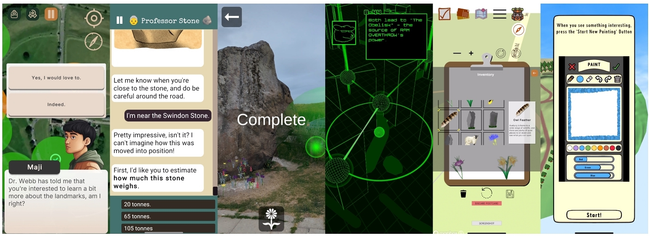
Our method seeks to understand the links and designs of locative ludonarrative heritage hypertext through a study of 6 locative games taken from the Avebury Adventures Anthology. This anthology was commissioned as part of the LoGaCulture project, investigating locative games for cultural heritage. A paid commission for freelance designers was established, whereby ten designers each created two locative games for the site with support from the National Trust (who manage the site), an independent archaeology expert on the site's history, an artist, and an engineer. Games were created using either the Unity Game Engine [49] or LUTE [8], a hypertextual mixed reality game toolkit (based on Unity). Our means of study is a fusion of HCI and Game Studies: we use a classical player experience evaluation to capture user attitudes on the experiences, but also conduct a close reading of the experiences to identify poetics and design patterns—both methods for which are detailed below.
2.1 Game Sample
The anthology's 20 games fell into three categories: Historic (8 games prioritising heritage education), Ludic (10 games prioritising play and mechanics), and Creative (2 games prioritising making and expression). From these, we took a sample of 6 games—2 from each category, 1 Unity and 1 LUTE per category—for a representative slice of the anthology, summarised in Table 1 and depicted in Figure 1. All games are playable on smartphone devices, though Bloom and Wander (at time of writing) is only available on Android; the remaining five support both Android and Apple.
Table 2: GEQ player study data by variable for overall data and separated by game. 54 participants returning 108 playtests.
Core | Social Presence | Post Game | |||||||||||||
Frequency | Competence | Sensory & Imag. Immersion | Flow | Tension/Annoyance | Challenge | Negative affect | Positive affect | Empathy | Negative Feelings | Behavioural Involvement | Positive Experience | Negative Experience | Tiredness | Return to Reality | |
Overall | 108 | 2.23 | 2.06 | 1.26 | 0.55 | 0.6 | 0.95 | 2.46 | 1.83 | 0.60 | 1.04 | 1.42 | 0.39 | 0.45 | 0.88 |
Replicas | 20 | 2.40 | 2.13 | 1.31 | 0.37 | 0.43 | 0.88 | 2.58 | 1.79 | 0.46 | 1.10 | 1.51 | 0.33 | 0.43 | 0.67 |
Bloom & Wander | 15 | 2.20 | 1.87 | 1.13 | 0.51 | 0.32 | 0.77 | 2.24 | 1.58 | 0.43 | 0.91 | 1.23 | 0.40 | 0.33 | 0.89 |
Imaging Avebury | 19 | 2.06 | 2.23 | 1.32 | 0.88 | 0.68 | 1.12 | 2.53 | 2.32 | 0.69 | 1.14 | 1.39 | 0.37 | 0.45 | 1.07 |
Avebury Res. Challenge | 17 | 2.19 | 1.83 | 1.00 | 0.53 | 0.51 | 1.07 | 2.20 | 1.90 | 0.64 | 0.92 | 1.56 | 0.33 | 0.44 | 0.80 |
Cyber@ Avebury | 19 | 2.00 | 1.95 | 1.21 | 0.75 | 1.00 | 1.15 | 2.13 | 1.57 | 0.66 | 1.06 | 1.12 | 0.62 | 0.74 | 1.11 |
Painting Avebury | 18 | 2.50 | 2.28 | 1.52 | 0.22 | 0.61 | 0.67 | 3.07 | 1.79 | 0.71 | 1.06 | 1.66 | 0.30 | 0.28 | 0.74 |
2.2 Player Experience Method
As part of our exploration of the design patterns and their impact with regard to RQ2, we conducted a traditional player experience user study. To do this we used the Game Experience Questionnaire (GEQ) [21, 22] as a standardised and commonly used HCI measure of player experience [10]. In order to gain the most detailed picture of the player experience of our sample, we also used both the social presence module of the GEQ [9] (to understand the games impact on player empathy and connection to others), and the post game module (to understand their perspective on their reflections after play). Study methodology was ethically reviewed and approved by Bournemouth University ethics committee and protocol for the study was as follows:
We recruited games and animation students at Bournemouth University, offering a £30 voucher incentive. Participants were each allocated 2 games to play and were asked to test game compatibility with their personal device before attendance. We provided transport to the Avebury site and participants were on site for four hours, during which they played each allocated game for 30 minutes. We mitigated order bias through game allocation, with half the tests for a given game playing it first, and half second. After each test, players completed an online version of the GEQ.
2.3 Close Reading Method
The player experience study was followed by a close reading in the tradition of game studies and other criticism methods in the humanities. We followed the Bizzochi and Tanenbaum method [7] as used in other game close readings such as [27, 35, 36, 38, 41]. Close reading is a hermeneutic approach, deconstructing and reflecting on the content of a work by examining experience repeat cycles, and analysing findings in terms of given lenses. It has demonstrated value in evaluating the poetics of design fiction [3] which make it valuable here. Our lenses were:
Linked Locations: How is the experience linked to place and how does it make use of locative technology and mixed reality? What is the role of traversal and movement?
Linked Ludonarrative: How is play linked to story? How are stories reflected in the use of ludonarrative poetics?
Our reading was conducted by two of this paper's authors and followed this protocol: we each played 6 games on site separately as ‘naive readers’ [7], for a maximum of 30 minutes while recording our play-through and following the verbal protocol (thinking aloud). On completion we reviewed the experience, using the recording to document a reflection of each game and conduct an open coding analysis in terms of each lens. Finally, we met to share reflections and codes, and collectively conducted a thematic analysis to draw our core themes from the games.
3 Results
Both methodologies outlined above were completed and present combined quantitative and qualitative findings.
3.1 Player Experience Findings
60 participants were recruited, of which 54 attended the study, each playing 2 games for 108 total playtests. All participants were students in games or animation at Bournemouth University, 23 identified as male, 26 as female, 3 as non-binary, 1 as genderfluid, and 1 not specified. Each of the three GEQ modules (core, social presence, and post game) score a range of metrics based on Ijsselsteijn et al’s original scoring methods [22], the results of which are summarised in table 2. Uneven frequencies are due to non-attending participants.
Some initial observations can be drawn directly from this data—players enjoyed the experiences, reporting higher positive than negative affect in the core module (2.46 to 0.95, p<0.001) and higher positive experience than negative experience in the post game module (1.42 to 0.39, p<0.001).
The data also shows some impact of the game category on experience, with games in the creative category showing higher positive affect, followed by historic, followed by ludic (2.79 for creative, compared to 2.40 for historic, and 2.18 for ludic, p<0.05), suggesting that the mechanics of these games may present a stronger positive impact for creative interactions than for ludic in this context.
In terms of correlations, we can see connections we might expect between positive or negative variables with variables of similar sentiment. What is more interesting is the strength of these correlations with positive and negative affect. The strongest positive variable correlation with positive affect was sensory and imaginative immersion (r=0.81, p<0.001), indicating the importance of creating a sense of immersion in mixed reality locative experiences. The weakest was behavioural involvement within social presence (r=0.27, p<0.05), which can be explained by single player experiences with only brief character interactions. On the negative side, the strongest correlation with negative affect was tension/annoyance (r=0.74, p<0.005), which can mostly be attributed to somewhat mundane annoyance at small bugs and interface design issues, but also in frustrations understanding what to do and where to go in the games.
3.2 Close Reading Findings
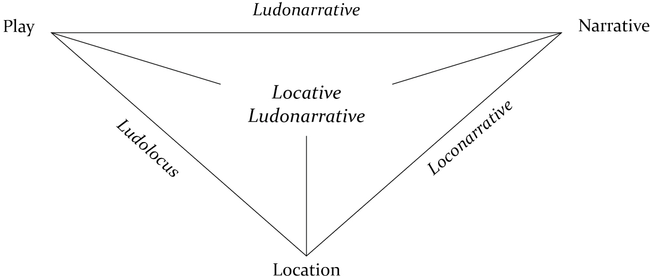
Close reading was conducted to the method during March 2026, and identified four link types operating across Play, Narrative, and Location—the three layers of each experience: Ludonarrative (play ↔ narrative), Ludolocus (play ↔ location), Loconarrative (narrative ↔ location), and a central Locative Ludonarrative category connecting all three simultaneously. Our model is presented in Figure 2; detailed analysis follows in Section 4.
4 Close Reading Analysis
Close reading identified a range of links with each shaping the poetics of the games. These links are not in the traditional hypertext sense from content to content, but between the three layers of each experience: Play, Narrative, and Location.
4.1 Ludonarrative: Linking Play and Narrative
Ludonarrative is an established concept within game studies and design [13, 18, 42, 45], describing the link (or lack thereof) between how a game plays and how a game reads.
4.1.1 Harmonies and Dissonances. Cyber@Avebury, as described in table 1, is a humorous, cyberpunk-themed game. Its aesthetics hearken to green-on-black MS-DOS terminals and a canon of science fiction films, and its narrative centres on hacking and counter-hacking. Playing its minigames felt connected to the narrative, as they successfully mimicked retro games to communicate an imagined hacking-like experience. The experience of ludonarrative harmony is that of a game feeling ‘complete’ and coherent, even where the subject matter is absurd. This draws an unfavourable comparison with Bloom and Wander’s mixed-reality puzzles, which call on the player to move small 3D orb objects around on an AR plane. The experience is simple to the point of feeling trivial, and bears no relevance to the game's themes of education and natural beauty.
4.1.2 Educational Play. Three of the six games (Bloom and Wander, Avebury Research Challenge (ARC), and Replicas) framed their narrative within an academic context of archaeological research as a means of connecting the game story to the heritage landscape. There are obvious benefits to this thematic framing: as players we immediately understand that the information we receive will be factual, and for a player new to the site this fulfils an expected mode of visiting engagement—that of a virtual tour guide [17, 26, 39, 50]. However, this affordance of easy on-boarding also limits the kind of play that feels coherent to the story. As described above, Bloom and Wander demonstrated this difficulty in linking theme and play. Replicas more effectively integrated a mechanic of pedagogic dialogue followed by quizzing, but each quiz was limited to only two options. The mode of play felt coherent, but unsatisfying. ARC was more successful, as it utilised a third dimension of connecting narrative and play to the landscape, as discussed in section 4.4.
4.2 Ludolocus: Linking Play and Location
Through play, we observed a variety of means by which the game experience and physical space were linked, both through technology and interaction. The experiences broadly demonstrated ‘hard’ (where location is specific and technologically linked) or ‘soft’ (where the relationship with location is more flexible) approaches to location links.
4.2.1 Detection. Detection describes how the game-as-system triggers content based on the player's location. ‘Hard’ detection makes use of the phone's GPS system to locate the player within approximately 10 meters of a location node, triggering content. Replicas, for example, handles on-location triggers and visually situates players and nodes on a map. However, the link that hard detection forges between game and landscape is imperfect. In the case of Replicas, the game's narrative is informative and diegetically linked to particular stones around the site. In practice, we found that some content triggered at a distance, closer to unintended stones than the intended one, confusing the player.
‘Soft’ detection, on the other hand, often relies on location self-report from the player to link their location to game content. It sacrifices a ‘hard’ technological link between the landscape and the player device through GPS, in favour of a fuzzier link through the player. From a content triggering perspective the function is identical, and from a complexity perspective has fewer potential points of failure: the point of failure is transferred from the device to the player, who may report inaccurately. This issue is effectively addressed in ARC, which uses a soft detection system in which the player reports their location (e.g. ‘near the visitors’ centre’). Game content is tailored to each location and, in order to progress, the player must visually interact with their surroundings. As such, when we tried to report our location inaccurately, we were unable to progress in the game until we had navigated to the correct location.
4.2.2 Guidance. We use ‘Guidance’ to describe how the game communicates location to the player, as well as the experience of being guided. ‘Hard’ guidance, again relying on GPS and mapping software such as MapBox [1], is common in locative game design (5/6 games in this study made use of it), but created navigational friction as we played. The player marker suffers from the same inexactness of location as node-triggering, and infrequent updating in games such as Replicas led to frustrating back-and-forth wandering while playing. Further, it relies on the player continuously orientating themself on a map. In the case of Cyber@Avebury, the map is wireframed to mimic its cyberpunk aesthetic. Visually effective, but the player unfamiliar with the site must keep their eyes on their phone to avoid getting lost, losing sight of the environment they have typically intended to visit.
‘Soft’ guidance requires that the player transpose diegetic instructions to successfully navigate the physical world. ARC, for example, relied purely on soft guidance such as non-responsive maps and text clues like ‘the entrance to the stone circle behind the barn’ to guide players through the game and site. This mode of guidance forced our attention as players onto the environment, as we actively made sense of our environment at each stage. Bloom and Wander combined both modes, using ‘hard’ GPS location points to bring us near to standing stones on the site, then adding ‘soft’ location in the form of a sketch of the specific stone to help us target the exact location. We experienced the blend of soft and hard guidance as being the most effective mode of instantiating location through play.
4.2.3 Agency in Navigation. Whether hard or soft guidance was implemented, part of the experience of navigating through the game and site involved choosing a path of traversal. All 6 games were non-linear in the sense that location nodes could be visited in any order. Games such as Replicas placed nodes on footpaths around the site, constrained to the stone circle itself, but choosing a path did not meaningfully affect gameplay. Imagining Avebury, meanwhile, offered over 20 locations spread over the site, which could be played in any order or not completed. This was a plethora of choice that we found somewhat overwhelming, and appreciated the contrast of ARC, which introduced core and optional clusters of locations around the site through narrative.
4.3 Loconarrative: Linking Location and Narrative
The experience of place while engaging with locative games fundamentally alters the way that the narrative is experienced [46]. Five of the six games explicitly engaged with the location through narrative, and we make the following observations as to how those links were drawn and felt.
4.3.1 Connecting Story and Place through Heritage. The Avebury stone circle is a site rich in cultural and natural heritage, which makes it a popular visiting destination. It is therefore perhaps unsurprising that 4/6 of the games chose to narratively communicate this heritage in some way. All three ‘academic’ games described in section 4.1.2 guide the player to the Cove stones, the Swindon stones, and the Barber stone (among others), and deliver similar information about the stones’ histories. This certainly forges coherent links between the place and its stories. However, as mentioned in ARC, these stones are visited on authorised site tours and so the player may be left wondering what value the locative game has added to the visiting experience.
We can compare this to a more dispersed, non-linear location nodal structure as in Imagining Avebury, which presents a fictional framework to deliver a more faceted factual heritage. Although the number of available location nodes may at first be overwhelming, they demonstrate a more complete connection with Avebury's cultural heritage beyond its stone circle, incorporating its church and chapel, its museum, its natural heritage, etc. which is then carried through in the available sticker designs and attached information. This de-prioritisation of an archaeological academic context allows for greater agency in loconarrative exploration on the part of the player, while still engaging in a visiting experience closely tied to place.
4.3.2 Narrative Weight and Loconarrative Dissonance. We observed a spectrum of narrative weight that directly impacted the feeling of location-specificity. When narrative is absent, as in Painting Avebury, there is no dissonance, but the site becomes less relevant; the game is location-agnostic and could just as easily be played in any given heritage site. On the other extreme, Cyber@Avebury utilised intentional thematic dissonance, pitting a fast-paced cyberpunk narrative against the slow reality of the heritage site. While entertaining and even ludonarratively coherent, this friction distracted from the storytelling and shifted focus away from the site's heritage. Lighter, more balanced narratives, such as those found in Imagining Avebury and ARC, fostered a greater connection by anchoring the player to the site without demanding constant screen attention, allowing the narrative to enable engagement rather than compete with it.
4.4 Locative Ludonarrative: Linking Location, Play, and Narrative
In this section we discuss observations that link together all three layers of locative games as mediated experiences. That is, the experience of story, place, and play together.
4.4.1 Dissonances. Through close reading, we found that missing links between these three layers led to a sense of dissatisfaction in play, even when other layers were engaging. When playing Bloom and Wander, for instance, an initially grey map turned green, and flower objects appeared in augmented reality around the stones themselves. The mechanical satisfaction of the map transformation was engaging, but the overarching narrative (or lack thereof) was too thin to give the blooming flowers a deeper relevance to the site and thus lacked emotional significance, leaving the locations visually distinct but narratively empty. In Cyber@Avebury, the cyberpunk aesthetic was effectively communicated through the game's mechanics, but while increasing challenge between minigames kept us engaged, it distracted us from our physical environment.
4.4.2 The Balance of Attention. This leads us to a persistent tension we experienced in play, that of juggling attention between the digital interface and the physical space, as described in [34] and [51]. We describe experiencing this during navigation, above, but the problem persisted further. Games like Cyber@Avebury and Replicas suffered from a "narrative scroller" effect, where fast-moving or heavy dialogue pulled attention entirely to the screen. This created social and spatial distractions, and left the heritage aspect feeling unanchored, as facts were delivered without guiding the player to observe their surroundings. Conversely, games that treated ‘noticing’ as a mechanic more successfully connected place and play (see also [52] and [39]): ARC required players to actively observe the environment to progress, utilising procedural tasks (such as counting obelisks) and reasoning tasks (such as deducing a building's original purpose). This design choice effectively shifted the player from a passive reader to an active observer, using the digital device as a lens to focus attention rather than a screen to divert from it.
4.4.3 Reflective Creation. Two games took the mechanic of ‘noticing’ further, from gameplay that amalgamated material-world observations, to synthesising creative outputs from observation with a mechanic we term ‘Reflective Creation.’ The success of this mechanic was not in its novelty—as the tools themselves are fairly simple—but in the creation of a game space that fosters mindfulness and presence. In Imagining Avebury, players collect virtual stickers by exploring the site, then use the stickers to create their own postcards (see fig 1). The act of making a postcard is narratively encouraged to be a moment to pause, take a seat, and reflect. As a mechanic, we felt this resonated with the bucolic peace and cultural spirituality of the stone circle. The stickers, too, had been designed with care to bear significance to the site's heritage. However, the act of reflection is internal, and the player's attention is held closely to their device as they create. There is therefore some tension as they are present in the site as a conceptual space, but not fully present in the material space.
Painting Avebury also encourages players to visually engage with the site in order to paint artworks which they may treat as digital souvenirs. The encouragement here is non-explicit: beyond the tutorial the game lacks any textual narrative at all. The game is toy-like, free-form, and any narrative that the player derives is drawn from the snapshots of their experiences around the site. As such, we felt it suffered from a lack of location-specificity. However, the game succeeds at fostering a seamless balance of attention as the player puts their notice on the landscape and their fingertip on the phone screen, the gameplay becoming a synthesis of the player's interaction with the landscape.
4.4.4 Locative Serendipity. During play, we experienced moments of surprise and delight when the game world and real world aligned, promoting a sense of locative ludo-harmony and joy in an unexpected reframing of the material world. We term this ‘locative serendipity’. Some of these moments were pure chance; ephemeral connections between game, story, and location. When playing Bloom and Wander, the map changes from grey to green, as described. Playing this on a foggy spring day, the landscape was rendered in shades of grey. As we played, the map transformation occurred alongside an environmental transformation, wherein the fog lifted to reveal a green and sparkling landscape. This created an unintended, but effective, moment of serendipity which felt as if the game and landscape had connected.
Other such moments demonstrated a design intentionality. Imagining Avebury fosters serendipitous moments through an abundance of opportunities. The stickers described in section 4.4.3 are items and objects both loosely and closely associated with the site's cultural heritage, and the node locations more specifically. For example, by reaching the node nearest to the Alexander Keiller museum, we found stickers of coins, bones, and pot sherds—each marked up with contextual information. With so many stickers to collect, it was almost inevitable that there would be ephemeral moments of connection between the site and the game. As we explored, we were delighted to find not only the standing stones and their sticker counterparts as expected, but daffodils, harebells, and (most ephemeral of all) a pigeon feather, appearing in close proximity both in the game and in the material world.
Avebury Research Challenge (ARC) fosters the same effect by relying on the popularity of the site with visitors. The game makes frequent diegetic references to the site and makes reference to common site activities to create likely (though not certain) magic moments of serendipity. For example, two tours of Avebury take place each day, excepting extreme weather, and the game narratively encourages the player to watch out for tour groups and visitors with cameras. On a harsh winter day it is unlikely that the player would encounter either phenomenon, but on even a mild spring day before the heavy tourist season, as when we were playing, both phenomena occurred. These moments effectively link the narrative and the experience of play within a material space to create moments of locative ludonarrative harmony.
5 Discussion: Toward Design Patterns for Locative Games and Ludic Heritage Experiences
In this section we discuss the findings from our close reading, above, and contextualise them with GEQ data from the participant study. We seek to answer RQ1 and RQ2 within a framework of links between Story, Narrative, and Play as described in figure 2 and, where possible, synthesize recommendations toward applications of design patterns for locative game design from our analysis.
Our observations indicate a point of friction in the ludolocative experience, particularly around guidance and navigation. Losing one's way, wandering back and forth, inaccurate content triggering, and unclear mapping all cause confusion and frustration [39]. GEQ data to support this is limited, but the strongest correlation with negative affect in our study was tension/annoyance (r=0.74, p<0.005), which indicates that these minor in-game irritations and bugs can have a major effect on the player experience and should be addressed wherever possible. As such, effective detection and guidance are crucial when combining play and place. While Bloom and Wander successfully made complementary use of ‘soft’ and ‘hard’ guidance, no game in our selection made use of both ‘hard’ and ‘soft’ location detection. This led to a poorer user experience in playing Replicas and Imagining Avebury, in which the location system got ‘stuck’ and failed to update. We posit that using both detection patterns in combination would be beneficial toward solving this problem, creating a more seamless user experience. For example, if a location system fails for any reason (due to disrupted signal or an unavailable location), it is helpful for the system to fail ‘gracefully’ (per principles of graceful degradation [12, 44]) and offer the player a way to trigger location content manually, or offer an alternative location.
As an ancient heritage site where the “past haunts the present” [14], it is perhaps not surprising that games in the ‘historic’ category make loconarrative sense in the context of Avebury (see also [26, 48]). In our GEQ study, the category of historic games scored higher for positive affect than ludic, (2.40 for historic, and 2.18 for ludic, p<0.05), though not as high as creative. As well as history, these games also tended toward modes of information delivery and education as a way of linking to narrative to heritage and place [52]. We experienced a difference between games which delivered information, and those which offered a more active experience with contextual learning: embedding facts at a location was not enough [15]. Games that relied heavily on text-based dialogues felt passive, anchoring our attention to the screen and rendering the heritage site a bland informational backdrop rather than a subject of learning. As such we recommend locative design that fosters conscious exploration on the part of the player, and which aligns exploration and learning toward a personalised experience [37, 46, 47].
We position the concept of locative ludonarrative harmony, and patterns by which to foster it, as the most important contributions of this paper. It is the experience of being immersed simultaneously and seamlessly in play, place, and story in a game. This position is to some extent borne out by GEQ data, which identifies the strongest positive variable correlation with positive affect as sensory and imaginative immersion (r=0.81, p<0.001). The two design patterns which we propose as being instrumental in this regard are Noticing as Mechanic and Locative Serendipity.
‘Noticing as Mechanic’ ludically shifts the player's attention from the play device onto the landscape. The two creative games in our study successfully made use of this pattern, and indeed took it further, by encouraging the player toward active synthesis through creation and exploration. That this was successful is supported by the GEQ data, which indicates that games in the creative category had the highest overall positive affect compared to historic and ludic games (2.79 for creative, compared to 2.40 for historic, and 2.18 for ludic, p<0.05).
The impact of locative serendipity is more challenging to measure beyond the broad category of sensory and imaginative immersion. This pattern is also somewhat risky: as it relies on chance, there may be players for whom it will not work. Furthermore, it requires study of and familiarity with the given site by the designer in order to foster moments of alignment. However, the experience of it which emerged from our close reading was significant; that of harmony between real world and game world. We have identified the following variations on the pattern:
Opportunity through Abundance fosters opportunities for moments of alignment by sheer numbers, diegetically referencing site-relevant elements. An example of this could be the integration of the weather as a factor in an outdoor setting, either using plug-ins or user-reportage.
Opportunity through Popularity as in ARC, seeks to align story and gameplay with popular site visiting habits. This could include limited-time content for holidays and festivals.
Ephemeral serendipity relies on habits of pattern-finding among users, as in emergent narratives [23, 28]. It is an application of the ‘magic circle’ effect of player thinking which, in this context, may encourage players to see the material world differently than when not framed by the context of games [50, 52]. Ephemeral serendipity may be fostered by (ludo)narratively embedding the game fiction within a realistic context for the site, within which the player may generate stochastic links and create an emergent ludo-harmony.
6 Conclusions, Limitations, and Future Work
Our work provides evidence towards answering our research questions; RQ1 through our model of links, and RQ2 through our mixed-methods inspection of experience impact. We explore design poetics in terms of the value and costs of different approaches to each of our four link types in sections 4 and 5. Our work shows the value of blending HCI UX methods with close reading from game studies, where a close reading approach has exposed richer poetic findings beyond initial GEQ data. While these contributions are valuable toward understanding links in locative ludic hypertext, they must be considered in the context of their limitations: the experience user study was conducted with students with limited diversity of participants, and the close readings were conducted at one point in time—where the experience may change with the seasons. While this is important, we do not believe these limitations undermine the findings, as they remain new empirical observations in hypertext research. Future work in this space should further expand the connections between poetics and ludic harmonies, with deeper explorations of how these impact player experience.
Acknowledgments
With thanks to the National Trust at Avebury, and all our designers for their hard work and invaluable contributions. LoGaCulture was funded by Horizon Europe (101094036) and UKRI (10069437).
Notes
1Avebury Adventures Anthology is detailed here: https://logaculture.eu/news-events/avebury-adventures-exploring-avebury-through-locative-games/
Source
Imported from ACM’s structured HTML source. ACM Reference Format: Bob Rimington, Jack Brett, and Charlie Hargood. 2026. Linked Locative Ludonarrative and Heritage Hypertext Harmonies. In 37th ACM Conference on Hypertext (HT '26), September 14--18, 2026, London, United Kingdom. ACM, New York, NY, USA 9 Pages. https://doi.org/10.1145/3800935.3830844
References
[1] Mapbox Services 2010-2026. [n. d.]. Mapbox. https://mapbox.com/ Accessed: 20/04/2026.
[2] Mark WR Anderson and David E Millard. 2023. Seven hypertexts. In Proceedings of the 34th ACM Conference on Hypertext and Social Media. 1–15. https://doi.org/10.1145/3603163.3609048
[3] Eric P. S. Baumer, Mark Blythe, and Theresa Jean Tanenbaum. 2020. Evaluating Design Fiction: The Right Tool for the Job. In Proceedings of the 2020 ACM Designing Interactive Systems Conference (Eindhoven, Netherlands) (DIS ’20). Association for Computing Machinery, New York, NY, USA, 1901–1913. https://doi.org/10.1145/3357236.3395464
[4] Mafkereseb Kassahun Bekele, Roberto Pierdicca, Emanuele Frontoni, Eva Savina Malinverni, and James Gain. 2018. A Survey of Augmented, Virtual, and Mixed Reality for Cultural Heritage. ACM Journal on Computing and Cultural Heritage (JOCCH) 11, 2 (2018), 1–36. https://doi.org/10.1145/3145534
[5] Mark Bernstein. 1998. Patterns of hypertext. In Proceedings of the ninth ACM conference on Hypertext and hypermedia: links, objects, time and space—structure in hypermedia systems: links, objects, time and space—structure in hypermedia systems. 21–29. https://doi.org/10.1145/276627.276630
[6] Julia L. Bitter, Ralf Dörner, Y. Liu, L. Rau, and Ulrike Spierling. 2022. Follow the Blue Butterfly–An Immersive Augmented Reality Museum Guide. In International Conference on Human-Computer Interaction. Springer, 171–178. https://doi.org/10.1007/978-3-031-06391-6_23
[7] Jim Bizzocchi and Theresa Tanenbaum. 2011. Well read: Applying close reading techniques to gameplay experiences. Well played 3, 3 (2011), 289–315.
[8] Jack Brett, Charlie Hargood, David Millard, Yoan-Daniel Malinov, and Bob Rimington. 2025. LUTE: A Hypertextual Mixed Reality Game Engine. In Proceedings of the 36th ACM Conference on Hypertext and Social Media. 137–145. https://doi.org/10.1145/3720553.3746666
[9] Yvonne AW De Kort, Wijnand A IJsselsteijn, and Karolien Poels. 2007. Digital games as social presence technology: Development of the Social Presence in Gaming Questionnaire (SPGQ). Proceedings of PRESENCE 195203 (2007), 1–9.
[10] Alena Denisova, A Imran Nordin, and Paul Cairns. 2016. The convergence of player experience questionnaires. In Proceedings of the 2016 Annual Symposium on Computer-Human Interaction in Play. 33–37. https://doi.org/10.1145/2967934.2968095
[11] Mara Dionisio, Paulo Bala, Valentina Nisi, and Nuno Nunes. 2017. Fragments of laura: incorporating mobile virtual reality in location aware mobile storytelling experiences. In Proceedings of the 16th International Conference on Mobile and Ubiquitous Multimedia. 165–176. https://doi.org/10.1145/3152832.3152868
[12] Murielle Florins and Jean Vanderdonckt. 2004. Graceful degradation of user interfaces as a design method for multiplatform systems. In Proceedings of the 9th International Conference on Intelligent User Interfaces (Funchal, Madeira, Portugal) (IUI ’04). Association for Computing Machinery, New York, NY, USA, 140–147. https://doi.org/10.1145/964442.964469
[13] Antonino Frazzitta and Charlie Hargood. 2021. Tale: Defamiliarizing ludonarrative puzzles. In International Conference on Interactive Digital Storytelling. Springer, 203–207. https://doi.org/10.1007/978-3-030-92300-6_18
[14] Yixiao Fu, Daragh Byrne, and Lawrence Shea. 2021. Evoking the post-industrial landscape memories through spectrality and mixed reality soundscapes. In Proceedings of the 13th Conference on Creativity and Cognition. 1–6. https://doi.org/10.1145/3450741.3465256
[15] Thomas Grace D, Christie Abel, and Katie Salen Tekinbaş. 2025. Learning Curiosity through Play: Exploring the Role of Games and Interactive Design in Museums. In Proceedings of the 2025 CHI Conference on Human Factors in Computing Systems(CHI ’25). Association for Computing Machinery, New York, NY, USA, Article 655, 14 pages. https://doi.org/10.1145/3706598.3713164
[16] Mads Haahr. 2017. Everting the Holodeck: Games and Storytelling in Physical Space. In 2017 IEEE 5th International Conference on Serious Games and Applications for Health (SeGAH). IEEE, 1–8. https://doi.org/10.4324/9781315769189-17
[17] Ramy Hammady, Minhua Ma, Carl Strathern, and Mostafa Mohamad. 2020. Design and development of a spatial mixed reality touring guide to the Egyptian museum. Multimedia Tools and Applications 79, 5 (2020), 3465–3494. https://doi.org/10.1007/s11042-019-08026-w
[18] Charlie Hargood. 2024. A LocoLudo Approach: Locative Hypertext Ludonarrative. In Narrative and Hypertext Workshop 2024 (NHT24).
[19] Charlie Hargood, Verity Hunt, Mark J Weal, and David E Millard. 2016. Patterns of sculptural hypertext in location based narratives. In Proceedings of the 27th ACM conference on hypertext and social media. 61–70. https://doi.org/10.1145/2914586.2914595
[20] Charlie Hargood, Mark J Weal, and David E Millard. 2018. The storyplaces platform: Building a web-based locative hypertext system. In Proceedings of the 29th on Hypertext and Social Media. 128–135. https://doi.org/10.1145/3209542.3209559
[21] Wijnand IJsselsteijn, Wouter Van Den Hoogen, Christoph Klimmt, Yvonne De Kort, Craig Lindley, Klaus Mathiak, Karolien Poels, Niklas Ravaja, Marko Turpeinen, and Peter Vorderer. 2008. Measuring the experience of digital game enjoyment. In Proceedings of measuring behavior, Vol. 2008. Noldus Information Tecnology Wageningen, Netherlands, 88–89.
[22] Wijnand A IJsselsteijn, Yvonne AW De Kort, and Karolien Poels. 2013. The game experience questionnaire. (2013).
[23] Jin Jeong and Tak Yeon Lee. 2025. LIGS: Developing an LLM-infused Game System for Emergent Narrative. In Proceedings of the Extended Abstracts of the CHI Conference on Human Factors in Computing Systems(CHI EA ’25). Association for Computing Machinery, New York, NY, USA, Article 369, 12 pages. https://doi.org/10.1145/3706599.3720212
[24] Joey Donald Jones and David Millard. 2024. Experiencing The Authorial Burden. In Proceedings of the 35th ACM Conference on Hypertext and Social Media (Poznan, Poland) (HT ’24). Association for Computing Machinery, New York, NY, USA, 78–87. https://doi.org/10.1145/3648188.3675134
[25] Panayiotis Koutsabasis, Konstantinos Partheniadis, Anna Gardeli, Panagiotis Vogiatzidakis, Vassiliki Nikolakopoulou, Pavlos Chatzigrigoriou, and Spyros Vosinakis. 2021. Location-Based Games for Cultural Heritage: Applying the Design Thinking Process. In CHI Greece 2021: 1st International Conference of the ACM Greek SIGCHI Chapter (Online (Athens, Greece), Greece) (CHI Greece 2021). Association for Computing Machinery, New York, NY, USA, Article 9, 8 pages. https://doi.org/10.1145/3489410.3489419
[26] Ursula Kretschmer, Volker Coors, Ulrike Spierling, Dieter Grasbon, Kerstin Schneider, Isabel Rojas, and Rainer Malaka. 2001. Meeting the spirit of history. In Proceedings of the 2001 conference on Virtual reality, archeology, and cultural heritage. 141–152. https://doi.org/10.1145/584993.585016
[27] Elizabeth LaPensée. 2021. When Rivers Were Trails: Cultural expression in an indigenous video game. International Journal of Heritage Studies 27, 3 (2021), 281–295. https://doi.org/10.1080/13527258.2020.1746919
[28] Qianwen Lyu, David Millard, and Nicholas Gibbins. 2025. Stories from the Bottom Up: Emergent Narratives with Composable Story Sifting Patterns. In Proceedings of the 20th International Conference on the Foundations of Digital Games(FDG ’25). Association for Computing Machinery, New York, NY, USA, Article 2, 11 pages. https://doi.org/10.1145/3723498.3723809
[29] Stacey Mason. 2013. On games and links: Extending the vocabulary of agency and immersion in interactive narratives. In International Conference on Interactive Digital Storytelling. Springer, 25–34. https://doi.org/10.1007/978-3-319-02756-2_3
[30] Stacey Mason and Mark Bernstein. 2019. On links: exercises in style. In Proceedings of the 30th ACM Conference on Hypertext and Social Media. 103–110.
[31] David E Millard. 2020. Games/hypertext. In Proceedings of the 31st ACM Conference on Hypertext and Social Media. 123–126. https://doi.org/10.1145/3372923.3404775
[32] David E Millard and Charlie Hargood. 2017. Tiree tales: A co-operative inquiry into the poetics of location-based narrative. In Proceedings of the 28th ACM Conference on Hypertext and Social Media. 15–24. https://doi.org/10.1145/3078714.3078716
[33] David E Millard and Charlie Hargood. 2021. Hypertext as a lens into interactive digital narrative. In International Conference on Interactive Digital Storytelling. Springer, 509–524. https://doi.org/10.1007/978-3-030-92300-6_51
[34] David E. Millard, Heather Packer, Yvonne Howard, and Charlie Hargood. 2020. The Balance of Attention: The Challenges of Creating Locative Cultural Storytelling Experiences. ACM Journal on Computing and Cultural Heritage (JOCCH) 13, 4 (2020), 1–24. https://doi.org/10.1145/3404195
[35] Alex Mitchell and Liting Kway. 2020. “How do I restart this thing?” Repeat experience and resistance to closure in rewind storygames. In International Conference on Interactive Digital Storytelling. Springer, 164–177. https://doi.org/10.1007/978-3-030-62516-0_15
[36] Alex Mitchell, Liting Kway, and Brandon Junhui Lee. 2020. Storygameness: understanding repeat experience and the desire for closure in storygames. In Proceedings of DiGRA 2020 Conference: Play Everywhere.
[37] C Thi Nguyen. 2025. Games: Agency as art. Oxford University Press. https://doi.org/10.1017/S0031819122000341
[38] Kristine Øygardslia, Charlotte Lærke Weitze, and Juhyung Shin. 2020. The educational potential of visual novel games: Principles for design. Replaying Japan 2, 2 (2020), 123–134. https://doi.org/10.34382/00013369
[39] Heather S Packer, Charlie Hargood, Yvonne Howard, Petros Papadopoulos, and David E Millard. 2017. Developing a writer's toolkit for interactive locative storytelling. In International Conference on Interactive Digital Storytelling. Springer, 63–74. https://doi.org/10.1007/978-3-319-71027-3_6
[40] Natasa Paterson, Gavin Kearney, Katsiaryna Naliuka, Tara Carrigy, Mads Haahr, and Fionnuala Conway. 2013. Viking ghost hunt: creating engaging sound design for location–aware applications. International Journal of Arts and Technology 6, 1 (2013), 61–82. https://doi.org/10.1504/IJART.2013.050692
[41] Simon Radchenko. 2025. Metamodern Nature of Hideo Kojima's Death Stranding Synopsis and Gameplay. Games and Culture 20, 1 (2025), 20–37. https://doi.org/10.1177/15554120231187794
[42] Christian Roth, Tom Van Nuenen, and Hartmut Koenitz. 2018. Ludonarrative hermeneutics: a way out and the narrative paradox. In International conference on interactive digital storytelling. Springer, 93–106. https://doi.org/10.1007/978-3-030-04028-4_7
[43] Doris C Rusch and Matthew J Weise. 2008. Games about love and trust? Harnessing the power of metaphors for experience design. In Proceedings of the 2008 ACM SIGGRAPH symposium on Video games. 89–97. https://doi.org/10.1145/1401843.1401861
[44] Titos Saridakis. 2009. Design Patterns for Graceful Degradation. Springer Berlin Heidelberg, Berlin, Heidelberg, 67–93. https://doi.org/10.1007/978-3-642-10832-7_3
[45] Yotam Shibolet. 2023. The Harmony of Escaping Hell: Ludonarrative Interplay in Hades. In Abstract Proceedings of DiGRA 2023 Conference: Limits and Margins of Games.
[46] Jae-Eun Shin and Woontack Woo. 2023. How Space is Told: Linking Trajectory, Narrative, and Intent in Augmented Reality Storytelling for Cultural Heritage Sites. In Proceedings of the 2023 CHI Conference on Human Factors in Computing Systems (CHI ’23). https://doi.org/10.1145/3544548.3581414
[47] Erica L. Snow, Laura K. Allen, Matthew E. Jacovina, and Danielle S. McNamara. 2015. Does agency matter?: Exploring the impact of controlled behaviors within a game-based environment. Computers and Education 82 (2015), 378–392. https://doi.org/10.1016/j.compedu.2014.12.011
[48] Ulrike Spierling, Peter Winzer, and Erik Massarczyk. 2017. Experiencing the presence of historical stories with location-based augmented reality. In Interactive Storytelling: 10th International Conference on Interactive Digital Storytelling, ICIDS 2017 Funchal, Madeira, Portugal, November 14–17, 2017, Proceedings 10. Springer, 49–62. https://doi.org/10.1007/978-3-319-71027-3_5
[49] Unity Technologies. [n. d.]. Unity 3D. https://unity.com/ Accessed: 01/04/2026.
[50] Silvia Torsi, Carmelo Ardito, and Cristina Rebek. 2020. An Interactive Narrative to Improve Cultural Heritage Experience in Elementary School Children. J. Comput. Cult. Herit. 13, 3, Article 22 (Aug. 2020), 14 pages. https://doi.org/10.1145/3382771
[51] Douglas Wilson, Dajana Dimovska, Sebbe Selvig, and Patrick Jarnfelt. 2009. Face-off in the magic circle: getting players to look at each other, not the screen. In Proceedings of the International Conference on Advances in Computer Entertainment Technology (Athens, Greece) (ACE ’09). Association for Computing Machinery, New York, NY, USA, 462. https://doi.org/10.1145/1690388.1690507
[52] Hyeyoung Yun. 2023. Combining cultural heritage and gaming experiences: enhancing location-based games for generation Z. Sustainability 15, 18 (2023), 13777. https://doi.org/10.3390/su151813777
Do you like what you are reading? Subscribe to receive updates.
Unsubscribe anytime