
Abstract
In this paper, we introduce a theory of apprehension to account for the medium-specific affordances of spatial hypertext. User engagement with spatial hypertext far exceeds conventional cognitive processes of reading, writing, and “wreading”, which have hitherto dominated hypertext theory in the humanities. We argue that the linear implications of reading “pathways” of nodes, following explicit hyperlinks, need replacing with a more holistic concept that reflects parallel, subconscious processing, selective attention, implicit linking and varied response. In its deliberate fuzziness, apprehension captures the platform-specific affordances of spatial hypertext while simultaneously engendering numerous concomitant actions, which may include reading and writing but cannot be limited to them. We illustrate our approach with a discussion of StoryMachine, a spatial hypertext application combining augmentation and automation built for a broad user base and a variety of use cases from creative writing through museum curatorship and education.
1 Introduction
Spatial hypertext has long promised forms of textual engagement that exceed the linear logics of print and conventional hypermedia. Yet, despite decades of experimentation, much hypertext theory continues to frame user interaction primarily in terms of reading, writing, or hybrid practices such as “wreading”. These models emphasize sequential traversal, interpretive choice, and authorial intent, but they struggle to account for the distinctive cognitive and perceptual dynamics elicited by spatially organized systems that combine implicit linking with recommender algorithms. As users encounter and organize clusters, patterns, and relative positions rather than predefined paths, their engagement increasingly involves processes that operate alongside, and sometimes prior to, conscious interpretation.
This paper argues that spatial hypertext demands a conceptual framework capable of addressing these broader, more varied modes of engagement. In contrast to pathway-oriented models that privilege linear navigation through nodes, spatial hypertext frequently invites parallel perception, selective attention, and tacit sense-making. Users “apprehend” relational structures holistically: they notice proximity, density, repetition, and visual rhythm, often forming understandings that are not reducible to explicit reading sequences. Such forms of interaction suggest that meaning-making in spatial hypertext is as much perceptual and selective as it is interpretive, and that theory must account for subconscious and pre-reflective dimensions of use.
To address this gap, we introduce a theory of spatial apprehension that foregrounds how users perceive, organize, and respond to textual nodes distributed in space. Rather than treating spatial layout as a secondary or decorative feature, apprehension frames spatiality as a primary medium of anticipation (“apprehensiveness”), cognition and communication. We argue that effective spatial hypertext systems emerge from an integration of system engineering including constraints, affordances, and interaction design, with an understanding of how users intuitively apprehend spatial structures. This combined perspective allows for more accurate descriptions of user behavior and opens new possibilities for the design of spatial hypertext environments and for hypertext theory more generally.
We illustrate our theoretical approach through StoryMachine, a platform designed for a broad and diverse user base that supports applications ranging from creative writing to museum curation and educational practice. Based on a component-based open hypermedia system, StoryMachine operationalizes principles of spatial apprehension by enabling users to work with text as a malleable spatial field rather than a predetermined sequence. Through this example, we demonstrate how a theory of apprehension can inform both the analysis and the construction of spatial hypertext systems, offering a foundation for future research and practice beyond linear models of hypertext interaction.
2 Revisiting wreading hypertext
The emergence of digital hypertext fiction and poetry in the late 1980s marked a decisive break with the assumptions underpinning linear writing as a normative pillar of literary and textual communication. Printed texts traditionally unfold along predetermined, sequential paths that privilege unity, hierarchy, and causal progression. Digital-born hypertext, by contrast, introduced a mode of literary communication defined by nonlinear composition resembling a map of interlinked nodes, often called lexias [37]. For readers choosing between hyperlinks rather than turning pages, this meant that texts no longer advanced from beginning to end but could be read in multilinear ways, through branching, looping, and textual fragmentation, inviting multiple trajectories rather than a single authoritative order.
This paradigm shift aligns conceptually with the rhizome, a metaphor popularized in poststructuralist theory to describe decentralized, horizontally organized systems without a clear origin or final destination [22]. Hypertextual writing resists traditional, arborescent textual structures, rooted in hierarchical thought, closure, and logocentric authority. It replaces them with networks of relations that foreground plurality and contingency. Early literary hypertext authors like Deena Larsen, Judy Malloy, Michael Joyce, Stuart Moulthrop and Shelley Jackson embraced this logic to challenge linear narrative development, offering readers discontinuous, subjective, and dynamic reading experiences that give rise to multiple possible worlds and plot developments [11]. Some of their most ground-breaking hypertext fictions, such as Marble Springs, Uncle Roger, afternoon: a story, Victory Garden, and Patchwork Girl, have meanwhile become canonical works of electronic literature [27].
Hypertexts as they are commonly known in literary theory are composed of discrete units of text or textual fragments, or lexias, connected through hyperlinks. Each lexia opens onto multiple possible paths as continuations of the plot, allowing readers to navigate the text along self-selected trajectories. As a result, narrative meaning emerges not from linear progression but from the specific sequence of links activated in any given reading. This implies that no single reading can exhaust the text's possibilities; each traversal produces a different textual configuration, and the need for completion and closure becomes relativized if not redundant [54].
In its compositional and receptive complexity, hypertext foregrounds process over product and movement over mastery. Writing becomes a mapping procedure producing architectures of potential plots rather than a fixed line of argument, redefining narrative, authorship, and interpretation as open, distributed, and inherently unstable practices. Hypertext reading, in turn, is more agentic, with readers making decisions about their individual pathways and plot constructions. In early literary hypertext theory, this gave rise to the concept of “wreading” [37] to mark a perceived blending of writing and reading that was very much in line with contemporaneous developments in poststructuralist literary theory and the alleged “death of the author” [10]. Yet in actual fact, many if not most readers felt disheartened by the plethora of possible pathways, the cognitive load of branching text and the resulting lack of narrative closure. Instead of feeling empowered by the alleged democratization of reading, readers have been empirically proven to perceive multilinear reading as disorienting and disempowering [23, 43].
The popularization of the World Wide Web in the mid-1990s significantly expanded the scope of hypertextual creativity, enabling forms that ranged from avant-garde experimentation to more mainstream interactive and multimodal narratives. Unlike the Storyspace School, whose works largely circulated within narrow academic audiences and remain commercially priced as proprietary, offline “serious hypertext”, web-based hypertext benefited from the Web's increasingly user-generated, gift-economy culture. This shift allowed digital writers to distribute their work freely and reach broader, non-specialist readerships [29].
The rise of the Web coincided with the development of multimodal technologies such as graphical browsers (e.g., Mosaic [4]) and authoring tools including Flash and Dreamweaver. HTML emerged as the Web's globally standardized mark-up language, capable of integrating multiple semiotic modes (text, sound, music, graphics, animation, and video) within a single protocol. In combination with JavaScript, Flash, and Shockwave, web-based hypermedia became a fertile environment for experimenting with interactivity, mono- and multilinear structures, multimodal composition, and, later, touchscreen-based gestural interaction.
More broadly, the Web's connectivity, multimodality, and adaptiveness have sustained hypertext composition as an innovative expressive practice. Simultaneously, the emergence of user-generated content platforms has democratized hypertext production, challenging its former status as an elitist literary form. The most prominent of these platforms is Chris Klimas’ Twine (released in 2009), a free, open-source, browser-based editor that publishes to HTML. Requiring no coding beyond a simple notation system, Twine enables novice users to create multilinear narratives, while allowing advanced authors to incorporate CSS, JavaScript, variables, conditional logic, and multimedia elements. The focus here is on reading nodes along pathways chosen via links, which reflects a data-centric view that prioritizes sequentializable content-on-screen over underlying structure.
Even before the advent of so-called Twine games, metaphors of game and play were often evoked to describe the experience of reading hypertext fiction, often framing it as a form of ludoliterary puzzle [28]. However, hypertext literature rarely involves gaming in a strict ludic sense, as it typically lacks formalized rules, victory conditions, or scalable player progression. Instead, readers engage in cognitively demanding, ergodic, and often aleatory forms of play. Reading becomes an experiment, guided by constraints coded into the text. Such constraints might for example be dynamic and/or conditional links, “which depend on the reader's past interactions” [14] or specific algorithms like randomization and are often found in text adventures, interactive fiction and indeed any videogame that provides players with systemic ways to level up and conditional achievements.
Another form of hypertext is sculptural hypertext, which refers to a way of building interactive, linked texts from an intricately interconnected structure by carving connections away using certain rules and constraints [15]. It is conceived in opposition to “calligraphic hypertext” as the more regular method of “finely authoring each link” [46]. Whereas calligraphic hypertext works in an additive way, sculptural hypertext shapes the text and its multilinear affordances by means of rule-governed subtraction.
Finally, context-aware (or content/entity) linking connects terms in a text (single words, phrases, acronyms, aliases) to standardized concepts in a knowledge base (e.g., an ontology or taxonomy), rather than treating them as raw strings. Whereas this form of structural computing [36, 69] has found fewer entries into literary uses than other, more creative approaches, it has enabled more accurate, consistent, and semantically meaningful connections across texts. As well, in content/entity hypertext, the linking structure is kept distinct from the content, thus creating a background scenario that is indicative of more open systems with implicit rather than explicit links and associations.
In sum, then, hypertext in the traditional sense of networked writing serves authors as a tool for creating affordances that pre-structure the multilinear reading process. Readers, in turn, depend for their navigational choices and their aesthetic experience on the affordances and constraints built into a hypertext. Such constraints may range from highly restrictive and often platform-specific functions like guard fields in Storyspace to more open and generic, AI-based recommender algorithms used in combination with knowledge bases [6, 47]. In the case of the former, a hypertext author places constraints to achieve very specific and foreseeable effects in the reader. In the latter, the author-developer abandons control over what the reader-user sees at the front-end to the recommender algorithm while reserving authority over the kinds of data upon which the recommender algorithm operates. Either way, through its diverse material constraints, hypertext becomes a systemic apparatus, a “text/machine” affording a tripartite communicative interplay between material medium, human operator and the semiotic signs on the surface [1, p. 21]. The primacy of the author, who composes and publishes the “text/machine” in the first place, thus remains intact, despite any attempts on the part of literary and media theorists to consider hypertext as a tool affording democratized communication (e.g., [24]).
Equally central has been the two-folded assumption that hypertext is defined by pre-scripted and perceivable hyperlinks on the one hand and the resultant distinction between an author, who scripts and maps the nodes and links of a hypertext, and an idealized reader, whose role it is to create their own paths from the hypertextual networks. Whereas textual nodes could theoretically be conceived as part of a broader transmedial ecology, manifesting in pages, chunks, paragraphs and other textual units, the primacy and idiosyncracy of the link in hypertext theory and practice has been taken for granted.
In this paper, we introduce a new theory based on an alternative form of hypertext that does away with the material, coded hyperlink, thus opening up new forms of posthuman, co-creative literary communication. When paired with a recommender system and generative AI [47], spatial hypertext becomes a powerful tool for semi-automated translanguaging and cognitive-creative augmentation [6] that calls into question the anthropocentric dichotomies between author and reader, and between human and machine in digital-born (literary) communication. In fact, as we argue in this paper, reading and writing blend into a more holistic process, removed from the assumed centrality of encoding and decoding prescripted paths, lines, or networks of nodes. The author as progenitor of text is replaced with the role of a systems engineer, and the text becomes a platform facilitating what we refer to as “apprehension”—an iterative, open process that engenders multiple forms of reading, writing, composing, skimming, scanning, (re)placing, arranging, and erasing—aided and augmented by the systemic means of recommendation and datafied information. The result of apprehension is not textual comprehension but an open-ended, cocreative human–machine relationship that can result in a wide array of textual processes and products, from mindmapping and actual hypertext maps through prompt-engineering and co-created stories, reflective and strategic processes and ideological refiguration.
3 Enter spatial hypertext
3.1 What are structure domains?
We categorize navigational (i.e. node–link hypertext) [35], taxonomic hypertext [45], and analogous frameworks as structure domains. This distinction facilitates the precise identification of structure elements corresponding to each structure type. More concretely, we define a structure domain as “the smallest coherent set of structure abstractions solving a particular organizational problem” [9]. Within this context, structure abstractions constitute the fundamental building blocks utilized within a structure domain. Prominent examples include nodes, links, and anchor points for navigational hypertext, color or spatial arrangement for spatial hypertext, and taxa or specimens for taxonomic hypertext.
Crucially, we assign structure abstractions to a specific structure type based on the underlying organizational problem addressed. For instance, navigational hypertext requires linking informational units, spatial hypertext facilitates the emergence of preliminary yet unknown structures, and taxonomic hypertext necessitates the classification of entities. Consequently, we argue that structure domains must be supported by specialized services, implying a component-based approach. This paradigm was already discussed in the hypertext community more than a quarter-century ago [68] and is exemplified by our component-based open hypermedia system (CB-OHS) “Mother” [7, 8] (see also Sect. 5).
3.2 From navigational to spatial hypertext
As we will argue in Sect. 4, the notion of authoring and reading is associated with traditional texts. In that respect, reading is building up meaning that is encoded in a sequence of words. Hypertext extends this by allowing readers to traverse nodes one after the other; that is, to create a sequence of text fragments that are interconnected with links.
Since its inception [20, 26, 44, 65, 66], the hypertext field has predominantly focused on the navigational structure domain (i.e. node–link structures). Even during the heyday of hypertext in the 1980s, systems primarily supported these structures. Prominent examples include KMS [2], Hyperties [59], NoteCards [34], Intermedia [42], Guide [19], and HyperCard [62]. Following Halasz's call for “Ending the Tyranny of the Link” [33], the hypertext community introduced alternative structure paradigms, such as spatial hypertext [38], taxonomic hypertext [45], and structures supporting argumentation [21]. However, with the rising popularity and success of the concurrently invented World Wide Web [13], these alternative systems were ultimately relegated to a niche in both research and industry. Indeed, the pervasive dominance of the Web has cemented the notion of embedded, unidirectional URIs—though somewhat naive—as the default in our common understanding of what constitutes a “link”. For alternative, more extended link structures, we refer to extensive hypertext research (e.g., [35, 49, 67]). The inherent nature and features of linking services impose or alleviate constraints on users and, thus, directly influence the reading process (i.e., the creation of a sequence of text snippets).
Unlike conventional hypertext structures reliant on explicit associations (e.g., links or classification schemes), spatial hypertext embodies associations implicitly via a “cards on a table” metaphor [52]. Much like paper snippets on a desk, informational units are arranged spatially or annotated visually, e.g., through changes in color or shape. The space within information is displayed becomes a workspace central to information composition and relay: relationships between units of information are expressed and visualized chiefly through their relative position to one another and through the relative proximity or distance between variably grouped clusters of nodes [39, 40, 57]. The shorter the distance between nodes, the more closely associated they are cognitively in individual users’ minds. Crucially, the structure itself is not explicitly represented but emerges through interpretation, hidden in users’ mental representations. Thus, the structure of a spatial hypertext is inherently implicit and informal [39], as well as ambiguous and emergent [51] by nature. The primacy of the link is replaced with an emphasis on visual structure and the dynamic, possible and serendipitous relationships between them.
Marshall and Shipman delineate the transition from document-centered systems to spatial hypertext [40]. Initially, they conceptualized systems prioritizing document content, akin to the experience afforded by Web browsers, where the overarching link structure remains hidden and users view one document at a time. In the second stage, they proposed making the underlying structure visible by presenting nodes—formerly documents—on a canvas, with links rendering associations explicit. Although similar presentations existed in systems such as NoteCards [34], which utilize space to outline network structures, the associations remain explicitly represented via lines or arrows indicating links. The final stage involves removing all explicit structural representations (i.e., lines or arrows between nodes) and instead conveying associations implicitly through arrangement and visual cues. This distinction fundamentally defines spatial hypertext. As Anderson observes: “At its simplest, SH [Spatial Hypertext] is the notion that individual hypertext nodes, drawn as a graph or “map”, can have semantic meaning that derives from either/both their position relative to one another or their appearance.” [3]
This map-based medium, characterized by implicit structural representation, differs significantly from conventional node–link hypertexts. Consequently, Nelson's original definition of hypertext no longer applies. He introduced “the word “hypertext” to mean a body of written or pictorial material interconnected in such a complex way that it could not conveniently be presented or represented on paper” [44]. In contrast, spatial hypertext can indeed be printed on a page. The necessity of interpreting its structure does not preclude this physical representability.
3.3 Focusing implicit structures
Scholarly discourse surrounding spatial hypertext often remains imprecise. Anderson highlights this ambiguity, observing: “Interestingly, there is no single short, definitive definition of SH, but general SH papers from 1993 [39], 1995 [40], and 1999 [57] respectively, give the best insight as to the wider context of the description of SH given above” [3]. However, a critical aspect overlooked both herein and broadly within the field is Schedel's formalization of spatial hypertext in his PhD thesis [52]. To our knowledge, this constitutes the first formal definition. Aligning with our previously outlined definition of structure domains, Schedel explicitly rejects all explicit structures. This principle is realized in our system, Mother, primarily via its spatial parser [52].
Mother's implementation of spatial hypertext is distinct from many other applications that permit a mixture of structural abstractions within a single, monolithic architecture. For instance, in addition to spatial hypertext features, systems such as Tinderbox [16], Storyspace [17], VKB [56], and VIKI [41] support links or collections (i.e., hierarchies) alongside spatial arrangements. However, such links and collections constitute explicit structures. Consequently, under Schedel's formal definition, they fall outside the spatial hypertext structure domain.
It is noteworthy that the majority of spatial hypertext applications operate on a 2D (or, considering overlays, a 2.5D) canvas. Prominent examples include Tinderbox, Storyspace, VIKI, VKB, and commercial systems like Miro1. Conversely, certain systems—or concepts—explore 3D VR or AR spaces for spatial hypermedia (e.g., Topos [32] or recently published work [5, 25]).
The inherently implicit and ambiguous nature of spatial hypertext challenges the appropriateness of the term “reading”. Conventionally, reading denotes the comprehension of meaning through sequential text. This concept extends to traditional, explicit hypertext forms, where understanding arises from the sequential traversal of nodes within a network combined with textual comprehension.
This model does not apply to spatial hypertext, as there is no explicit structure to traverse. Instead, spatial hypertexts are perceived more like images viewed by an observer. Meaning emerges in parallel and cannot be reduced to a single path of nodes or a sequential line of words. The spatial hypertext retains its ambiguous nature as long as the observer engages with it; interpretation remains continuous throughout the act of viewing. We investigate this phenomenon further in Sect. 4.
As indicated in Sect. 2, most established hypertext theories consider only node–link structures. Since these structures are explicit, such theories fail to capture the nature of implicit hypertextual structures. This necessitates a new theory that recognizes implicit and ambiguous structures as hypertextual and accommodates them accordingly.
3.4 Machine-supported augmentation
The necessity for a new hypertext theory arises not only from the implicit and ambiguous nature of spatial hypertext but also from the emergence of collaborative machines. In this domain, our focus lies on augmentation rather than automation [6]. We aim to augment human intellect instead of automating tasks, which would risk reducing the human to a mere recipient of information.
This objective is achieved by enabling the machine to understand implicit, human-created structures. This task is specifically supported by so-called spatial parsers. Within the context of spatial hypertext, only a few research teams have addressed this challenge. In the early 2000s, Shipman's team is noteworthy [31] (e.g., spatial parsers enabling VKB's “suggestion manager” [58]). Subsequently, in the 2010s, researchers at Hof University developed a number of specialized parsers, most notably for spatial arrangements, visual appearance, and temporal manipulation of nodes within a spatial hypertext. They termed this spatio-temporal parsing [51, 52]. Numerous other parser types remain feasible.
Parsing spatial hypertexts (i.e., machine interpretation of implicit structures to render them explicit) facilitates close collaboration between human and machine. Mother's spatial structure service allows queries to knowledge bases [6, 7, 8], such that the user receives suggestions that are placed onto the spatial hypertext [47]. This recommender functionality positions the machine as a “co-author” for both the “author” and the “reader” of a spatial hypertext.
Authors composing spatial hypertexts for an audience do not merely author the hypertext itself. Given that the system presents suggestion nodes to readers, authors must also define constraints regarding the context in which readers encounter specific suggestions. Alternatively—given that selecting individual suggestions from large knowledge bases proves prohibitively complex—authors may specify which subsets of the knowledge base to query. In doing so, the author assumes the role of an engineer.
Moreover, suggestion nodes are not inserted as sequential text; they appear within a space characterized by implicit connections. As argued above and elaborated in the following section, this process cannot be classified as “reading”.
Overall, given its inherently implicit nature, spatial hypertext—although developed within the hypertext community—differs fundamentally from many other structure domains. As indicated in Sect. 2, this discrepancy underscores the need for a renewed discussion on hypertext theory. We commence this discourse in the subsequent section by critically examining the term “reading” and proposing “apprehending” in its stead.
4 Reconsidering reading
The hypertext community has largely adopted the terms “to read”, “to write” and “to author” from the analogous terms as applied to traditional text [18, 50, 53]. We speak of (the roles of) readers and writers/authors of hypertext quite naturally. And although there are, of course, differences in reading and writing when applied to, e.g., literary hypertexts [12], it seems that the hypertext community has become, over the past many decades, accustomed to “read” and “write/author” as “close enough” descriptions to these actions that using them, with appropriate caveats, has become the norm.
Furthermore, many have used these terms in alternative hypertext structural domains, such as spatial hypertext, as well. We have, perhaps less thoughtfully, collectively decided that one can meaningfully speak of “reading” or “authoring” a spatial hypertext (e.g., [30, 55, 57]), again with potential caveats—a compromise, perhaps, but an expedient one. We, the authors, have grown increasingly uncomfortable with this compromise. We feel that the term “to read” obscures too many important differences between the action one performs with a traditional (hyper-)text and how one approaches and understands a spatial hypertext. In fact, if one considers a non-hypertext version of a spatial hypertext (simply, a space), one might rightfully hesitate to describe the actions one takes with respect to it as “authoring” and “reading”.
Consider the kanban2 board shown in Fig. 1. We might speak of “designing”, “modifying”, “populating”, “monitoring” or “walking” the board, or “moving” or “removing” cards, but “authoring” would seem entirely out of place, whereas “reading” might be acceptable in only very specific circumstances (e.g., “reading” the content of each column top-to-bottom [i.e., priority-order], moving through columns left-to-right [i.e., workflow order], to get an overview of the work in progress).
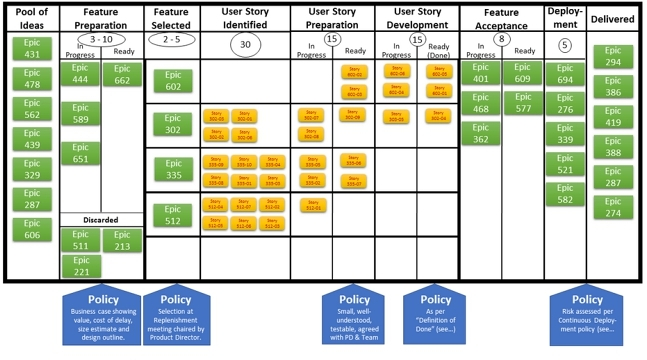
A rectangular area, divided into columns representing steps in a workflow, populated by “cards” of different colors containing task labels. Some columns have additional metadata annotations.
Caption references: 71
While the term “to author” is problematic, we turn our immediate focus to the term “to read”, explaining why it is insufficient, and even potentially pernicious. We propose an alternative—“to apprehend”—and explain why we feel this addresses some of the shortfalls of “to read”.
4.1 Differences in consuming text and space
4.1.1 Profound non-linearity. Hypertexts are, nearly by definition, “non-linear” in the sense that there may be many paths through the text. This is far less true of a traditional text. A reader of a mystery novel, for example, might read the end of the book early to find out whodunnit; a reader of a textbook might skip sections with which they are familiar; a reader of an academic paper might constantly skip back and forth between sections that lay out an argument and those that review related work. Such actions may be seen as “deviations” from a conventional reading path. A hypertext, in contrast, may have no conventional path—only many possible paths, the availability of which might depend on prior path choices, time of day, or any number of other factors. However, in all of these cases, a path is chosen—the reading is still linear, even if the underlying text is not.
Spatial hypertexts allow more than this type of linear path-based reading. When confronted with a space, one can choose to observe the whole space (or a “viewport” onto a space) all at once. Human vision processing is highly parallelized. Because of this parallelization, we really can “apprehend” the space as a whole before diving into any particular part of the space. Thereafter, we can, as with traditional hypertexts, choose our path and examine more closely objects in the space (including, in the case of 2.5D spaces, which child spaces to visit in which order). There are no good analogs to apprehending a space all at once in the notion of reading a text. In some cases, typographic conventions might help us determine something about a page before we “read” it (Fig. 2), but generally speaking, we do not talk of meaningfully “apprehending” a page before it is read.

A page from the Book of Durrow, a manuscript from around the sixth century CE. This page is from Matthew 1:18, containing a large, gold-colored “Chi-Rho” symbol in the middle of the page.
Caption references: 64
4.1.2 Significant subconscious processing. Reading a text or hypertext is generally an explicitly conscious action. Many of us may have had the experience of “zoning out” while reading only to realize suddenly that we are a paragraph or two further along in the text than we remember being, but we may have no clear recollection of what we have read. Perhaps in such situations, we have “subconsciously” read and understood parts of the text we do not recall reading. It seems, however, to stretch the term “reading” to suggest that it covers such action.
Conversely, we visually process spaces in many different ways simultaneously, and not all necessarily consciously. Consider driving down a city street. You may be apprehending the actions of other vehicles, road signs, traffic signals, road markings, and driving conditions all at once, even if you are not consciously focusing on any of these at any given moment. Likewise, you may apprehend aspects of a spatial hypertext without necessarily using your conscious attention. When you apprehend the kanban board above, you may get a sense of how busy the team is, how well balanced the work is across different phases, and even about how big the team is, without counting cards, reading each column header, or examining any of the cards in detail.

First-person view from within a car on a busy city street with a variety of other vehicles on the road, traffic signals, road signs, and street markings.
4.1.3 Highly parallel-processing. When reading a text or hypertext, we almost exclusively focus on one “input” (word or chunk) at a time. In the simplest case, we read each word on a page serially. With unfamiliar words, we may even read one morpheme at a time; speed readers may read several words simultaneously. Whatever the “unit” of input, however, mechanically, we read serially. This is related to our tendency to subvocalize while reading. Although some speed reading advocates talk of “eliminating” subvocalization, there is evidence that all readers subvocalize at least to some extent. Any amount of subvocalization would imply serial processing.
This is very different to how we process spaces visually. As mentioned above, our visual processing subsystem is highly parallel. Consider a simple problem: drawing a convex hull around a set of points. This problem requires one to draw the smallest convex polygon that encloses all points in a given set (if this is possible at all). Intuitively, imagine each point as a pin on a tackboard and using a rubber band to enclose all of the pins.
Serial solutions for this problem (including most computer algorithms) need to consider every point in the set and thus run in Ω(n) time for a set of n points. In many cases, you will most probably solve this in sublinear time. In Fig. 4, the example on the left shows a typical convex hull solution in which the red points are on the hull and the black points are not. Consider for a moment the example on the right: you can find the convex hull of the set of points in the same amount of time whether there are 20 or 20,000,000 points clustered in the black area, meaning you are solving this problem in sublinear time. This example illustrates that your visual system is highly parallelized at a sub- (or pre-)conscious level. Whatever system you rely upon to solve this convex hull problem, it cannot be adequately described as “reading”.
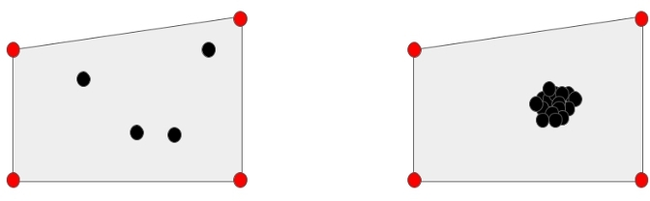
Examples of convex hull solutions. In the picture on the right, we see a handful of points and a convex hull drawn around them. In the picture on the left, we see a similar situation, except that there is a cluster near the middle of the convex hull that contain a large number of points.
4.2 Apprehend versus read
Our modern word “apprehend” comes from the Latin apprehendere, meaning to grasp (physically or mentally). The term “to apprehend” suggests many of the differences mentioned above between how people actually consume spatial hypertexts and the meaning usually encompassed by the term “to read”.
4.2.1 Profound non-linearity. Grasping a physical object can involve a number of micro-movements aimed at adjusting in real-time to the object's weight, surface characteristics, internal structure, etc. Likewise, one can grasp a situation, or understand its many intricacies, in a number of ways. This is almost certainly familiar to anyone who has taught students. Different students will grasp complex topics in different ways, taking different paths, and often making progress along several fronts at once. Fully grasping an idea might better be seen as an iterative exercise, with each iteration allowing a deeper understanding of a complex idea. For example, understanding how the rise of agriculture impacted economic specialization is unlikely to be something we can describe as a single, linear path of logical assertions that follow one from another.
4.2.2 Significant subconscious processing. We can choose to grasp objects consciously, but grasping can be subconscious, too. For example, a subconscious “grasp reflex” in babies is a well-documented phenomenon. It is easy to generate further examples of subconscious physical grasping in people, and straightforward to extend this to subconscious grasping of ideas. We are all influenced by the understanding of those around us; their grasp of concepts, their particular way to “hold” or understand ideas, can affect us both consciously and subconsciously.

A baby's hand is grasping an adult's finger.
Caption references: 70
4.2.3 Highly parallel processing. As above, grasping a physical object involves the simultaneous coordination of many different inputs and outputs. We may foreground some subprocesses as needed, but the simultaneous background processes will remain. This is equally true of grasping situations mentally. The driver in the picture above (Fig. 3) must track multiple inputs simultaneously in order to navigate safely.
4.2.4 Apprehensiveness. Another aspect to the term “apprehend” is the potentiality inherent in the phrase “apprehensiveness”. When we apprehend (a space), are there elements in which we might feel uncertain, or even dread, coming to terms with its meaning? We discuss this aspect of apprehending in more detail below.
4.3 The bigger picture
We have discussed why the term “to apprehend” captures aspects of the actions that consumers of a spatial hypertext may undertake that may be missing from the term “to read”. We have also been careful largely to avoid speaking of roles such as “reader” or “author” in favor of the actions that people undertake, in order to stress that any one person may be simultaneously or consecutively acting in any particular role. Additionally, as we mentioned at the beginning of Sec. 4, we have thus far glossed over the ways in which “to author” may be insufficient to fully describe the action(s) undertaken when creating a spatial hypertext, without proposing an alternative. Finally, we acknowledged above that there may be times at which one really does “read” a spatial hypertext, even if that term fails to capture many other important actions. Likewise, one may “apprehend” a navigational hypertext as well, even if this action is not normally foregrounded when we speak of consuming such a work.
If we think more broadly, we can imagine a framework in which multiple actions apply to multiple hypertext domains, even if they may do so to varying degrees. We can acknowledge all of the overlaps between applicability of various terms to various domains, even while simultaneously acknowledging that their relative importance to those domains differs. In Fig. 6, we see how “reading” may be critically important when discussing navigational hypertext, but also recognize that this same action applies to spatial hypertext, even if to a lesser extent. We can see how, within navigational hypertext, the actions of “reading” and “authoring” overlap (“wreading”). And we can see that, although “authoring” does apply to production of spatial hypertexts, specifically addressing all of the ways in which such spaces are “apprehended” may encourage us to think about a specific new term that captures this action (perhaps “context engineering” or even simply “designing”). Finally, although we can speak of distinct structure domains and distinct actions, ultimately, all of these borders are fuzzy—systems rarely implement exactly one structure domain; users flow freely between idealized definitions of actions.
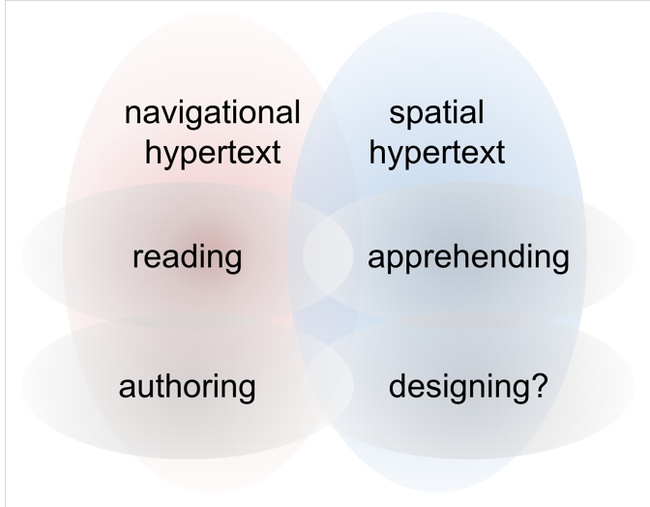
A Venn diagram showing the relationships between two hypertext domains (namely, navigational and spatial) and the actions of “reading”, “apprehending”, “authoring”, and “designing”.
There is, in short, value in calling out and naming the specific actions people take when creating, modifying, and consuming hypertexts of any sort; namely, by doing so, we do not obfuscate and/or background important details of these actions. For example, explicitly naming the act of “apprehending”, we can (more easily) address the implications of this action in addition “reading”. There is, additionally, value in being specific about the degree to which various systems may combine aspects of multiple structure domains; namely, by doing so, we are forced to account for additional actions users may be taking. For example, should we consider 2.5D spatial hypertext systems as also being taxonomic? That is, is the tree implied by the depth dimension a classification structure? If so, what actions (aside from reading) do producers and consumers of such structures undertake that are not captured by terms like “to read”, “to apprehend”, etc.?
Finally, “apprehending” is just one additional action undertaken by consumers of spatial hypertext. We can imagine a whole series of other potential actions that we might observe from user interactions with spatial hypertexts (e.g., scouting, internalizing, comprehending, etc.) Again, naming these actions helps us focus on how they differ from a generic terms such as “reading” or “consuming”.
5 StoryMachine—an application of apprehending
StoryMachine is a project that aims to preserve, explore and provide greater access to folklore traditions [60, 61]. Folklore is a crucial element in identity construction and cultural understanding, but it faces archival and cultural challenges, particularly in an era of alternative truths and populist separatism. Traditional digital interventions have focused on archiving and digitizing rather than on exploration and analysis. Consequently, they are often concerned with discrete collections rather than wider folkloric traditions; lack interactivity; and, are not designed to capture emerging folklore and folk experience. StoryMachine addresses these issues by combining spatial hypertext and recommender systems to create a dynamic platform for deep-linking folkloristic narratives. Recommender systems can create exciting, dynamic opportunities for information studies and our approach to archives in general, while spatial hypertext allows this emerging context to be visually and dynamically represented.
We are using the Mother CB-OHS [7] as a basis for the software being built for this project. Mother provides multiple structure services, each of which can provide abstractions from a specific structure domain. We are using SPORE [48], an application built on top of Mother that combines spatial hypertext and recommender system functionality, as the starting point for the application to support the StoryMachine project.
Until recently, within the project group, we have often explicitly discussed the roles of “reader” and “author” of spaces and spatial hypertexts, implicitly based upon the actions of “reading” and “authoring”. Specifically naming and talking about “apprehending”, however, has broadened our discussion. All of the nuance and complexity that is attached to “apprehending” is now foregrounded; we have a rhetorical place from which to discuss users’ experiences with the StoryMachine application not only in terms of “reading” spaces, but “apprehending” them—including the implications of the profound non-linear, subconscious, and parallel activities in which these users are engaged.
Consider the user studies we are currently designing and will be carrying out in the near future. We can ask users about how effectively they are able to “apprehend” the information in a space. Are they able to understand the basic structure of the space before reading individual cards? Do they have a feel for how the behavior of the recommender system varies as they move nodes in the space, even without doing exhaustive before/after comparisons? Can they recreate organizations of nodes without memorizing them?
One specific scenario we are interested in exploring is allowing students to share some of their folklore traditions with their classmates using StoryMachine. Concretely, this may take the form of students adding nodes representing characters, themes, artifacts, etc., from folk tales told to them by their parents and/or grandparents. These nodes can then be arranged by the students to reflect their emergent understandings of the relationships among them. Recommendations of related materials made by the recommender system may also spur deeper understanding. When testing the efficacy of StoryMachine in this scenario, we should specifically look for what students have learned implicitly (perhaps subconsciously) through apprehension of the jointly constructed space. For example, are there correlations between spatial placement of nodes and the degree to which the ideas they represent are widely recognized archetypes?
6 Conclusions and future work
In this paper, we have argued that spatial hypertext calls for a fundamental rethinking of how we conceptualize engagement with hypertextual systems. By moving beyond the long‑standing primacy of explicit, traversable links and pathways to author and read, we revisited Halasz's call to end the “Tyranny of the Link” [33] not merely as a technical concern, but as a cognitive and theoretical one. In spatial hypertext, meaning does not arise through the sequential traversal of prescripted, nonlinear textual networks, but through the holistic apprehension of implicit, ambiguous, and emergent structures distributed in space.
We have proposed apprehension as a more adequate descriptor for the parallel, selective, and often subconscious processes by which users engage with such systems—processes that exceed reading without replacing it, and that reframe authorship as the engineering of conditions for sense‑making rather than the encoding of paths. Through StoryMachine and its underlying architecture, we have shown how a combination of automation and augmentation can operate within this paradigm, enabling new forms of human–machine co‑creation grounded in implicit structure rather than explicit control.
Liberation from the link and from the primacy of reading and authoring does not entail the rejection of structure, but its reconfiguration: from imposed connections to implicit relations, from navigational orientation to agentic possibility. Future empirical work will need to explore how apprehension manifests in specific user scenarios and in what relationships concomitant actions such as mapping, plotting, shifting, reading, authoring, and prompting co-occur. Overall, these actions corroborate a hypertext theory and practice oriented not toward traversal, but toward spatial organization and methodological refiguration.
Acknowledgments
StoryMachine is a project funded by the Arts and Humanities Research Council (grant ID “AH/Z507222/1”) and the Deutsche Forschungsgemeinschaft (grant ID “547532269”) under their sixth UK–German Funding Initiative in the Humanities.
Notes
2Kanban is a system of scheduling work often used in software engineering settings. The particular details are not necessarily relevant to this discussion.
Source
Imported from ACM’s structured HTML source. ACM Reference Format: Peter Nürnberg, Astrid Ensslin, and Claus Atzenbeck. 2026. Apprehending Hypertext. In 37th ACM Conference on Hypertext (HT '26), September 14--18, 2026, London, United Kingdom. ACM, New York, NY, USA 10 Pages. https://doi.org/10.1145/3800935.3830876
References
[1] Espen J. Aarseth. 1997. Cybertext: Perspectives on Ergodic Literature. Johns Hopkins University Press, Baltimore, MD, USA.
[2] Robert M. Akscyn, Donald L. McCracken, and Elise A. Yoder. 1988. KMS: a distributed hypermedia system for managing knowledge in organizations. Commun. ACM 31, 7 (1988), 820–835. https://doi.org/10.1145/48511.48513
[3] Mark W. R. Anderson. 2025. W(h)ither Spatial Hypertext?. In Proceedings of the 36th ACM Conference on Hypertext and Social Media(HT ’25). ACM Press, New York, NY, USA, 100–112. https://doi.org/10.1145/3720553.3746683
[4] Marc Andreessen. 1993. NCSA Mosaic Technical Summary. Technical Report Revision 2.1. National Center for Supercomputing Applications. https://web.archive.org/web/19991009182307 http://cbl.leeds.ac.uk/WWW/ps/mosaic.2.1.ps
[5] Claus Atzenbeck and Lisa Eidloth. 2024. Harnessing Hypertext Paradigms to Augment VR Spaces. In Proceedings of the 7th Workshop on Human Factors in Hypertext (HUMAN’24). ACM, New York, NY, USA, Article 5, 10 pages. https://doi.org/10.1145/3679058.3688633
[6] Claus Atzenbeck, Peter J. Nürnberg, and Daniel Roßner. 2021. Synthesising augmentation and automation. New Review of Hypermedia and Multimedia 27, 1–2 (2021), 177–203. https://doi.org/10.1080/13614568.2021.1942237
[7] Claus Atzenbeck, Daniel Roßner, and Manolis Tzagarakis. 2018. Mother – An Integrated Approach to Hypertext Domains. In Proceedings of the 29th ACM Conference on Hypertext and Social Media. ACM, New York, NY, USA, 145–149. https://doi.org/10.1145/3209542.3209570
[8] Claus Atzenbeck, Thomas Schedel, Manolis Tzagarakis, Daniel Roßner, and Lucas Mages. 2017. Revisiting Hypertext Infrastructure. In Proceedings of the 28th ACM Conference on Hypertext and Social Media. ACM, New York, NY, USA, 35–44. https://doi.org/10.1145/3078714.3078718
[9] Claus Atzenbeck, Uffe K. Wiil, David L. Hicks, and Peter J. Nürnberg. 2003. Investigating Structure Domain Interoperability. In Proceedings of the 3rd Workshop on Spatial Hypertext at the 14th Conference on Hypertext and Hypermedia, Nottingham, England. ACM, New York, NY, USA, 8 pages.
[10] Roland Barthes. 1968. La mort de l'auteur. Manteia 5, Article 1 (1968), 7 pages.
[11] Alice Bell. 2010. The Possible Worlds of Hypertext Fiction. Palgrave Macmillan, New York. https://doi.org/10.1057/9780230281288
[12] Alice Bell and Astrid Ensslin. 2024. Reading Digital Fiction: Narrative, Cognition, Mediality. Routledge, New York.
[13] Tim Berners-Lee, Robert Cailliau, Ari Luotonen, Henrik Frystyk Nielsen, and Arthur Secret. 1994. The World-Wide Web. Communication of the ACM 37, 8 (Aug. 1994), 76–82. https://doi.org/10.1145/179606.179671
[14] Mark Bernstein. 1998. Patterns of hypertext. In Proceedings of the 9th ACM Conference on Hypertext and Hypermedia. ACM, New York, NY, USA, 21–29. https://doi.org/10.1145/276627.276630
[15] Mark Bernstein. 2001. Card shark and thespis: exotic tools for hypertext narrative. In Proceedings of the 12th ACM Conference on Hypertext and Hypermedia. ACM, New York, NY, USA, 41–50. https://doi.org/10.1145/504216.504233
[16] Mark Bernstein. 2003. Collage, composites, construction. In Proceedings of the 14th ACM Conference on Hypertext and Hypermedia. ACM Press, New York, NY, USA, 122–123. https://doi.org/10.1145/900051.900077
[17] Mark Bernstein. 2016. Storyspace 3. In Proceedings of the 27th ACM Conference on Hypertext and Social Media(HT ’16). ACM, New York, NY, USA, 201–206. https://doi.org/10.1145/2914586.2914624
[18] Martine Braaksma, Gert Rijlaarsdam, and Tanja Janssen. 2017. Writing hypertexts: Proposed effects on writing processes and knowledge acquisition. L1-Educational Studies in Language and Literature 7, 4 (2017), 93–122. https://doi.org/10.17239/L1ESLL-2007.07.04.06
[19] P. J. Brown. 1987. Turning ideas into products: the Guide system. In Proceedings of the ACM Conference on Hypertext. ACM, New York, NY, USA, 33–40. https://doi.org/10.1145/317426.317430
[20] Vannevar Bush. 1945. As we may think. The Atlantic Monthly 176, 1 (7 1945), 101–108. http://www.theatlantic.com/doc/194507/bush
[21] Jeff Conklin and Michael L. Begeman. 1987. gIBIS: a hypertext tool for team design deliberation. In Proceedings of the ACM Conference on Hypertext. ACM, New York, NY, USA, 247–251. https://doi.org/10.1145/317426.317444
[22] Gilles Deleuze and Félix Guattari. 2004. A Thousand Plateaus: Capitalism and Schizophrenia. Bloomsbury Academic, London and New York. Translated by Brian Massumi. Original work published 1980.
[23] Diana DeStefano and Jo-Anne LeFevre. 2007. Cognitive load in hypertext reading: A review. Comput. Hum. Behav. 23, 3 (May 2007), 1616–1641. https://doi.org/10.1016/j.chb.2005.08.012
[24] Gassim H. Dohal. 2023. Contextualizing Hypertext: Its Literary Status. Revista de Investigaciones Universidad del Quindío 35, 1 (2023), 352–358. https://doi.org/10.33975/riuq.vol35n1.803
[25] Lisa Eidloth, Claus Atzenbeck, and Thies Pfeiffer. 2024. Stepping into the Unknown: Immersive Spatial Hypertext. In Proceedings of the 7th Workshop on Human Factors in Hypertext (HUMAN’24). ACM, New York, NY, USA, Article 4, 7 pages. https://doi.org/10.1145/3679058.3688632
[26] Douglas C. Engelbart. 1962. Augmenting Human Intellect: A Conceptual Framework. Summary Report AFOSR-3233. Standford Research Institute. http://dougengelbart.org/content/view/138
[27] Astrid Ensslin. 2007. Canonizing Hypertext: Explorations and Constructions. Bloomsbury, London.
[28] Astrid Ensslin. 2014. Literary Gaming. MIT Press, Cambridge, MA.
[29] Astrid Ensslin and Lyle Skains. 2017. Hypertext: Storyspace to Twine. In The Bloomsbury Handbook of Electronic Literature, Joseph Tabbi (Ed.). Bloomsbury, London.
[30] Luis Francisco-Revilla and Frank Shipman. 2004. Reading and Interacting with Shared Distributed Spatial Hypertexts. In Fourth Workshop on Spatial Hypertext (HT 2004). Dept. Comp. Sci., Texas A&M Univ., 4 pages. https://people.engr.tamu.edu/shipman/SpatialHypertext/SH4/luis.pdf
[31] Luis Francisco-Revilla and Frank M. Shipman. 2005. Parsing and interpreting ambiguous structures in spatial hypermedia. In Proceedings of the 16th ACM Conference on Hypertext and Hypermedia. ACM, New York, NY, USA, 107–116. https://doi.org/10.1145/1083356.1083376
[32] Kaj Grønbæk, Peter Posselt Vestergaard, and Peter Ørbæk. 2002. Towards geo-spatial hypermedia: Concepts and prototype implementation. In Proceedings of the 13th Conference on Hypertext and Hypermedia. ACM, New York, NY, USA, 117–126. https://doi.org/10.1145/513338.513370
[33] Frank G. Halasz. 1991. “Seven Issues” Revisited. Keynote Address, Hypertext ’91 Conference, San Antonio, Texas. WWW.
[34] Frank G. Halasz, Thomas P. Moran, and Randall H. Trigg. 1987. NoteCards in a nutshell. In Proceedings of the SIGCHI/GI Conference on Human Factors in Computing Systems and Graphics Interface (CHI ’87). ACM, New York, NY, USA, 45–52. https://doi.org/10.1145/29933.30859
[35] Frank G. Halasz and Mayer Schwartz. 1994. The Dexter Hypertext Reference Model. Commun. ACM 37, 2 (2 1994), 30–39. https://doi.org/10.1145/175235.175237
[36] David L. Hicks and Uffe K. Wiil. 2003. Searching for revolution in structural computing. Journal of Network and Computer Applications 26, 1 (2003), 27–45. https://doi.org/10.1016/S1084-8045(02)00058-9
[37] George P. Landow. 1992. Hypertext: The Convergence of Contemporary Critical Theory and Technology. The Johns Hopkins University Press, Providence, RI.
[38] Catherine C. Marshall, Frank G. Halasz, Russell A. Rogers, and William C. Janssen. 1991. Aquanet: a hypertext tool to hold your knowledge in place. In Proceedings of the 3rd ACM Conference on Hypertext. ACM, New York, NY, USA, 261–275. https://doi.org/10.1145/122974.123000
[39] Catherine C. Marshall and Frank M. Shipman. 1993. Searching for the missing link: discovering implicit structure in spatial hypertext. In Proceedings of the fifth ACM conference on Hypertext. ACM, New York, NY, USA, 217–230. https://doi.org/10.1145/168750.168826
[40] Catherine C. Marshall and Frank M. Shipman. 1995. Spatial hypertext: designing for change. Commun. ACM 38, 8 (8 1995), 88–97. https://doi.org/10.1145/208344.208350
[41] Catherine C. Marshall, Frank M. Shipman, and James H. Coombs. 1994. VIKI: Spatial hypertext supporting emergent structure. In Proceedings of the 1994 ACM European Conference on Hypermedia Technology. ACM, New York, NY, USA, 13–23. https://doi.org/10.1145/192757.192759
[42] Norman Meyrowitz. 1986. Intermedia: The architecture and construction of an object-oriented hypemedia system and applications framework. ACM SIGPLAN Notices 21, 11 (1986), 186–201. https://doi.org/10.1145/960112.28716
[43] David S. Miall and Teresa Dobson. 2001. Reading Hypertext and the Experience of Literature. Journal of Digital Information 2, 1, Article 2 (2001). https://jodi-ojs-tdl.tdl.org/jodi/index.php/jodi/article/view/jodi-36
[44] Theodor Holm Nelson. 1965. Complex information processing: a file structure for the complex, the changing and the indeterminate. In Proceedings of the ACM 20th National Conference. ACM, New York, NY, USA, 84–100. https://doi.org/10.1145/800197.806036
[45] H. Van Dyke Parunak. 1991. Don't link me in: Set based hypermedia for taxonomic reasoning. In Proceedings of the 3rd Annual ACM Conference on Hypertext. ACM, New York, NY, USA, 233–242. https://doi.org/10.1145/122974.122998
[46] Jim Rosenberg, Mark Bernstein, Cathy Marshall, Paul de Bra, David Millard, and Frank Shipman. 2002. Chain saws for sculptural Hypertext. In Proceedings of the Thirteenth ACM Conference on Hypertext and Hypermedia. ACM, New York, NY, USA, 137. https://doi.org/10.1145/513338.513341
[47] Daniel Roßner. 2025. Spatial Composition: Integrating Recommendations into Spatial Hypertext. Ph. D. Dissertation. Universität Bamberg. https://doi.org/10.20378/irb-108312
[48] Daniel Roßner, Claus Atzenbeck, and Sam Brooker. 2024. Narrative co-creation with SPORE: a spatial hypertext based narrative recommender system. New Review of Hypermedia and Multimedia (2024), 1–20. https://doi.org/10.1080/13614568.2024.2402704
[49] Daniel Roßner, Claus Atzenbeck, and Daniel Urban. 2020. Weblinks: Augmenting Web Browsers with Enhanced Link Services. In Proceedings of the 3rd Workshop on Human Factors in Hypertext. ACM, New York, NY, USA, Article 5, 5 pages. https://doi.org/10.1145/3406853.3432663
[50] Simon Rowberry. 2023. Hypertext narrative and the reader: a view from cognitive theory. In HT ’23: Proceedings of the 34th ACM Conference on Hypertext and Social Media. ACM, New York, NY, USA, Article 41, 10 pages. https://doi.org/10.1145/3603163.3609038
[51] Thomas Schedel. 2016. Spatio-Temporal Parsing in Spatial Hypermedia. Ph. D. Dissertation. Aalborg University. https://opus4.kobv.de/opus4-hof/frontdoor/index/index/docId/71
[52] Thomas Schedel and Claus Atzenbeck. 2016. Spatio-Temporal Parsing in Spatial Hypermedia. In Proceedings of the 27th ACM Conference on Hypertext and Social Media. ACM, New York, NY, USA, 149–157. https://doi.org/10.1145/2914586.2914596
[53] Ralf Schneider. 2005. Hypertext narrative and the reader: a view from cognitive theory. European Journal of English Studies 9, 2 (2005), 197–208. https://doi.org/10.1080/13825570500172067
[54] Robert L. Selig. 2000. The Endless Reading of Fiction: Stuart Moulthrop's Hypertext Novel “Victory Garden”. Contemporary Literature 41, 4 (2000), 642–660.
[55] Frank M. Shipman. 2001. Seven Directions for Spatial Hypertext Research. In 1st International Workshop on Spatial Hypertext in Conjunction with the 12th ACM Conference on Hypertext and Hypermedia. 4 pages. https://people.engr.tamu.edu/shipman/SpatialHypertext/SH1/shipman.pdf
[56] Frank M. Shipman, Haowei Hsieh, Preetam Maloor, and J. Michael Moore. 2001. The Visual Knowledge Builder: a second generation spatial hypertext. In Proceedings of the 12th ACM Conference on Hypertext and Hypermedia. ACM, New York, NY, USA, 113–122. https://doi.org/10.1145/504216.504245
[57] Frank M. Shipman and Catherine C. Marshall. 1999. Spatial hypertext: an alternative to navigational and semantic links. Comput. Surveys 31, 4es (dec 1999), 14–es. https://doi.org/10.1145/345966.346001
[58] Frank M. Shipman, J. Michael Moore, Preetam Maloor, Haowei Hsieh, and Raghu Akkapeddi. 2002. Semantics happen: Knowledge building in spatial hypertext. In Proceedings of the 13th Conference on Hypertext and Hypermedia. ACM, New York, NY, USA, 25–34. https://doi.org/10.1145/513338.513350
[59] Ben Shneiderman. 1987. User interface design for the Hyperties electronic encyclopedia (panel session). In Proceedings of the ACM Conference on Hypertext. ACM, New York, NY, USA, 189–194. https://doi.org/10.1145/317426.317441
[60] Sabine Slowik, Astrid Ensslin, Claus Atzenbeck, Sam Brooker, Sarah Diefenbach, Ceri Houlbrook, Christopher Ohge, and Marie Veihelmann. 2026. Project StoryMachine: Spatial Hypertext as a Tool for Contemporary, Transcultural Folkloristics. In Book of Abstracts – DHd 2026, Silke Schwandt, Gabriel Viehhauser, Tara Andrews, and Thomas Wallnig (Eds.). Zenodo, 612–614. https://doi.org/10.5281/zenodo.18591948
[61] Sabine Slowik, Astrid Ensslin, Claus Atzenbeck, Sam Brooker, Sarah Diefenbach, Ceri Houlbrook, Christopher Ohge, and Marie Veihelmann. 2026. Project StoryMachine: Spatial Hypertext as a Tool for Contemporary, Transcultural Folkloristics (Poster). In Poster publications of the Digital Humanities im deutschsprachigen Raum Conference (DHd 2026). Zenodo, 1 pages. https://doi.org/10.5281/zenodo.18999797
[62] Ted Smith and Steve Bernhardt. 1988. Expectations and experiences with HyperCard: a pilot study. In Proceedings of the 6th Annual International Conference on Systems Documentation (SIGDOC ’88). ACM, New York, NY, USA, 47–56. https://doi.org/10.1145/358922.358931
[63] Esther T. 2019. different vehicles on road viewing buildings during daytime. Retrieved April 24, 2026 from https://unsplash.com/photos/different-vehicles-on-road-viewing-buildings-during-daytime-l9_f-ikWZG4
[64] The Board of Trinity College Dublin. 2021. Book of Durrow. IE TCD MS 57. https://doi.org/10.48495/wm117t53k
[65] Andries van Dam. 1988. Hypertext ’87: Keynote Address. Communication of the ACM 31, 7 (July 1988), 887–895. https://doi.org/10.1145/48511.48519
[66] Andries van Dam. 2019. Reflections on a Half-Century of Hypertext. In Proceedings of the 30th ACM Conference on Hypertext and Social Media. ACM, New York, NY, USA, 3–4. https://doi.org/10.1145/3342220.3344782
[67] Harald Weinreich, Hartmut Obendorf, and Winfried Lamersdorf. 2001. The look of the link – concepts for the user interface of extended hyperlinks. In Proceedings of the 12th ACM Conference on Hypertext and Hypermedia. ACM, New York, NY, USA, 19–28. https://doi.org/10.1145/504216.504225
[68] Uffe K. Wiil, David L. Hicks, and Peter J. Nürnberg. 2001. Multiple open services: a New Approach to Service Provision in Open Hypermedia Systems. In Proceedings of the 12th ACM Conference on Hypertext and Hypermedia. ACM, New York, NY, USA, 83–92. https://doi.org/10.1145/504216.504241
[69] Uffe K. Wiil, Peter J. Nürnberg, and David L. Hicks. 2003. Editorial: structural computing: research directions, systems and issues. Journal of Network and Computer Applications 26, 1 (2003), 3–9. https://doi.org/10.1016/S1084-8045(02)00056-5
[70] Wikimedia Commons. 2010. File:Grasp reflex baby.jpg. Retrieved April 24, 2026 from https://commons.wikimedia.org/wiki/File:Grasp_reflex_baby.jpg

[71] Wikimedia Commons. 2017. File:Sample Kanban Board.png. Retrieved April 24, 2026 from https://commons.wikimedia.org/wiki/File:Sample_Kanban_Board.png

Do you like what you are reading? Subscribe to receive updates.
Unsubscribe anytime