
Abstract
Human interaction with documents extends beyond reading words in sequence. Readers move through documents, judge what the text supports, and form accounts from what they find. Hypertext has made this interaction structurally visible. Agentic AI changes this relation by allowing systems to take part in document work before or beside the reader. These operations can be useful, but they can also move core parts of document work into hidden processes and make the generated answer the main object of interaction. We introduce hyperlayered hypertext as a representational idea. A hyperlayer is a separable structure attached to a document substrate, allowing human and agent contributions to remain connected to the source. We develop this idea through three axes of relation to the substrate: a topological axis concerned with movement through the document, an epistemic axis concerned with what the document supports, and an ontological axis concerned with what the document becomes through use. Along these axes, navigation, validation, and contextualization describe how human and agent activity can be represented over documents without replacing them. The paper argues that agentic AI should support document work without dissolving the reader's ability to inspect, question, and revise that work.
1 Introduction
Reading a document is an act of control, but that control is rarely absolute 1. A reader enters with a purpose, follows some parts more closely than others, treats some claims as useful, leaves others unresolved, and returns when the document needs to support later work. These actions are not outside reading. They are how a document becomes available for use beyond the moment of reading.
Hypertext made this control structural. Bush's associative trails gave an early form to the idea that readers could build paths through related material [4]. Engelbart placed document work inside a broader project of augmenting human intellect [6]. Nelson and Landow made nonsequential writing and readerly movement central to hypertext theory [7, 9]. Later work on navigation and hypertext activity treated paths, movement, and episodes as part of how hypertexts are used [3, 12]. We return to this history not to rehearse it, but to recover a representational principle: relations around a document can be made explicit without replacing the document.
Agentic AI changes this arrangement because it can now perform some document actions before or beside the reader. It can retrieve, rank, summarize, connect, flag, and interpret document material. These actions may allow readers to work with complex documents, but they can also move parts of reading into processes that are hard to inspect. The reader may see the answer without seeing the route, the support, or the alternatives.
The problem is therefore not only error. A generated answer can be correct and still weaken the reader's control over the document relation. The deeper problem is substitution: generated prose can become the main surface of interaction, as seen in default conversational AI interfaces, while the document becomes background material [11]. Hyperlayered hypertext is proposed as an alternative. The aim is to keep human and agent actions attached to the document, so that movement, judgment, and account formation remain available for inspection and revision.
2 Human-Document Interaction with Agents
This section grounds the paper's main shift: from human-document interaction to human-agent-document interaction. The point is not to replace the reader with the agent, but to show how agents enter a relation that hypertext research has long treated as active, situated, and structured. Dillon, Rosenblatt, McEneaney, and Rosenberg provide the basis for this shift: documents are used through purpose, stance, navigation, response, and activity.
2.1 Reader-document interaction
Reading a document unfolds as a relation between the reader and the material. Dillon's framework treats information use as involving task, information model, manipulation facilities, and reading processes [5]. This means document interaction is broader than presentation. Agentic AI should therefore be analyzed by how it changes document use, not only by output quality.
Transactional reading gives this analysis a human center. Meaning emerges through a reading event shaped by stance and purpose [8, 13]. In expository hypertext, stance has been shown to influence navigation and response [8]. The same document can therefore become different objects of use as readers approach it with different purposes, paths, and responses.
2.2 Hypertext activity
Hypertext also connects document use to activity. Rosenberg describes hypertext activity through actions that can cohere into episodes and sessions [12]. The meaningful object of reading may be an activity structure, not only the stored document [12]. Hyperlayers extend this insight to AI-supported activity over a substrate.
2.3 Agents and substrate
Agents now enter the document relation at points that used to belong mainly to the reader. The agentic shift matters because these systems can carry out multi-step document work across retrieval, selection, checking, and synthesis before the reader sees the result. They can shape what material is encountered first, how it is framed, and which interpretation becomes easiest to carry forward. This can help with complex documents, but it also shifts control over attention and judgment.
Current systems partially address this problem. Tools such as NotebookLM2, Elicit 3, and citation-grounded assistants allow readers to inspect which passage grounds a generated claim. These measures handle parts of the validation relation. They do not represent the route taken through the document before the answer appeared, nor how separate passages were combined into a single account. A reader can see that a claim is grounded; they cannot see which sections were traversed, which were ranked below the threshold of retrieval, or how disparate passages were assembled into the framing they received. Source grounding is necessary but not sufficient. To counter this shift in control, the substrate must remain available as a shared reference point for human and agent action.
3 Hyperlayers: Attachment, Axes, and Modalities
This section introduces hyperlayers as the paper's representational response. The argument has two parts. First, agentic document work should attach to the substrate rather than replace it with generated prose. Second, that attached work can be organized through three relations to the substrate: movement, judgment, and account formation.
3.1 Attachment against substitution
A hyperlayer is a separable structure attached to a substrate. It can be shown, hidden, revised, accepted, rejected, preserved, or shared. It is not the document itself and not a replacement for it. Its function is to keep document work visible as structure [10].
Hyperlayers may attach to more than highlighted spans. Existing annotation models treat annotations as resources directed at targets and support sharing and reuse across systems [1]. These models give readers and systems a way to mark, comment, and cite within documents. They do not, however, represent the activity structure over the document: the route taken through the material, the reasoning that connects evidence to claim, or the process by which separate parts are assembled into a usable account. A hyperlayer is therefore not an annotation on a span. It is a representation of document work, work whose meaning comes from the relation it records, not from the target it addresses.
Substitution produces a new text that becomes the main object of use. Attachment adds structure while keeping the substrate as the shared reference. The reader can inspect the relation between the layer and the document. This distinction is the core of the paper's argument.
3.2 Three axes of relation to the substrate
Human and agent relations to the substrate can be described along three axes, each grounded in a distinct dimension of the frameworks in Section 2. Dillon's treatment of document interaction as involving manipulation facilities and reading processes motivates the first: the topological axis concerns movement through the substrate, the paths taken and not taken [5]. Rosenblatt's account of reading as a stance-shaped transaction, in which the reader evaluates what the text supports relative to a purpose, motivates the second: the epistemic axis concerns what the substrate supports, leaves uncertain, or fails to support [8, 13]. Rosenberg's description of hypertext activity as a structure that gives meaning beyond any single document state motivates the third: The ontological axis concerns how a document takes shape as a usable account through use. This is distinct from document structure or schema: the same document can become different objects of use as readers with different purposes move through it and form different accounts from what they find [12, 13]. The axis tracks this becoming, how the document's identity as a usable object is constituted through reading activity. The three axes are not an arbitrary taxonomy. Each corresponds to a dimension of human-document interaction that agentic AI can affect, and each requires a distinct form of representation.
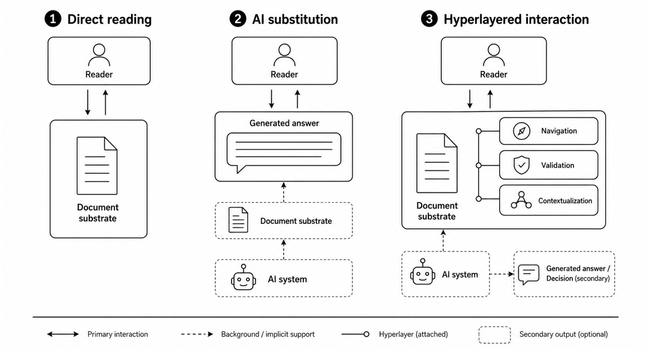
3.3 Navigation, validation, and contextualization
Navigation is the topological modality. It makes the reader's route through the document available as structure [3, 8, 12]. In agentic systems, this route may be shaped before the reader sees it, through retrieval and ranking. A navigation layer keeps the route available for later inspection and revision. Validation is the epistemic modality. It makes the basis for judgment available where the claim is used. Validation does not certify truth. It keeps the claim tied to the part of the document that supports or challenges it [8, 13].
Contextualization is the ontological modality. It records how separate parts of a document were assembled into a coherent account during a reading event: which passages were treated as related, which framings were applied, and which alternative accounts were set aside. A contextualization layer does not fix the document's meaning. It makes one account visible as an account, partial, purposive, revisable, rather than presenting it as the document's own conclusion [12, 13]. This is the sense in which the axis is ontological: it concerns what the document became for a reader, not what the document is.
These modalities often appear together. A generated recommendation may select a route through the document, treat some support as stronger than other support, and form an account from the selected material. In generated prose, these relations are compressed into a single answer. In a hyperlayer, they remain available as distinct parts of the document work.
3.4 Worked example: three layers over a document record
Many forms of professional reading require a reader to build an account from a record rather than from a single text. A clinician reviews a chart, a journalist reviews leaked documents, a lawyer reviews case materials, and a policy analyst reviews reports. In each case, the reader must move through a collection, judge what it supports, and assemble a usable account from dispersed material. An AI-generated answer may compress that work into a conclusion. A hyperlayered version keeps the work attached to the record through three forms of document structure.
The navigation layer records how the record was traversed. It shows which parts shaped the reading path and which parts were treated as peripheral. This route is not additional prose about the record. It is structure over the record, allowing the reader to return to the material that shaped the answer.
The validation layer keeps a claim tied to the evidence used to support it. Instead of presenting a source citation as a finished justification, the layer keeps the claim connected to the relevant material and to the places where the evidence remains uncertain. The reader can revise the judgment locally when the support is weak, outdated, or incomplete.
The contextualization layer shows how the record became an account. Separate entries may be brought together as jointly relevant, while other entries remain outside the account. The reader can adjust this assembly, add missing material, or preserve an alternative reading without first accepting or rejecting the generated conclusion. None of these layers is the decision. Their purpose is to keep the document work available where the decision is being formed.
4 Negotiation, Preservation, and Open Problems
Hyperlayers are useful only if they remain active parts of document work. A layer that cannot be inspected, revised, or carried forward becomes another fixed output. This section therefore turns from representation to use: how layers remain negotiable, how they persist beyond a single reading event, and what problems this creates for future hypertext systems.
4.1 Negotiability
Hyperlayers matter only if they can be acted on. That action matters because a layer can guide the rest of the document work without replacing the document itself. These actions are often partial and provisional, allowing a layer to remain useful even when it is not fully adopted.
4.2 Human role and preservation
AI-added structure is most useful when readers can see how it affects their work with the document. The human role is preserved by keeping proposals inspectable and revisable, addressing the ethical dimensions of AI-mediated reading [2]. Preserving this role requires the possibility of inspection when the layer affects movement, judgment, or interpretation.
Preservation extends negotiation over time. Some layers disappear after use, while others become part of reports, reviews, decisions, or arguments. Hyperlayered hypertext should support movement from private reading to shared artifact. That movement keeps its value when the layer remains connected to the substrate.
4.3 Open problems
This model brings several research challenges into focus.
Anchor stability. A layer must remain connected to the part of the document it addresses, even as the document changes or the reference spans more than a single passage. Robust anchoring has been studied in annotation systems and structured hypertext editors, but those approaches assume relatively stable, human-authored documents. Agentic systems produce references over dynamic material, and neither the layer nor the document may have a human author available to repair broken connections.
Provenance legibility. A layer's history must show how human and AI contributions shaped it. Provenance models from data pipelines track data lineage; they were not designed to record the epistemic status of a claim at the moment a reader used it. A hyperlayer provenance model must capture not only what produced the layer but what it meant to the reader at the time, a requirement that current attribution approaches do not address.
Attention without capture. Layers must guide attention without foreclosing alternatives. An AI-generated navigation layer can be comprehensive in a way that a human annotation is not, and comprehensiveness may itself suppress other routes. The design problem, how to make a layer directive enough to be useful and open enough to be revisable, is largely unsolved.
Portability across contexts. When a layer becomes part of a later report or argument, its relation to the original substrate must remain legible to readers who did not participate in the original reading event. This extends beyond current citation norms, which record what was used but not the work through which it was used.
5 Discussion
Hyperlayered hypertext shifts the question from whether AI can produce a useful answer to how document work remains available after AI has participated in it. This matters because many current systems treat grounding as a property of the answer: a passage is cited, a source is linked, or a quotation is shown. Those mechanisms are valuable, but they still make the answer the center of the interaction. A hyperlayer changes the center of gravity. The document remains the place where paths, judgments, and accounts are formed, inspected, and carried forward.
This also changes how we think about human control. Control does not mean that the reader performs every step manually. It means that the reader can recover the structure of the work when it matters. If an agent selects material, the route should remain available. If it treats a claim as supported, the basis for that judgment should remain tied to the document. If it forms an account, the account should remain recognizable as one possible assembly of the material. In this sense, hyperlayers are not only a transparency device. They are a way of preserving the document relation after part of the work has been delegated.
The larger implication is that agentic AI makes old hypertext questions newly urgent. Links, anchors, trails, annotations, and views were never only interface devices; they were ways of giving structure to reading. In agentic systems, that structure can be produced by machines before the reader arrives. Hypertext research is well positioned to ask what forms of structure should survive this handoff, how they should remain attached to the substrate, and how they should support later human judgment.
6 Conclusion
Agentic AI brings document work into a shared space between readers and systems. This can broaden what readers are able to see in complex material. It can also weaken their control when the work behind a generated answer is hidden.
Hyperlayered hypertext responds by keeping that work attached to the document substrate. The route through the material, the basis for judgment, and the account formed from the document remain available as part of the document relation. This gives readers a way to examine and reuse AI-supported work instead of receiving it only as a finished answer.
This framing gives hypertext a clear role in the agentic AI era. As systems take part in reading, checking, and composing over documents, their work becomes part of the structure through which documents are used. Hyperlayered hypertext keeps that structure tied to the substrate, where it can remain open to later inspection and interpretation.
Notes
1We use “document” to mean a working document or a collection used to support a task, and “reading” to mean task-oriented reading directed toward judgment, decision, or action. The argument may extend to literary reading, but not as a primary concern.
Source
Imported from ACM’s structured HTML source. ACM Reference Format: Behnam Rahdari, Shriti Raj, and Peter Brusilovsky. 2026. Hyperlayered Hypertext: Rethinking Human-Document Interaction with Agentic AI. In 37th ACM Conference on Hypertext (HT '26), September 14--18, 2026, London, United Kingdom. ACM, New York, NY, USA 4 Pages. https://doi.org/10.1145/3800935.3830890
References
[1] 2017. Web Annotation Data Model. W3C Recommendation. W3C. https://www.w3.org/TR/annotation-model/
[2] C. Atzenbeck. 2024. Unwinding AI's Moral Maze: Hypertext's Ethical Potential. In Proceedings of the 35th ACM Conference on Hypertext and Social Media (HT ’24). ACM, New York, NY, 23–28. https://doi.org/10.1145/3648188.3678213
[3] M. Bernstein. 1991. Deeply Intertwingled Hypertext: The Navigation Problem Reconsidered. Technical Communication 38, 1 (1991), 41–47.
[4] V. Bush. 1945. As We May Think. The Atlantic Monthly (July 1945).
[5] A. Dillon. 1996. Myths, Misconceptions and an Alternative Perspective on Information Usage and the Electronic Medium. In Hypertext and Cognition, J.-F. Rouet, J. J. Levonen, A. Dillon, and R. J. Spiro (Eds.). Lawrence Erlbaum Associates, Mahwah, NJ, 25–42.
[6] D. C. Engelbart. 1962. Augmenting Human Intellect: A Conceptual Framework. Summary Report AFOSR-3223. Stanford Research Institute, Menlo Park, CA.
[7] G. P. Landow. 1992. Hypertext: The Convergence of Contemporary Critical Theory and Technology. Johns Hopkins University Press, Baltimore, MD.
[8] J. E. McEneaney, L. Li, K. Allen, and L. Guzniczak. 2009. Stance, Navigation, and Reader Response in Expository Hypertext. Journal of Literacy Research 41, 1 (2009), 1–45. https://doi.org/10.1080/10862960802695081
[9] T. H. Nelson. 1987. Literary Machines: Edition 87.1. Published by the author, South Bend, IN.
[10] P. Nuernberg and C. Atzenbeck. 2025. It Really is Structure, all the Way Down. In Adjunct Proceedings of the 36th ACM Conference on Hypertext and Social Media (HT Adjunct ’25). ACM, New York, NY, 21–24. https://doi.org/10.1145/3720533.3750063
[11] Behnam Rahdari and Peter Brusilovsky. 2025. From Links to Dialogue; Hypertext Challenges and Opportunities in Conversational Navigation. In Adjunct Proceedings of the 36th ACM Conference on Hypertext and Social Media(HT Adjunct ’25). Association for Computing Machinery, New York, NY, USA, 25–29. https://doi.org/10.1145/3720533.3750064
[12] J. Rosenberg. 1996. The Structure of Hypertext Activity. In Proceedings of the Seventh ACM Conference on Hypertext (Hypertext ’96). ACM, New York, NY, 22–30. https://doi.org/10.1145/234828.234831
[13] L. M. Rosenblatt. 1994. The Reader, the Text, the Poem: The Transactional Theory of the Literary Work. Southern Illinois University Press, Carbondale, IL.
Do you like what you are reading? Subscribe to receive updates.
Unsubscribe anytime